Imagine a super-powerful computer that usually needs a spaghetti-tangle of wires – one for every tiny bit of information it processes. Now picture it running just as well, but with hardly any wires at all. That's what a team of scientists just pulled off with a new quantum processor.
Quantum computers are already pretty wild. They use special particles called qubits that can be in multiple states at once. Think of it like a coin that's both heads and tails until you look at it. To make these qubits work, they need to be kept colder than deep space, just a tiny fraction above absolute zero.
The catch? Each qubit usually needs its own dedicated wire to tell it what to do. As these computers get bigger, the wiring becomes a nightmare, making them super hard to build and even harder to operate.
We're a new kind of news feed.
Regular news is designed to drain you. We're a non-profit built to restore you. Every story we publish is scored for impact, progress, and hope.
Start Your News DetoxA Clever Two-Chip Solution
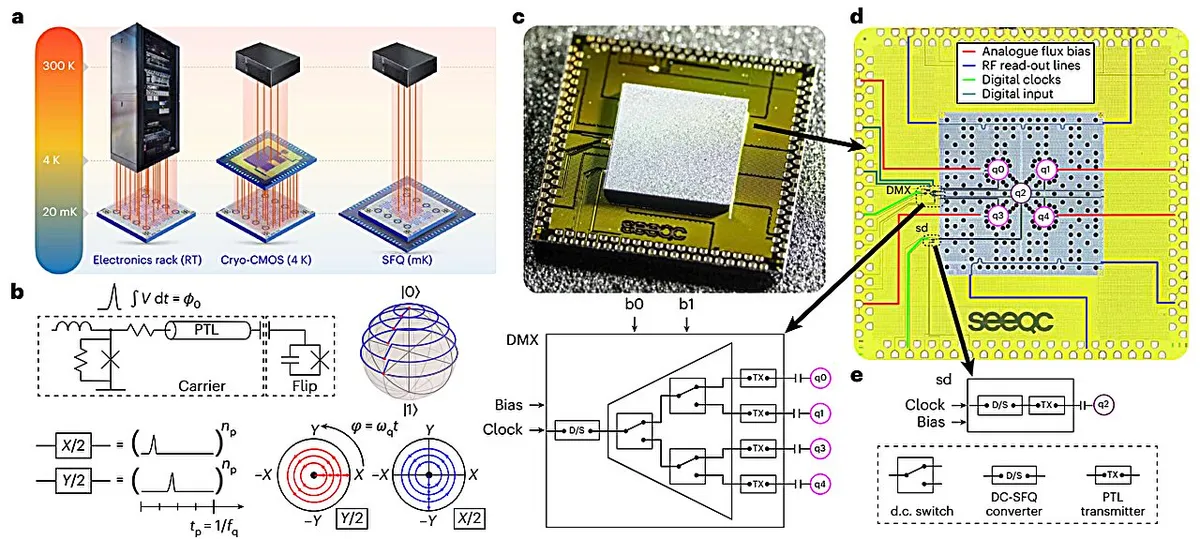
Researchers at Seeqc Inc. came up with a seriously cool fix. Instead of all those individual wires, they put the qubits on one chip and the control electronics on a separate, second chip. These two chips are then stacked together like a tiny, high-tech sandwich.
This setup uses special 'single-flux quantum' circuits on the control chip. These circuits are superconducting, meaning electricity flows through them with zero resistance, and they create super-fast, precise electrical pulses using tiny magnetic signals. It's like sending whispers instead of shouts down the line.
Here's the thing most people miss: by having the control chip right next to the qubit chip, both operating at those ultra-cold temperatures, they cut down on the wiring dramatically. This isn't just a small improvement; it breaks the old rule where you needed more wires for every new qubit.
Why This Matters
This new design means quantum computers can scale up much easier. The team showed that their system can control individual qubits with over 99% accuracy, which is incredibly good, especially with the reduced wiring. That's like making sure almost every single whisper gets heard perfectly.
This isn't just about tidier computers. It means we could build quantum processors with many more qubits, opening the door to solving problems that are currently impossible, from discovering new medicines to designing advanced materials. It's a huge step toward making quantum computing a practical reality, not just a lab curiosity.