After a wildfire scorches a landscape, most life retreats or dies. But certain fungi don't just survive the inferno—they thrive on it, breaking down charred remains that nothing else can touch. A new study from UC Riverside has finally uncovered how they do it, and the answer lies in three distinct genetic strategies that evolved to turn ash into food.
Sydney Glassman and her team spent five years collecting fungi from seven California wildfire burn sites, sequencing their genes and testing them against charcoal. What they found, published in the Proceedings of the National Academy of Sciences, reveals how some of the tiniest organisms on Earth adapted to one of the harshest environments imaginable.
How fungi learned to eat fire
The first strategy is brute force through repetition. Some fungi, like Aspergillus (the green mold you might find on old bread), simply copy their charcoal-digesting genes multiple times over, like a biological copy-paste. More copies mean more enzymes, and more enzymes mean a faster meal from all that carbon-rich burned matter.
We're a new kind of news feed.
Regular news is designed to drain you. We're a non-profit built to restore you. Every story we publish is scored for impact, progress, and hope.
Start Your News DetoxOthers take the sexual route. Basidiomycota—the group that includes the classic mushroom-shaped fungi—can shuffle their genes during reproduction, quickly evolving new abilities to metabolize char. It's genetic mixing at speed.
But the most surprising finding caught even the researchers off guard. One fungus, Coniochaeta hoffmannii, didn't evolve its charcoal-eating genes at all. It borrowed them. From bacteria. "Horizontal gene transfer is like sharing genes with a friend or sibling," Glassman explains. "It's why bacteria are so diverse. But finding it happen between bacteria and other kingdoms of life is incredibly rare." This fungus essentially hacked the genetic toolkit of another organism entirely, stealing the tools it needed to break down fire scars.
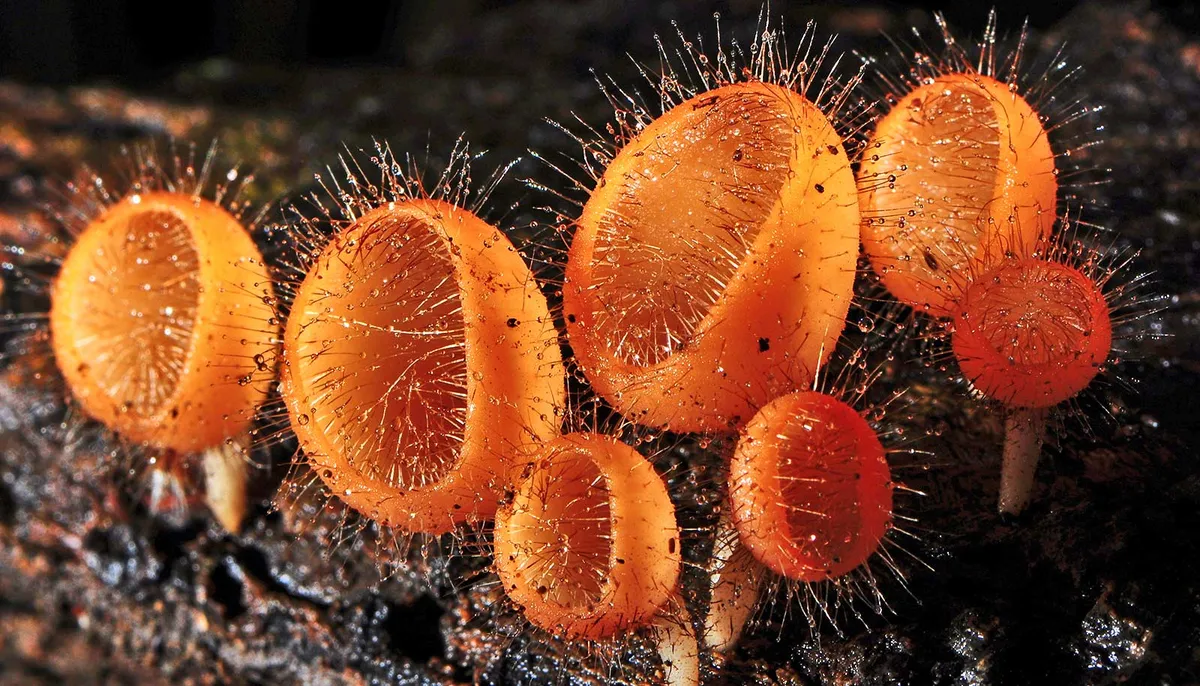
The team also discovered how fungi survive the fire itself. Some produce sclerotia—dormant, heat-resistant structures that can sleep underground for decades, waiting for the right moment to wake. Others burrow deeper into the soil and then colonize the burned surface once competitors have been wiped out. Pyronema, for instance, doesn't have much genetic machinery for breaking down charcoal, but it doesn't need to. It simply races to form tiny orange cup-shaped mushrooms in a landscape suddenly free of rivals.
Why this matters beyond the forest
Charcoal is chemically similar to many pollutants humans have left behind—oil spills, mining waste, industrial residue. If researchers can understand how these fungi break down charred carbon, they might one day use them to clean up contaminated environments. It's still early, but the potential is real. A fungus that evolved to feast on wildfire ash might become a tool for healing landscapes scarred by human activity.
For now, the fungi are doing what they've always done: thriving in places where almost nothing else can survive, quietly reshaping the post-fire world one spore at a time.