For decades, physicists have puzzled over one of the universe's biggest mysteries: it's expanding faster and faster, not slowing down like gravity should make it do. To explain this acceleration, scientists invented dark energy—an invisible force that supposedly fills all of space. Except nobody knows what it actually is.
Now a team of physicists from Germany and Romania thinks they might have been asking the wrong question.
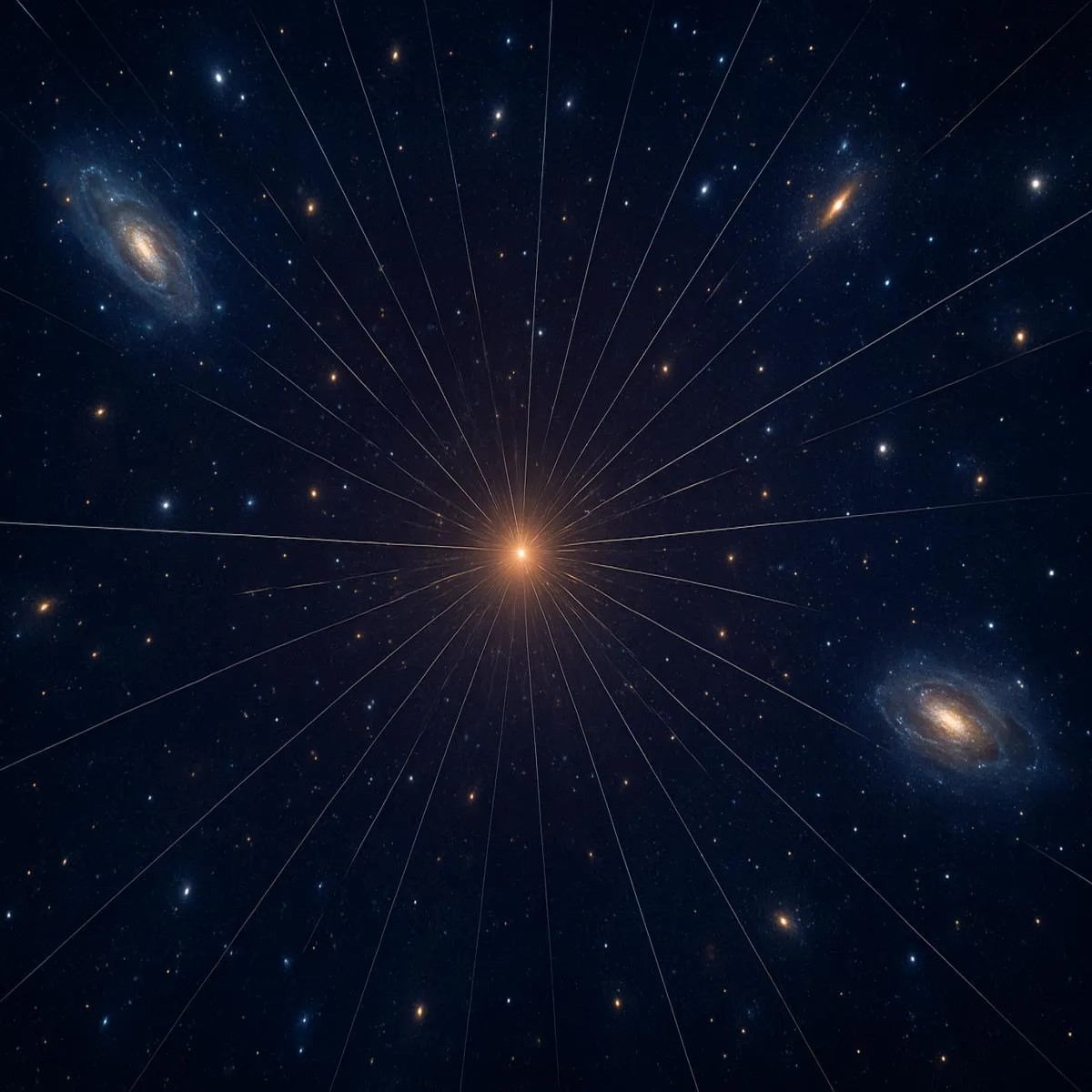
The problem starts with Einstein's equations. When physicists use them to describe the universe's large-scale behavior, they get a prediction that doesn't match observations. The universe should be slowing down. It isn't. So they added dark energy—a term they inserted manually into the math to make the numbers work. It's a bit like discovering your car is going faster than it should, then deciding there must be an invisible force pushing it. Technically it solves the problem, but it feels like a patch.
We're a new kind of news feed.
Regular news is designed to drain you. We're a non-profit built to restore you. Every story we publish is scored for impact, progress, and hope.
Start Your News DetoxChristian Pfeifer and his colleagues at the Center of Applied Space Technology and Microgravity (ZARM) at the University of Bremen decided to try a different approach. Instead of sticking with Einstein's original framework, they used an extension called Finsler gravity. It's a more general way of describing spacetime—the fabric of reality itself—that handles how gravity interacts with gases and other matter more accurately than Einstein's version.
When they recalculated the universe's expansion using Finsler geometry, something remarkable happened: the equations predicted cosmic acceleration on their own, without needing to add dark energy at all. The acceleration emerged naturally from the geometry of spacetime itself.
"This is an exciting indication that we may be able to explain the accelerated expansion of the universe, at least in parts, without dark energy, on the basis of a generalized spacetime geometry," Pfeifer said. It's not a complete solution—the team isn't claiming dark energy doesn't exist. But it suggests that some of the acceleration we observe might be explained by the shape of space itself, not by an unknown invisible substance.
The research, published in the Journal of Cosmology and Astroparticle Physics in 2025, opens a new direction for cosmology. Instead of hunting for what dark energy is, physicists might need to reconsider what spacetime actually looks like on the largest scales. It's a reminder that sometimes the deepest mysteries aren't solved by finding new things—they're solved by understanding the things we already have in a different way.