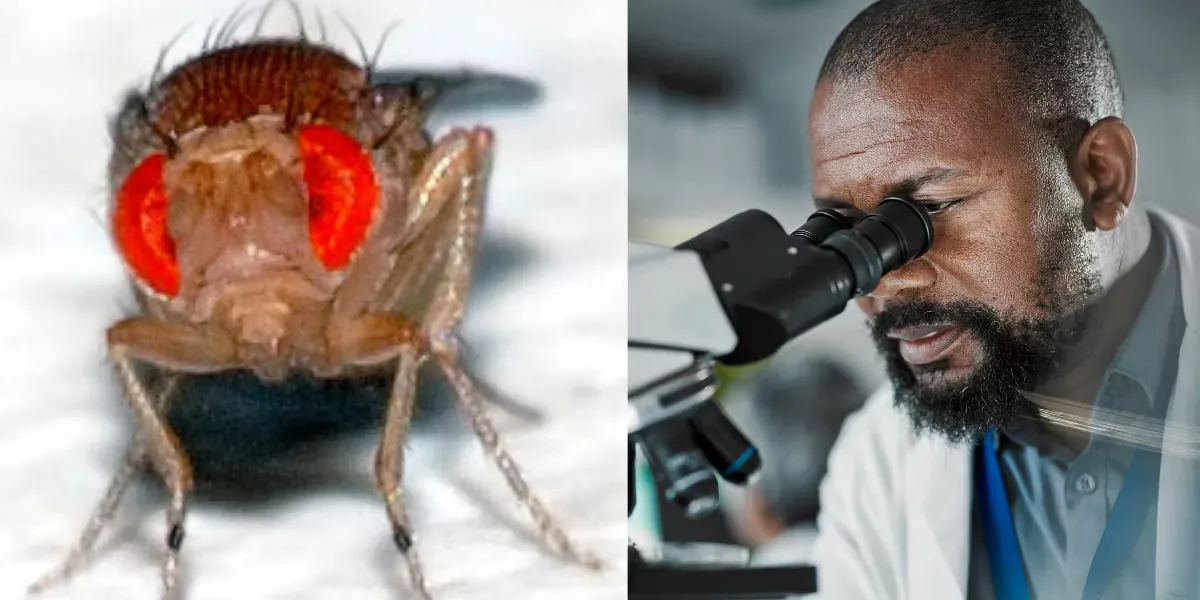
In 1954, a Japanese ecologist sealed fruit flies in darkness and left them there. Seventy years later, they're still there—and they've become something measurably different from their wild cousins.
Evolution usually moves too slowly to see. Adaptations that reshape a species take thousands of years, far longer than any human lifetime. But fruit flies compress that timeline. They breed in weeks, cycling through generations at a pace that lets researchers actually watch natural selection unfold.
The Dark-Fly Experiment
Syuiti Mori's original setup was simple: glass bottles, cloth covering, complete darkness. The flies would never see light. What he created, by accident, was one of the longest-running active experiments in science.
We're a new kind of news feed.
Regular news is designed to drain you. We're a non-profit built to restore you. Every story we publish is scored for impact, progress, and hope.
Start Your News DetoxToday, over 1,500 generations later, the colony has produced something new. The Dark-fly—as researchers named it—looks almost identical to wild fruit flies. But it's not. These flies have longer sensory bristles on their heads, a sharper sense of smell, and lay more eggs in darkness. They're better adapted to an environment that would stress their wild relatives.
Fruit flies work for this research because they share about 60% of their DNA with humans, with even greater overlap in disease-related genes. What happens in a fruit fly colony can hint at how human genetics respond to pressure. And because researchers can control every variable—temperature, food, light exposure—they can isolate which changes matter.
In 2012, when Naoyuki Fuse took over the project, his team sequenced the Dark-fly genome. They found 220,000 single-letter differences in its DNA compared to wild flies, plus thousands of larger insertions and deletions. For the first time, scientists could see exactly which genes had shifted and how.
How This Actually Works
Here's what's crucial: darkness didn't cause these changes directly. The flies' DNA wasn't rewritten by the environment. Instead, natural selection favored mutations that helped flies survive in darkness. Flies born with slightly better smell or more sensory bristles reproduced more successfully. Their offspring inherited those traits. Over generations, those small advantages compounded.
When researchers bred Dark-flies with wild flies in darkness, Dark-fly DNA was more likely to be passed forward. The adaptation was real enough to win out in competition.
This kind of controlled observation is rare. Outside the Dark-fly experiment, scientists have tracked E. coli and yeast colonies over decades. But watching a living, breathing species visibly adapt to extreme conditions—and being able to map the genetic changes—is genuinely unusual.
Adaptations in nature happen constantly. Bedbugs have evolved pesticide resistance. The blind cave fish lost its eyesight after generations in pitch-black caves. Animals are shifting their ranges as climates warm. But those changes happen in the wild, where variables blur together. The Dark-fly experiment lets scientists see the mechanism clearly.
The next question is whether understanding this mechanism could help humans. If scientists can map how genes respond to environmental pressure, they might one day use that knowledge to help protect against disease or reshape how our own bodies respond to extreme conditions. For now, the Dark-flies keep breeding in their bottles, generation after generation, still teaching us how life changes.