For over six decades, linguists have relied on Charles Hockett's checklist of features to define human language—the traits that supposedly set us apart. Arbitrariness. Displacement. Duality of patterning. These became the gold standard, taught in classrooms and cited in textbooks as the markers of what makes language uniquely ours.
Now an international team of linguists and cognitive scientists is saying: that framework isn't wrong, exactly. It's just incomplete.
A new study in Trends in Cognitive Sciences argues that language can't be captured by a fixed set of traits. Instead, it's a flexible system shaped by how people actually use it—through social interaction, context, and creativity. The researchers aren't discarding Hockett's work. They're updating it for what we've learned in the decades since.
We're a new kind of news feed.
Regular news is designed to drain you. We're a non-profit built to restore you. Every story we publish is scored for impact, progress, and hope.
Start Your News DetoxWhat Changed
The shift started quietly, with discoveries that didn't fit the old model. Sign languages used by deaf communities turned out to be fully complex linguistic systems, not simplified versions of spoken language. Tactile signing—used by DeafBlind people in the Pacific Northwest—showed that language could work through touch. Dolphins have signature whistles. Birds organize their songs with syntax-like structure. Apes gesture intentionally, adjusting what they "say" based on context.
Meanwhile, AI systems like ChatGPT started producing language-like outputs, raising an awkward question: if machines can do this, maybe language isn't as uniquely human as we thought.
"This isn't about discarding Hockett," says Dr. Michael Pleyer, lead author at Nicolaus Copernicus University in Toruń. "It's about updating him. His framework was revolutionary in 1960—but science has moved on."
The New Picture
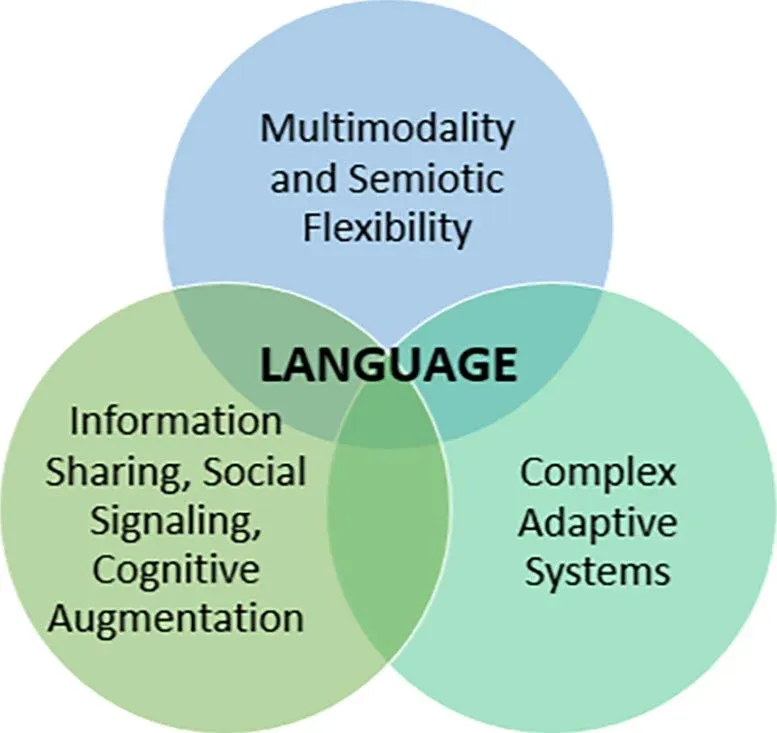
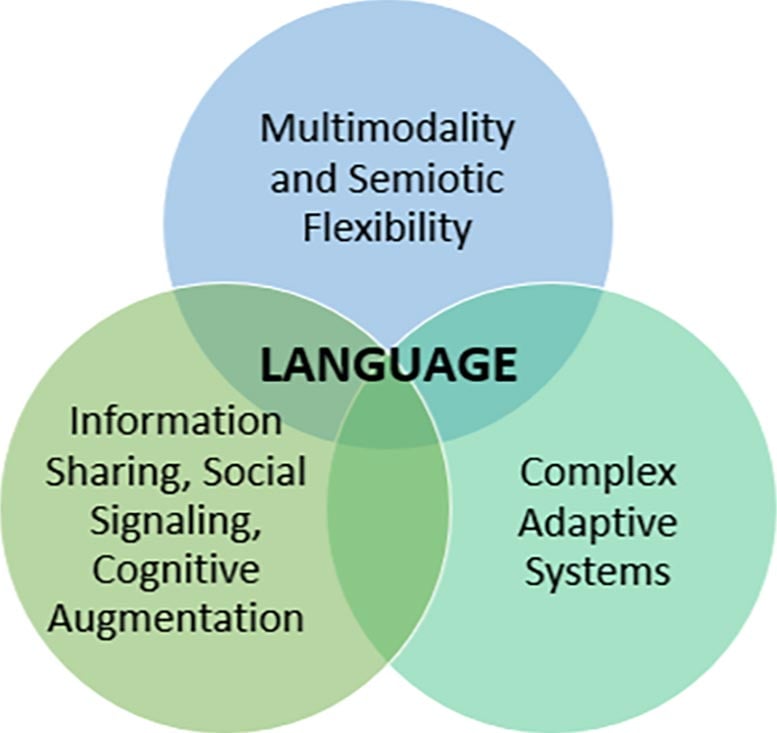
The research team proposes three major shifts in how we think about language.
First: language isn't just spoken words. Gestures, facial expressions, and emoji are integral to how we communicate—not add-ons. And language isn't purely arbitrary. The word "buzz" actually sounds like what it describes. A stretched-out "slooooow" carries meaning in its form. This flexibility means humans can turn almost any behavior into communication.
Second: language is fundamentally social. When someone says "Isn't that Tom's bike?" they might mean "Let's meet here" or "Let's avoid this place," depending on shared history. Language carries identity—your accent or dialect signals where you're from, who you are. It can build solidarity or create distance. And here's the kicker: learning a new word for a color can actually change how you see colors.
Third: language evolves. Properties we thought were fixed—like the ability to create infinite sentences or embed one idea within another—emerge through repeated interaction across generations. Languages adapt to their communities. The world's linguistic diversity isn't a puzzle to solve; it's a reflection of how languages fit the social environments they live in.
Dr. Marcus Perlman from the University of Birmingham notes the timing: "The last few decades have been an exciting time for linguistics. We've learned huge amounts about sign languages, tactile signing systems, and now large language models. It makes sense that linguistic theory would require a major update."
Why This Matters
The implications ripple outward. Sign languages are finally being recognized as equal to spoken ones—a shift that affects policy, education, and inclusion. Teachers now have an updated framework for discussing language evolution and cognition. The study questions the traditional textbook accounts that reduce language to speech alone, opening space for recognizing communication in all its forms.
Dr. Limor Raviv from the Max Planck Institute for Psycholinguistics puts it plainly: "Language is not a static thing. It's a dynamic, embodied, and deeply social act. When we accept that, we see not just what makes us human—but how we are in fact connected to the wider story of animal communication."
The shift from "language as a checklist" to "language as a living system" might sound academic. But it changes how we teach, how we value different forms of communication, and how we understand what connects us to each other—and to the rest of the animal world.