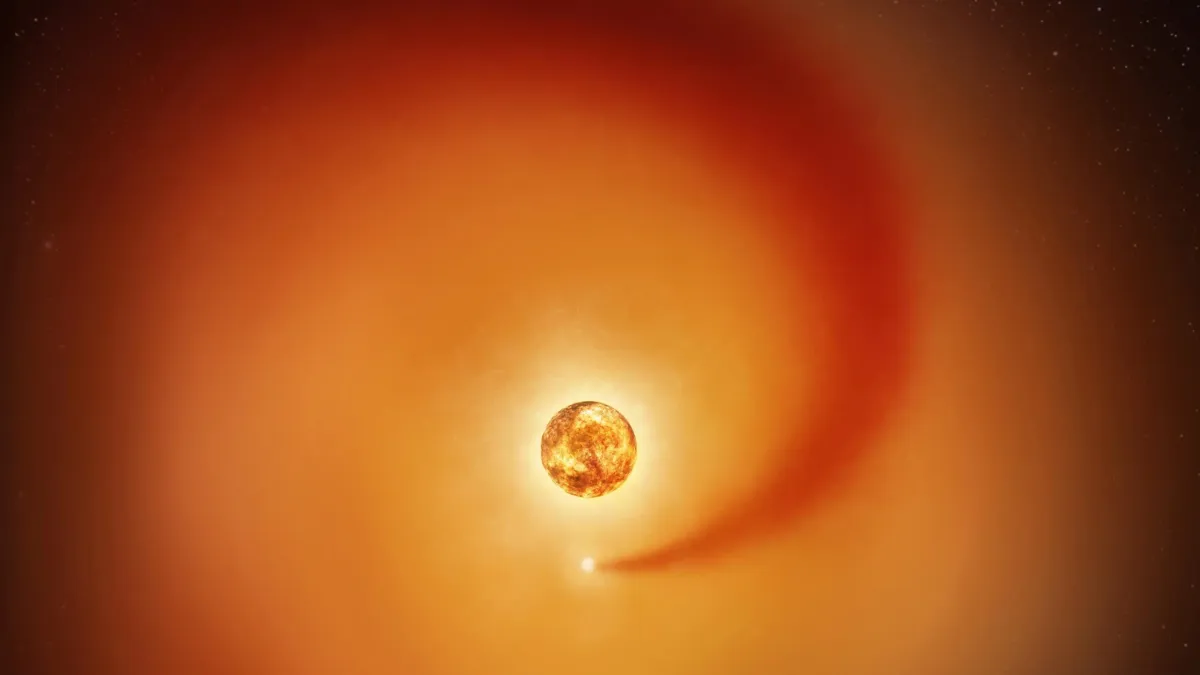
Astronomers have finally caught direct evidence of something they've suspected for years: Betelgeuse, the massive red star in Orion, has a hidden companion orbiting within its atmosphere. Using eight years of data from NASA's Hubble Space Telescope and ground-based observatories, researchers at the Center for Astrophysics | Harvard & Smithsonian identified the companion star—known as Siwarha—by tracking the wake of dense gas it leaves behind as it moves through Betelgeuse's enormous outer layers.
The discovery resolves a puzzle that has nagged astronomers for decades. Betelgeuse has long shown strange, unpredictable changes in brightness and behavior. Scientists noticed two distinct patterns: a shorter 400-day cycle linked to the star's internal pulsations, and a longer 2,100-day cycle that didn't fit the usual explanations. They'd ruled out massive convection cells, dust clouds, and magnetic effects. The companion star theory kept gaining ground in recent years, but without proof, it remained speculation.
A Wake Through the Cosmos
Now they have proof. By carefully monitoring shifts in Betelgeuse's light spectrum over nearly eight years, the team detected repeating patterns that pointed to a low-mass star plowing through the red supergiant's extended atmosphere. As Siwarha orbits, it creates a trail of denser material—essentially a stellar wake—that shows up clearly in the data roughly every 2,100 days, or about six years. "It's a bit like a boat moving through water," said Andrea Dupree, the study's lead author. "The companion star creates a ripple effect in Betelgeuse's atmosphere that we can actually see in the data."
We're a new kind of news feed.
Regular news is designed to drain you. We're a non-profit built to restore you. Every story we publish is scored for impact, progress, and hope.
Start Your News DetoxThis matters because Betelgeuse is one of the few stars close enough and large enough that we can study its surface and atmosphere in detail. At roughly 650 light-years away in the constellation Orion, it's a red supergiant so vast that more than 400 million Suns could fit inside it. What happens to Betelgeuse—how it loses mass, how it changes, how it will eventually explode as a supernova—offers a rare window into the final stages of a massive star's life.
The research team used Hubble alongside telescopes at the Fred Lawrence Whipple Observatory and the Roque de Los Muchachos Observatory to detect the repeating patterns. The data showed changes not just in Betelgeuse's brightness but in the speed and direction of gas flowing through its atmosphere, all linked to the companion's passage. The timing matched theoretical predictions almost exactly.
Astronomers are already planning the next phase of observations. From Earth's vantage point, Betelgeuse is currently eclipsing its companion, but when Siwarha emerges again in 2027, new instruments will be waiting. This discovery may also help explain similar mysteries surrounding other giant and supergiant stars elsewhere in the galaxy—stars whose behavior has seemed erratic until now.
"With this new direct evidence, Betelgeuse gives us a front-row seat to watch how a giant star changes over time," Dupree said. The research was presented at the 247th meeting of the American Astronomical Society in January and has been accepted for publication in The Astrophysical Journal.