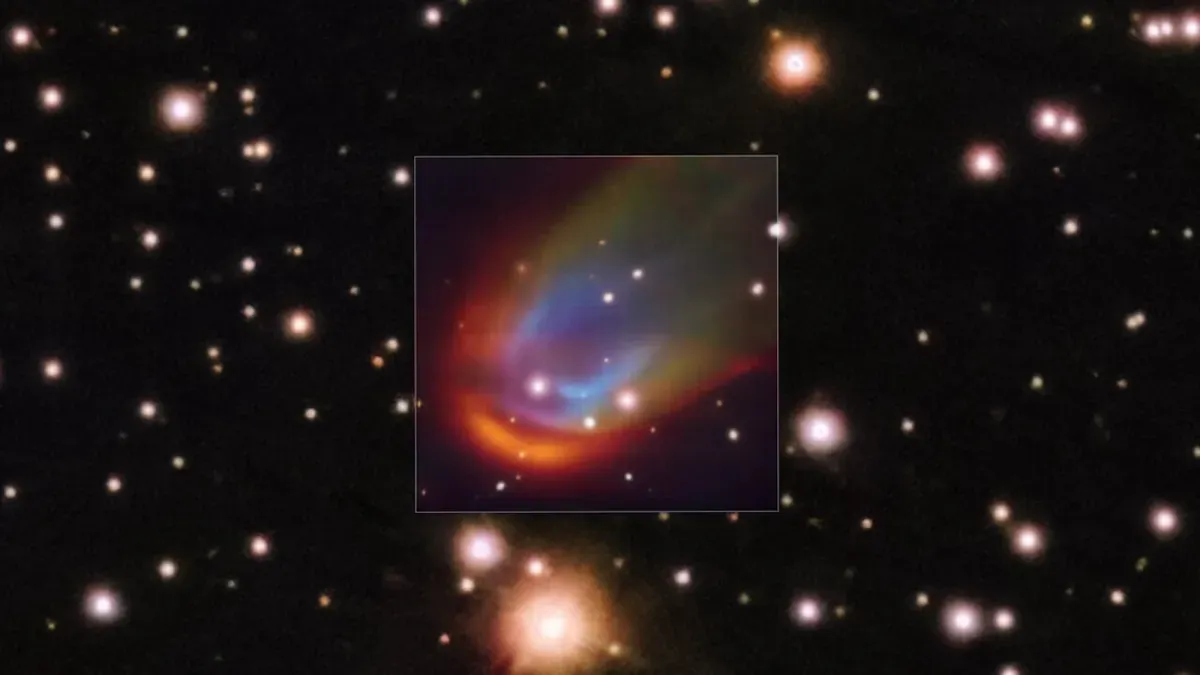
Astronomers expected a white dwarf—the burned-out core of a dead star—to sit quietly in space, its influence spent. But when researchers detected powerful shockwaves streaming from one 730 light-years away, they realized they'd stumbled onto something the cosmos hadn't shown them before.
"We found something never seen before and, more importantly, entirely unexpected," said Simone Scaringi, a researcher at Durham University.
The white dwarf, called RXJ0528+2838, orbits alongside a living star similar to our sun. In most binary systems like this, material flows from the active star to the dead one, creating a disk of debris. That disk usually generates the outflows and shockwaves astronomers see. But RXJ0528+2838 has no disk. According to everything we understand about how these systems work, it shouldn't be producing anything at all—yet it's been blasting material into space for at least 1,000 years.
We're a new kind of news feed.
Regular news is designed to drain you. We're a non-profit built to restore you. Every story we publish is scored for impact, progress, and hope.
Start Your News DetoxA Magnetic Puzzle
When Scaringi's team analyzed detailed images from Spain's Isaac Newton Telescope, they noticed curved bow shocks around the white dwarf—the kind of signature you'd expect from a powerful outflow. They confirmed the signal using the European Southern Observatory's Very Large Telescope, mapping the shockwave's composition and tracing it directly back to the dead star.
The team discovered that RXJ0528+2838 possesses an unusually strong magnetic field, which appears to be gathering material from its companion star. That magnetic field seems to be the key—but only partially. The current understanding of how strong that field is suggests it should only power an outflow lasting a few hundred years, not the thousand-year phenomenon they're observing.
"Our finding shows that even without a disc, these systems can drive powerful outflows, revealing a mechanism we do not yet understand," explained Krystian Iłkiewicz, a study co-author at Poland's Nicolaus Copernicus Astronomical Center, in research published today in Nature Astronomy.
What's happening here challenges the standard model of how matter moves in extreme binary systems. There's still a "mystery engine" at work—Scaringi's term for whatever is actually powering this outflow. More observations will be needed to understand why a dead star can behave so dramatically, and what role its magnetic field really plays. But for now, the astronomers have something rarer than a solved puzzle: a genuine cosmic surprise.