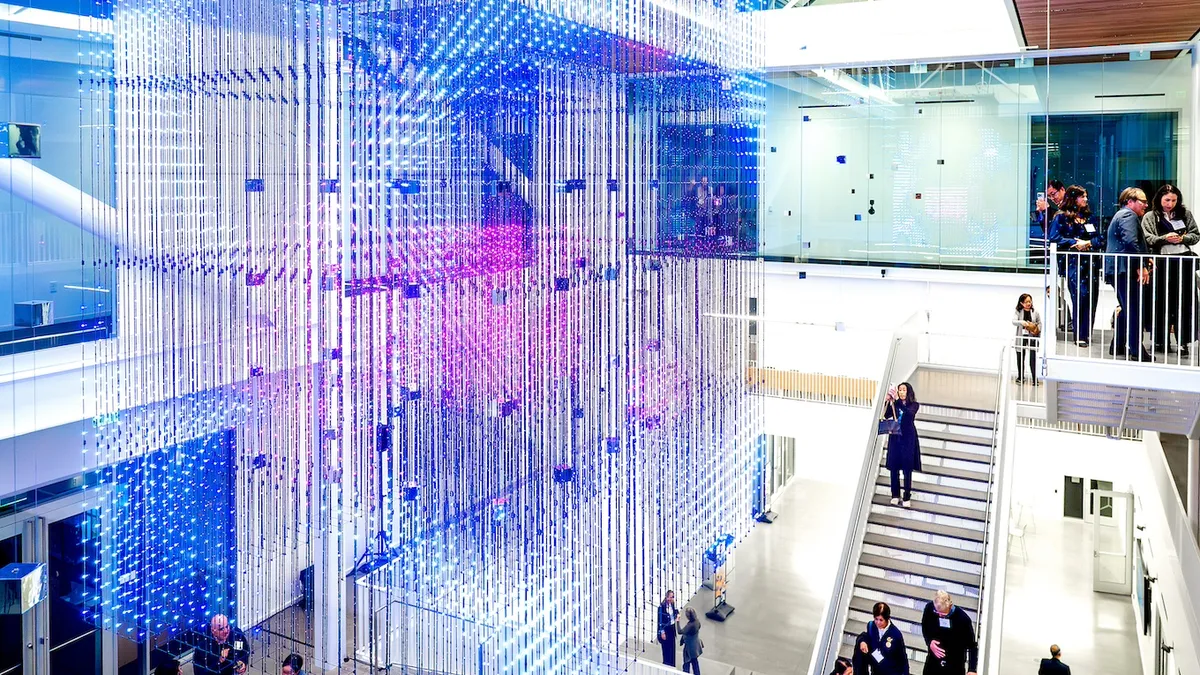
UC Berkeley's Grimes Engineering Center just got a glow-up, and it's not your average LED strip. Hanging in the atrium is the Strauch Hypercube, a dazzling light installation that's less art piece, more living algorithm. Think 'mathematical beauty' meets 'hypnotic light show that never repeats itself.'
It officially switched on last fall during a Dean’s Society event, bathing the entire building (and parts of campus, thanks to the open design) in multicolored light. One minute, it’s a shimmering starry night; the next, a blinking, pixelated marquee. Each cube pulses independently, yet somehow, it all works together, blending Berkeley's signature blue and gold into something that feels almost alive.
Math, Slime, and Infinite Patterns
Architect and artist Susan Narduli, the mastermind behind the Hypercube, calls it a "voxel structure." Essentially, it's a bunch of suspended LED strands, all deeply rooted in Cartesian grids and engineering principles. Because, of course, it is.
We're a new kind of news feed.
Regular news is designed to drain you. We're a non-profit built to restore you. Every story we publish is scored for impact, progress, and hope.
Start Your News DetoxThis isn't just a static display; it's generative artwork. That means it uses data from its own LED framework to conjure up endless visual patterns. Narduli says it runs on algorithms, constantly cycling through a content library, always shifting. Even when it revisits an old algorithm, it’s never quite the same. It's built with TouchDesigner, a programming environment that basically lets visual coding and data throw a party. The result? A living system of logic, data, and light.
Some of these algorithms are inspired by actual Berkeley Engineering science. One sequence, for instance, mimics fluid dynamics, translating abstract concepts into a mesmerizing flow of gold and blue. During the ceremony, Narduli even highlighted an algorithm inspired by Physarum polycephalum — a type of slime mold. As she spoke, a shimmering wave of light, straight out of a sci-fi movie, flowed through the Hypercube on screen. Which, if you think about it, is both impressive and slightly terrifying.
The Light Fantastic, Earthquake-Proof Edition
Donor Roger Strauch, an engineer himself, funded the installation with his brother Hans. Roger envisioned a "lava-like flow of light" filling the building’s massive volume, sparking curiosity in everyone who walked by. The Hypercube’s small, reflective cubes, scattering like exploding pixels, deliver exactly that.
Narduli was drawn to the building's simple geometry and designed a structure that appears to float effortlessly. This floating act is partly thanks to a clever bit of engineering: the Buckling-Restrained Brace (BRB), an earthquake-prevention feature developed right there at Berkeley. Paired with shape memory alloys (SMAs) — a first for this kind of application — the Hypercube hangs completely unobstructed across the atrium. Civil engineering professor Khalid Mosalam points out this innovation reduces floor acceleration, protecting the artwork from any seismic shenanigans.
Narduli describes light as the installation's "ephemerality" — a fancy way of saying it's all about fleeting beauty. This concept extends to the Grimes Engineering Center itself, which has quickly become a buzzing hub for students. Advising, career services, late-night study sessions, peer tutoring — it's all happening under the Hypercube's watchful, ever-shifting glow.
It's a fitting realization of the Strauch family's vision: to inspire future engineers to be "courageous, creative, and impactful." So, when attendees at the Illumination ceremony shouted "Fiat Lux!" (Latin for "Let there be light!") as the Hypercube transformed again, it felt less like a cheer and more like a declaration. Because apparently, that’s where we are now: art that's also a science experiment, constantly evolving, and probably smarter than your phone.