Turns out, everything we thought we knew about how giant stars go boom — and what they leave behind — needed a serious rewrite. For two decades, our models of supernova explosions were, shall we say, a little off. But thanks to some stellar X-ray data from a cluster of galaxies so massive it makes our Milky Way look like a suburban cul-de-sac, scientists have finally updated the cosmic recipe book.
Behold, the Perseus Cluster: a sprawling cosmic neighborhood of over a thousand galaxies, collectively weighing in at a thousand trillion times the mass of our sun. It's one of the biggest things we can even see in the universe. And inside this behemoth, hot gases — the intracluster medium (ICM) — are constantly screaming in X-rays, a fiery echo of billions of supernova explosions over cosmic history. Their chemical makeup is basically a giant cosmic ledger, telling us what kind of stellar fireworks have been happening.
Cosmic Chemistry Gets a Makeover
For years, our theoretical models of these explosions kept spitting out too much silicon and sulfur, and not enough argon and calcium. These elements are the handiwork of massive stars, the ones at least ten times heftier than our sun. The discrepancy was like trying to bake a cake with a recipe that always yielded a brick. Something had to give.
We're a new kind of news feed.
Regular news is designed to drain you. We're a non-profit built to restore you. Every story we publish is scored for impact, progress, and hope.
Start Your News DetoxDr. Shing-Chi Leung at SUNY Polytechnic Institute, along with a team including students Seth Walther and Henry Yerdon, decided it was time to update the cookbook. They created entirely new models for how these gargantuan stars evolve and then spectacularly detonate. And the secret ingredient? Fresh observations.
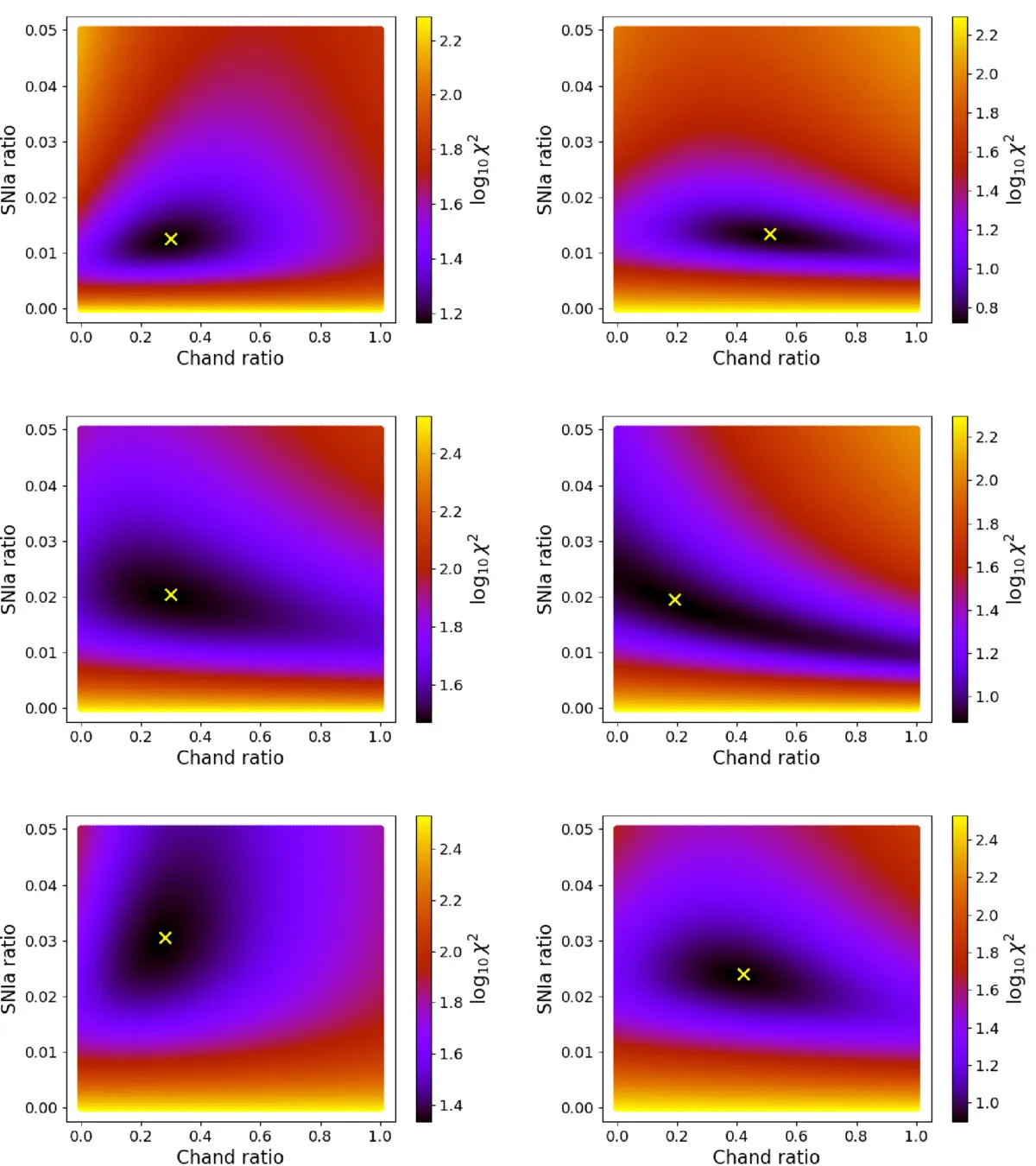
Their first paper unveiled new massive star models that finally, blessedly, matched the silicon, sulfur, argon, and calcium ratios observed in the Perseus Cluster. The universe, it seems, does make sense after all. Their second paper expanded on this, exploring stars from 15 to 60 solar masses and different metal contents, essentially mapping out how heavy elements have built up from supernovae over the last ten billion years.
Which, if you think about it, is both impressive and slightly terrifying. We're talking about rebuilding the history of elemental creation, tracking how the very stuff that makes up planets (and us) got scattered across the cosmos.
Students to the Rescue (and Beyond)
Physics students Seth Walther and Henry Yerdon weren't just fetching coffee; they were knee-deep in calculations and even co-authored parts of the papers. Walther noted that research teaches you that things don't always go smoothly — a lesson many of us learn outside of astrophysics, too. Yerdon, meanwhile, discovered that dedication and resilience are key, especially when results aren't what you expect. Sounds like a solid life lesson, even if you're not tracking exploding stars.
Dr. Leung credits the Hitomi telescope's precise measurements from the Perseus Cluster for kicking off this whole endeavor. And the best part? These shiny new models aren't just for distant clusters. They can be applied to stars in our own Milky Way, metal-poor stars, and other galaxies.
The next-generation XRISM telescope, launched just this year, is set to provide even more data, promising even better models of stars and supernovae. Because apparently, we're not done rewriting cosmic history yet. The team is already planning to see how these new models hold up in extreme scenarios, like bipolar explosions. Because why stop at just regular explosions when you can have bipolar ones?
It’s a good reminder that even after decades, the universe still has plenty of surprises up its sleeve. And occasionally, it just needs a good edit.