Imagine a planet where the surface is literally a molten ocean. Now imagine that ocean has been sloshing around for billions of years, fueled by a core so sulfur-rich it makes other rocky worlds look positively bland. Scientists just found one, about 35 light-years away, and it's making them rethink everything they thought they knew about planets.
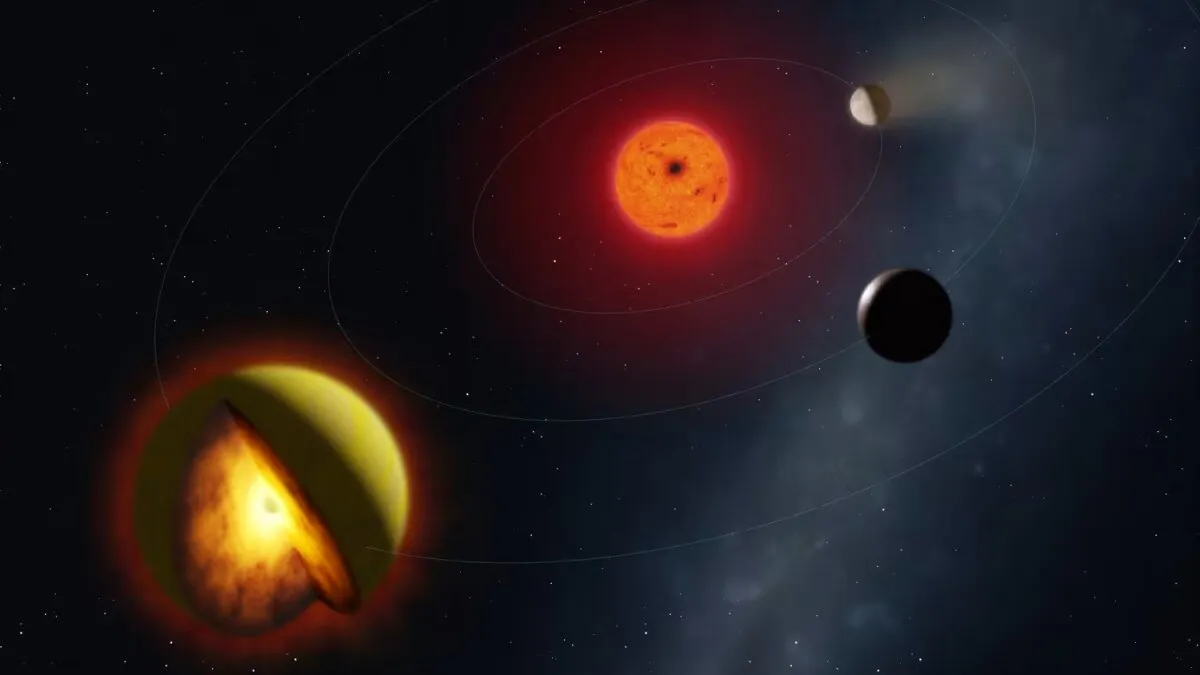
Meet L 98-59 d, a world roughly 1.6 times the size of Earth, but don't let the size fool you. This isn't your garden-variety "super-Earth." Its core is molten silicate, like Earth's lava, but with a twist: it's absolutely packed with sulfur. So much sulfur, in fact, that researchers are calling it a completely new class of planet: a sulfur-rich, magma ocean world. Which, if you think about it, is both impressive and slightly terrifying.
These revelations, published in Nature Astronomy, come courtesy of the James Webb Space Telescope (JWST) and a few ground observatories. As lead author Harrison Nicholls put it, this discovery proves "we still have so much to learn about how planets form and evolve." Because apparently, the universe still has a few tricks up its sleeve.
We're a new kind of news feed.
Regular news is designed to drain you. We're a non-profit built to restore you. Every story we publish is scored for impact, progress, and hope.
Start Your News DetoxThe Ancient Ocean That Refused to Dry Up
Here's where it gets weird: most rocky planets shed their lighter atmospheric elements, like hydrogen and sulfur, over time. A star's solar wind usually just blasts them into space. But L 98-59 d has held onto its hydrogen-rich atmosphere for nearly five billion years. Why? That stubborn molten ocean.
Scientists, armed with advanced computer models (because JWST only gives you a snapshot, not a five-billion-year time-lapse), figured out that L 98-59 d was once a much gassier, more "inflated" sub-Neptune. It cooled and shrank, but its low density still points to a massive, high-pressure atmosphere. Think Venus, but with even more dramatic real estate.
This thick, hydrogen-rich atmosphere creates an intense greenhouse effect, keeping that primordial magma ocean perpetually liquid. Add in some stellar radiation and tidal heating from nearby planets, and you've got a recipe for eternal magma. Other planets have magma oceans, sure, but they're usually practically hugging their stars. L 98-59 d is different; it's a perfect storm of conditions, a scenario that doesn't quite fit into our current planetary pigeonholes.
Sulfur's Story and the Future of Worlds
Beyond its dramatic landscape, L 98-59 d offers clues about sulfur's role in planetary formation. While this particular lava-world isn't exactly a vacation spot, its history suggests it formed in an environment far richer in sulfur than our own solar system. This has huge implications for the search for other rocky worlds.
Nicholls' team believes there could be entire populations of smaller "sulfur-worlds" out there, planets with entirely different elemental compositions than Earth. This means our definition of a "super-Earth" – currently just a size classification – might need a serious upgrade. L 98-59 d is technically a super-Earth, but it's clearly playing by its own rules.
The next step? Hunting for more of these sulfur-soaked oddballs with JWST and future missions. Because if we've learned anything from L 98-59 d, it's that the universe is far stranger, and more interesting, than we ever imagined.