Scientists have finally figured out why two species of long-necked dinosaurs could stand upright on their hind legs — and it came down to bone structure and stress tolerance.
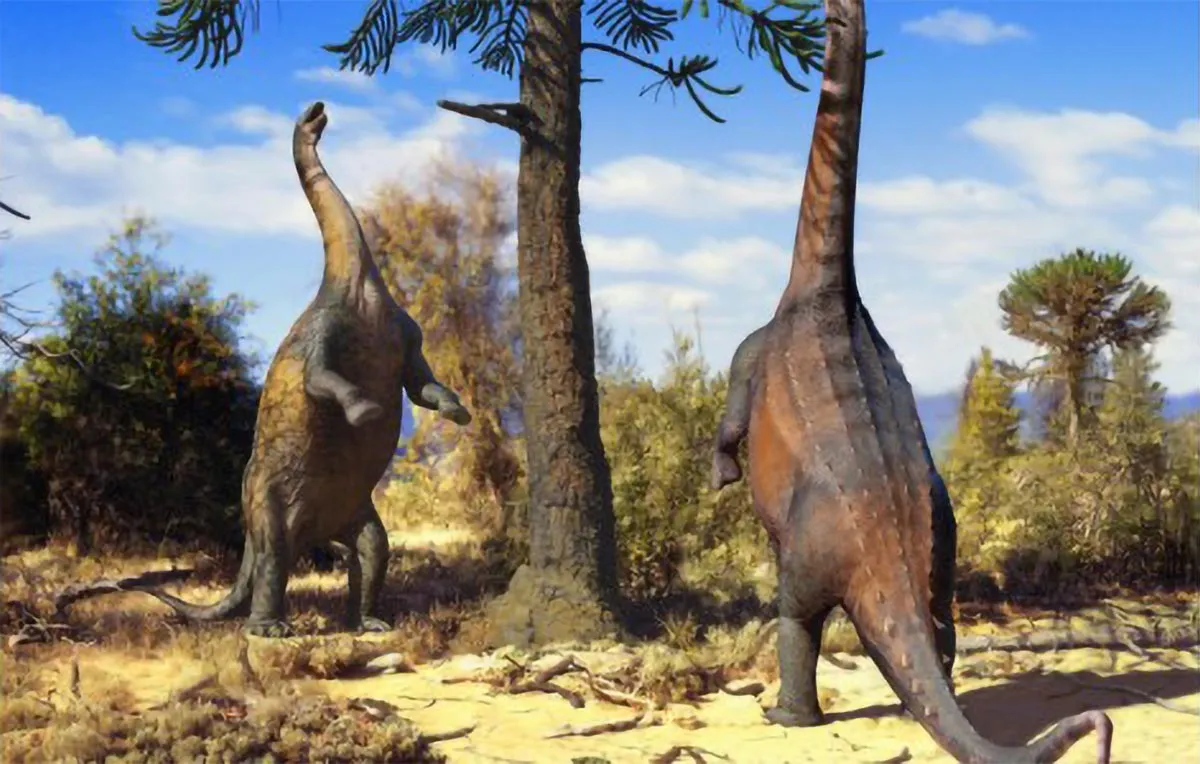
Sixty-six million years ago, the Brazilian Uberabatitan and Argentine Neuquensaurus had an advantage over their sauropod cousins. Both roughly the size of modern elephants, they could rear up and hold themselves upright for extended periods. This wasn't just a party trick. Standing tall let them reach leaves in the highest tree canopy, display dominance to potential mates, and look larger when predators approached.
The mystery was how. Sauropods were among the largest land animals ever — some species stretched longer than a basketball court — and keeping that much weight balanced on two legs seems physically impossible. A team of researchers from Brazil, Germany, and Argentina used computational engineering methods to find out which species managed it best.
We're a new kind of news feed.
Regular news is designed to drain you. We're a non-profit built to restore you. Every story we publish is scored for impact, progress, and hope.
Start Your News DetoxThe engineering approach
Instead of guessing, the scientists modeled the stress placed on each dinosaur's femur (thigh bone) when standing upright. They calculated how gravity and body weight pressed down on the bone, much the way engineers test whether a bridge can handle traffic.
The results were clear: smaller sauropods had the advantage. Uberabatitan and Neuquensaurus, while enormous by any modern standard, had femurs and muscle structures robust enough to distribute stress effectively. Larger sauropod species could probably stand too, but only briefly and uncomfortably — the position put too much strain on their bones.
"Smaller sauropods like these had a bone and muscle structure that allowed them to stand more easily and for longer on their two hind legs," explains Julian Silva Júnior, a postdoctoral researcher at São Paulo State University. "Larger ones were probably also able to stand, but for a shorter time and with less comfort, since the position caused a lot of stress on the femur."
Even juvenile versions of the largest species likely couldn't maintain the posture for long. Young animals had less developed musculature, making the position even more strenuous.
Why it mattered
For Uberabatitan and Neuquensaurus, the ability to rear up opened practical doors. A 26-meter-long dinosaur standing on hind legs could access vegetation no four-legged competitor could reach. During mating season, males could mount females and perform displays that signaled strength and health. When threatened, the same rearing posture made them appear larger and more intimidating.
This study, published in Palaeontology in 2025 and supported by FAPESP (São Paulo Research Foundation), shows how modern engineering tools can answer ancient questions about animal biology. It's a reminder that evolution doesn't optimize for comfort — only for whatever works well enough to survive and reproduce.
Study: Standing giants: a digital biomechanical model for bipedal postures in sauropod dinosaurs - Palaeontology, 2025