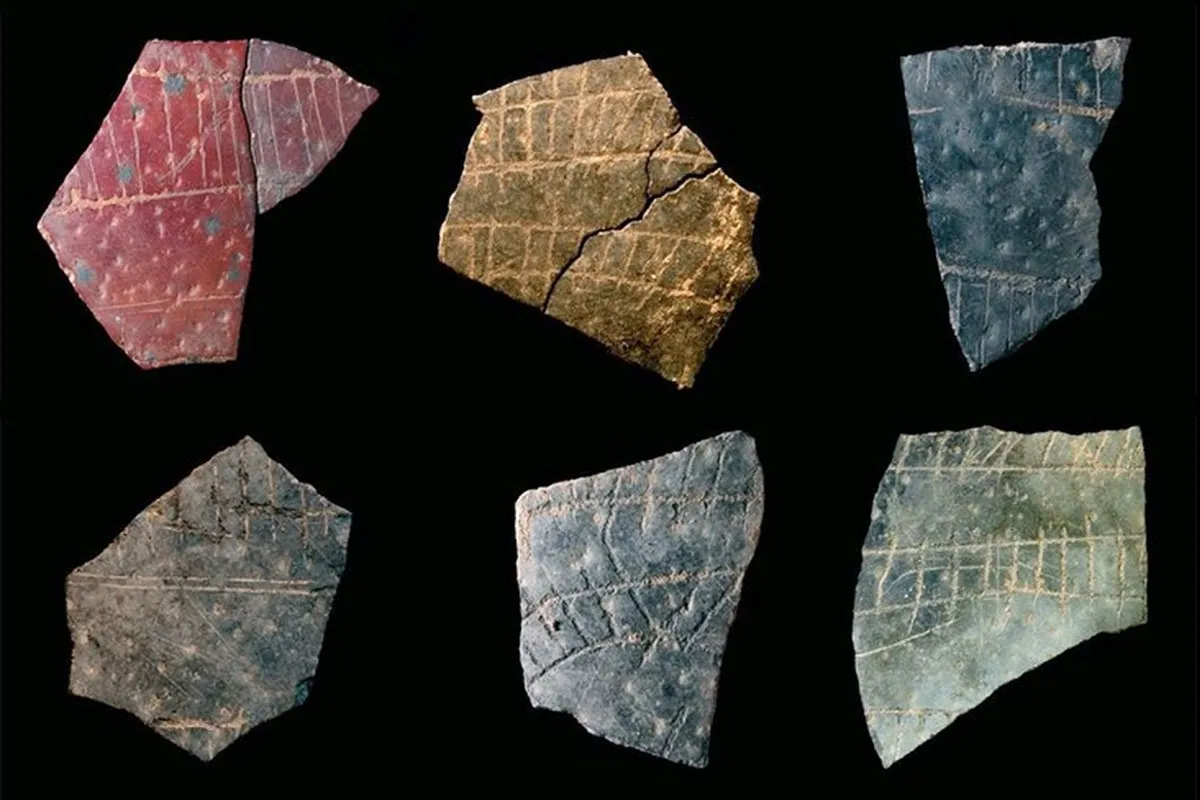
Sixty thousand years ago, someone in southern Africa held an ostrich eggshell—a practical water container—and decided to carve it. Not with random scratches, but with grids and diamond patterns, organized with such precision that researchers now recognize the marks as evidence of geometric thinking.
A new study in PLOS One examined 112 eggshell fragments from three sites across South Africa and Namibia. Using geometric analysis, scientists reconstructed the designs and found something striking: more than 80 percent displayed what they call "coherent spatial regularities." These weren't doodles. They were patterns built on understanding parallel lines, right angles, rotations, and hierarchical layering—the visual equivalent of planning an architecture before building it.
"We are talking about people who did not simply draw lines, but organized them according to recurring principles," says Silvia Ferrara, a philologist at the University of Bologna and co-author of the study. "There is real visuospatial planning, as if the authors already had an overall image of the figure in mind before engraving it."
We're a new kind of news feed.
Regular news is designed to drain you. We're a non-profit built to restore you. Every story we publish is scored for impact, progress, and hope.
Start Your News DetoxWhat matters here is what these carvings tell us about how our ancestors' minds worked. Abstract thinking—the ability to hold an idea in your head, plan it out, and execute it with consistency—is the cognitive leap that made humans different. It's what allowed us to invent writing, mathematics, art, and eventually everything we've built. These eggshell carvings are among the earliest evidence we have of that capacity.
The Gateway to Everything That Came After
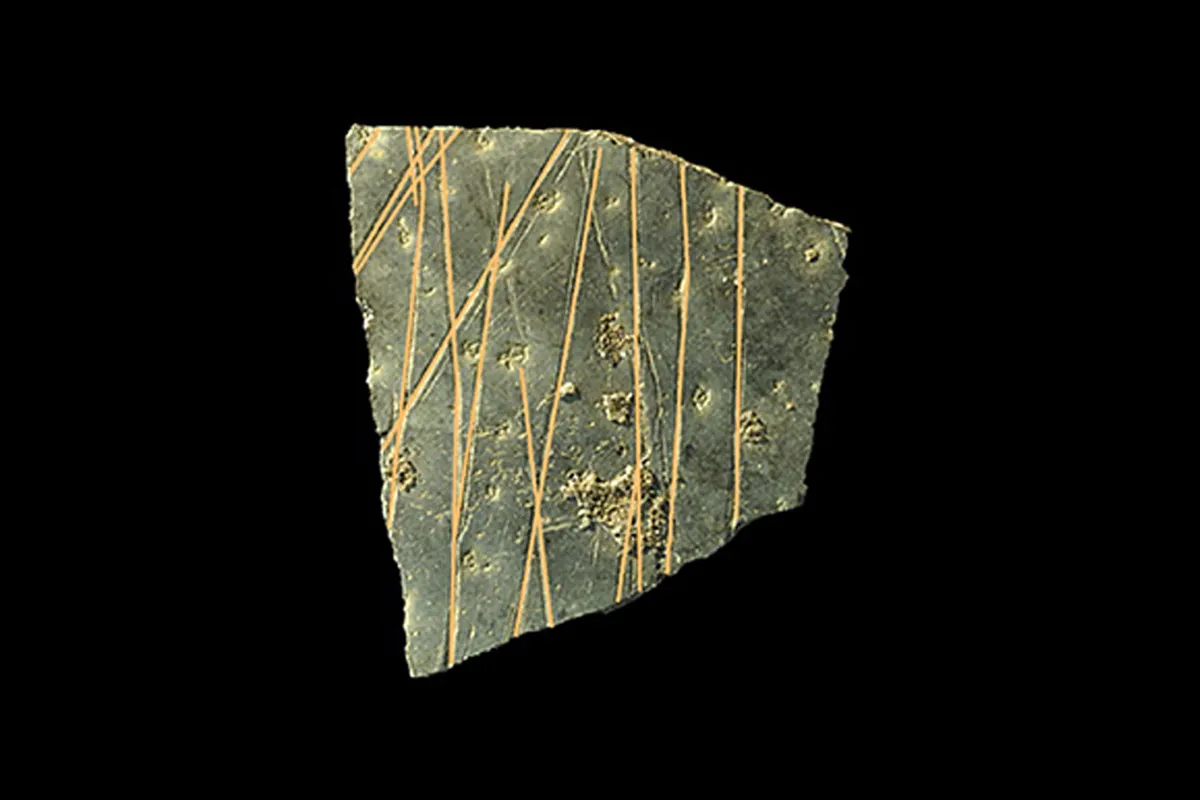
Think of it this way: carving geometric patterns into an eggshell requires you to imagine something that doesn't exist yet, then make it real. You have to understand that a shape can repeat, that lines can relate to each other in meaningful ways, that you can create a visual system with its own logic. That's not instinct. That's abstract reasoning.
This matters because these ancestors were living at a critical moment in human history. Around 60,000 years ago, Homo sapiens began leaving Africa in significant numbers, eventually spreading across Eurasia and beyond. The cognitive tools revealed in these carvings—the ability to think in systems, to plan ahead, to create visual language—were the same tools that made that expansion possible.
Ostrich eggshells have been quietly revealing the sophistication of early human life for years. A 2020 study found that beads made from the same shells, dating back roughly 30,000 years, may have served as a form of social currency. Different groups exchanged them as a kind of insurance policy, agreeing to help each other through droughts or hardship. That's not just cooperation—that's abstract thinking applied to economics and trust. Other researchers have identified ostrich eggshell beads as evidence of early fashion trends spreading across Africa, and the shells themselves have shown us that humans were harvesting marine resources along the South African coast more than 100,000 years ago.
What these discoveries collectively suggest is that our ancestors weren't simply surviving. They were thinking, planning, creating systems of meaning, and building social networks that spanned territories. The ostrich eggshell—practical, abundant, and durable enough to survive 60,000 years—became a canvas for their minds.
The next question researchers are likely asking: what other evidence of this geometric thinking exists, waiting in the archaeological record? If we've found it in eggshells, what else did our ancestors create with the same careful intention?