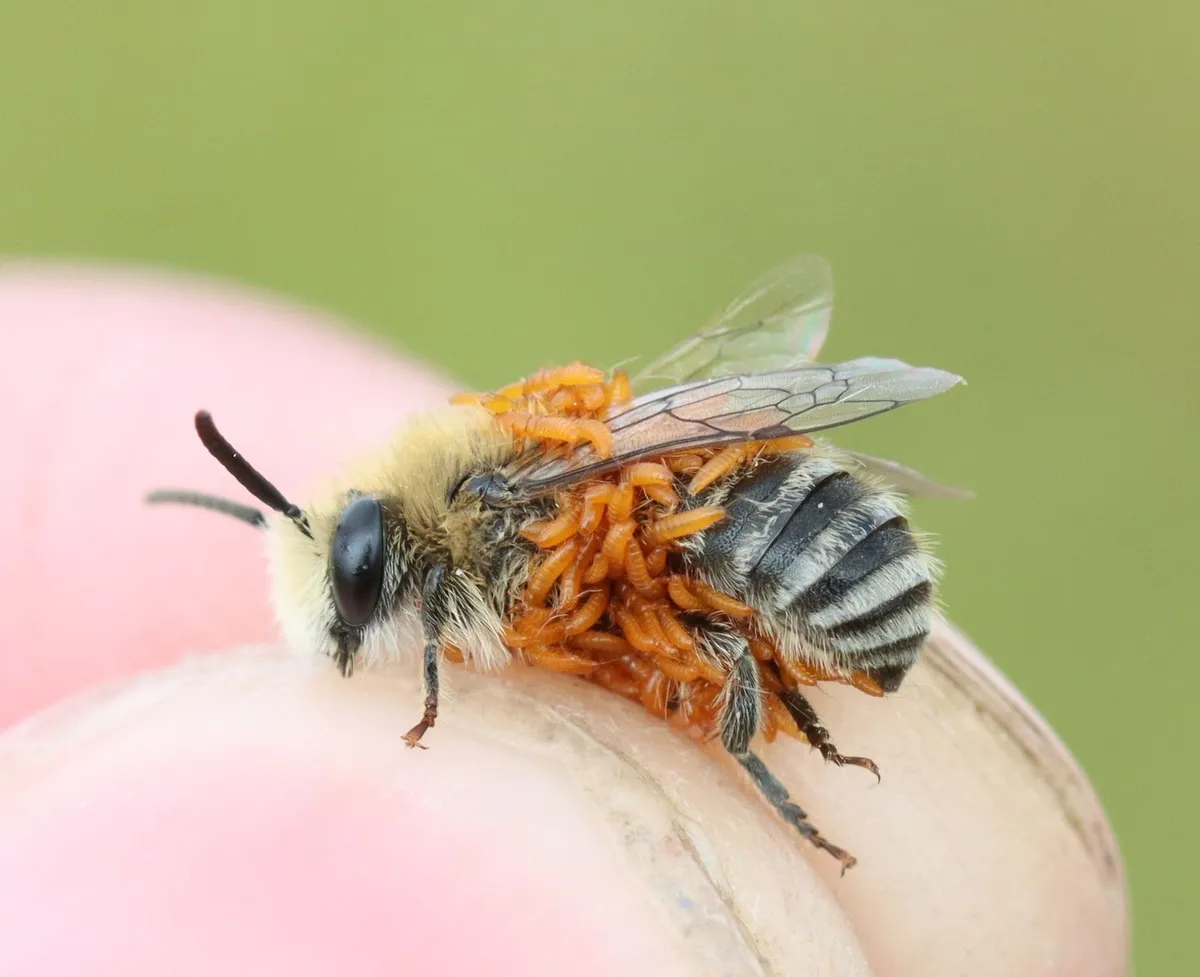
A beetle species has evolved one of nature's cleverest cons: its larvae produce the exact chemical perfume of flowers to lure bees, then hitch a ride to the hive where they feast on eggs.
Researchers studying the European black oil beetle (Meloe proscarabaeus) discovered that the larvae cluster together on grasses in early spring, turning themselves orange and releasing 17 floral compounds—including linalool oxide and lilac aldehyde—that naturally attract pollinators. When a bee arrives expecting nectar, the larvae cling to its body and travel back to the nest, where the real plundering begins.
The sophistication is striking. When researchers created synthetic blends of the larvae's scent and tested them on four bee species, the bees consistently preferred the beetle perfume to wheatgrass used as a control. "It wasn't just that they were producing one compound and then loosely trying to mimic a flower," says Ryan Alam, a synthetic chemist at the Max Planck Institute for Chemical Ecology. "It was like their own personal larval perfume."
We're a new kind of news feed.
Regular news is designed to drain you. We're a non-profit built to restore you. Every story we publish is scored for impact, progress, and hope.
Start Your News DetoxThis may be the first documented case of an animal imitating floral scents—a form of deception that's likely far more common than we realize. Chemical trickery is harder to spot than visual deception because humans rely more on sight than smell. "It takes really careful observation and intuition to figure out some of these very strange relationships," says May Berenbaum, an entomologist at the University of Illinois.
The evolutionary backstory is equally intriguing. The compounds that attract bees also attract the larvae themselves, suggesting the scent may have originally evolved as an internal signal telling young beetles when and where to gather. Over time, they may have amplified this signal until it became potent enough to fool a pollinator—a shift from following flowers to impersonating them.
The study, posted January 15 on bioRxiv and awaiting peer review, hints at a broader pattern: deception in nature is far more elaborate than we typically assume, and there are likely countless other chemical cons waiting to be uncovered.