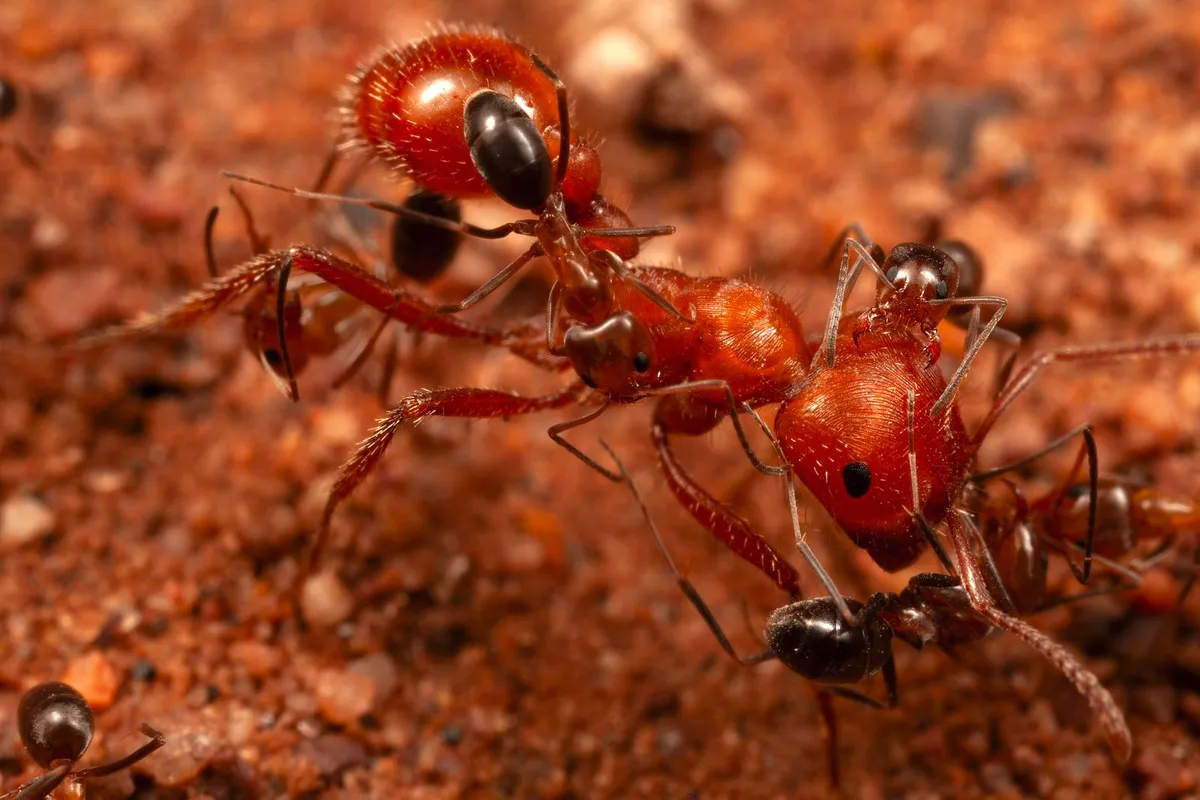
Twenty years ago, entomologist Mark Moffett saw something unusual in southeastern Arizona. Red harvester ants, much larger than cone ants, were getting a "spa treatment" from the tiny cone ants.
This behavior had never been described before. Moffett's study, published in Ecology and Evolution, is the first to observe a possible "cleaner" ant that grooms another species. However, scientists are still unsure how this interaction benefits either ant.
A Strange Spa Treatment
In 2006, Moffett, from the Smithsonian’s National Museum of Natural History, saw quarter-inch-long harvester ants in the desert. They "seemed frozen in place," which was odd for these busy worker ants. Cone ants, about one-third their size, climbed all over them.
We're a new kind of news feed.
Regular news is designed to drain you. We're a non-profit built to restore you. Every story we publish is scored for impact, progress, and hope.
Start Your News DetoxMoffett first thought the ants were fighting, as ants are usually aggressive towards other species. But he noticed the larger ants seemed to want the attention. They would visit the cone ant nests and let the small ants lick and nibble them.
Over five days, Moffett saw at least 90 of these interactions. He took many photos. The activity started at sunrise and was most common before 9:00 a.m. After that, the ants would hide from the heat.
A harvester ant would approach a cone ant nest and stand still, high on its legs, with its mandibles open. A cone ant would then emerge, usually within a minute, and start licking, nipping, and pulling. Up to five cone ants would work together. These cleaning sessions lasted from a few seconds to over five minutes.
Moffett later realized his photos told the whole story. The cone ants were an undescribed species from the Dorymyrmex genus. He compares them to cleaner fish, which remove parasites and dead skin from other animals.
The cleaner ants did a thorough job, even cleaning between the harvester ants' open jaws. Interestingly, they did not try to clean dead harvester ants that Moffett placed near their nests.
Unanswered Questions
Alexandra Grutter, a marine ecologist, was surprised by how close the tiny ants got to the large ants' powerful jaws. She noted the small ants moved fearlessly. The big harvester ants allowed the cleaning without biting. However, when a harvester ant was done, it would vigorously fling the cone ants off, sometimes flipping onto its back.

Moffett is still unsure of the exact benefits for each ant. He thinks the cone ants might eat tiny, calorie-rich crumbs from the harvester ants, possibly flakes from seeds they eat. The harvester ants might get a better cleaning than they could do themselves, especially in hard-to-reach areas.
Joe Parker, an evolutionary biologist, believes it "certainly looks like a mutualism." He suggests the benefits must be significant for this interaction to have evolved. More research is needed to understand what each species gains. Scientists could study if the grooming reduces infections or improves the ants' microbiomes.
Moffett emphasizes that many amazing discoveries are still waiting to be made outside of labs. He says finding new species and behaviors often means paying close attention to the small things, like ants.
Deep Dive & References
Interspecies grooming ritual may have been spotted in desert ants - Science