Imagine being an undergrad, staring at a screen, and suddenly realizing you’ve stumbled upon something billions of years old that shouldn't even be here. That’s precisely what a group of University of Chicago students did, unearthing one of the universe's most ancient stars — a cosmic immigrant that decided our Milky Way was the place to be, despite forming somewhere else entirely.
Led by Professor Alex Ji, with help from graduate teaching assistants Hillary Andales and Pierre Thibodeaux, ten students in a "Field Course in Astrophysics" decided to go star-hunting. And boy, did they bag a trophy.
The Cosmic Haystack and the Needle
For a quarter-century, the Sloan Digital Sky Survey (SDSS) has been vacuuming up astronomical data, creating a cosmic library of millions of objects. It’s the kind of project that makes you realize just how much information is out there, waiting for someone to sift through it.
We're a new kind of news feed.
Regular news is designed to drain you. We're a non-profit built to restore you. Every story we publish is scored for impact, progress, and hope.
Start Your News DetoxThe students, armed with this colossal dataset, dove into thousands of stars, specifically looking for the weirdos. Out of this digital treasure hunt, they flagged 77 stars for a closer look – a kind of cosmic casting call for the most interesting celestial bodies.
Then came Spring Break, which for these students meant a trip to Chile's Las Campanas Observatory. Forget beach parties; these folks were using the Magellan Inamori Kyocera Echelle (MIKE) instrument on the Magellan telescopes. On their very first night, March 21, 2025, they aimed at their chosen targets. The second star they observed, SDSSJ0715-7334, immediately started flashing "I'm special!" in cosmic Morse code.
"We found it the first night, and it completely changed our plans for the course," Ji recounted. What was supposed to be a quick 10-minute peek turned into a three-hour deep dive the very next night. Student Natalie Orrantia admitted, "I was looking at that camera the whole night to make sure it was working." Because, of course, the universe waits for no one, especially not a finicky camera.
An Ancient Immigrant, Light on Metals
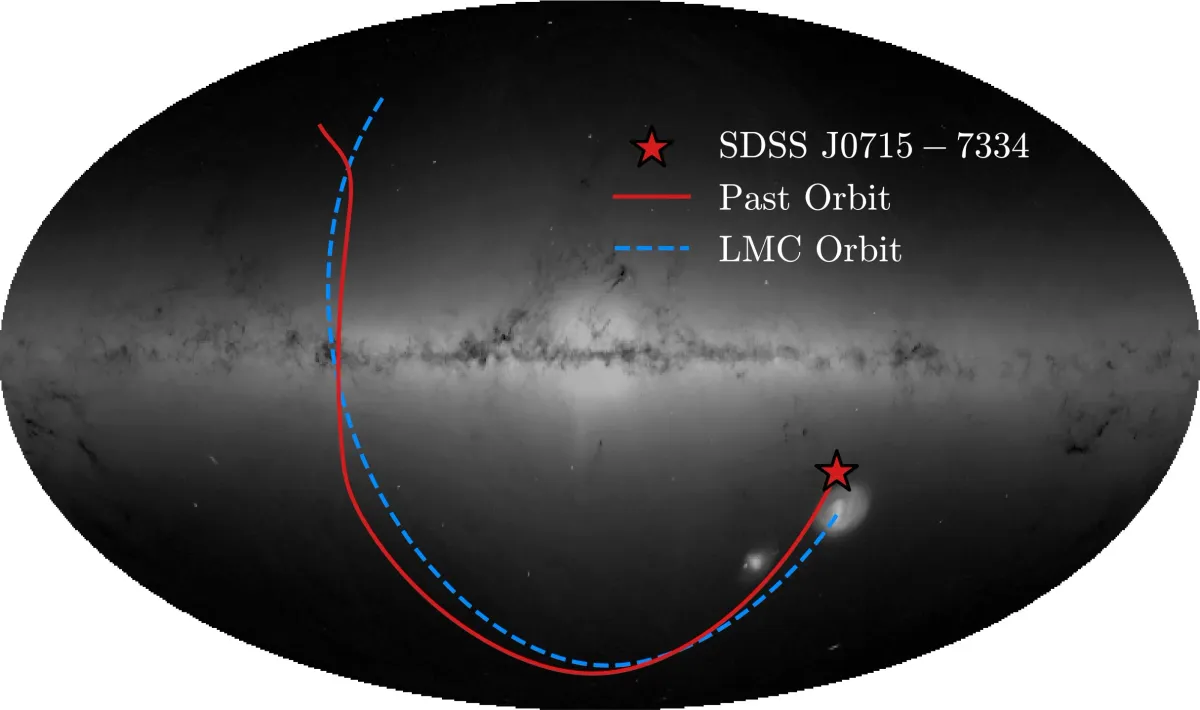
The star's chemical signature screamed "ancient." Almost entirely hydrogen and helium, it’s a relic from the early universe, practically untouched by the cosmic processes that create heavier elements. Its orbit, a kind of celestial passport, revealed its origin: the Large Magellanic Cloud, the Milky Way’s largest companion galaxy. Billions of years ago, it packed its bags and migrated to our galaxy. Ji, quite rightly, dubbed it an "ancient immigrant."
And here’s where it gets truly wild: this star has a record-low "metallicity." In astronomy, "metals" are anything heavier than hydrogen and helium. Our sun, for context, is about 1.6% metals. SDSSJ0715-7334? A paltry 0.005%. That's less than half the metals of the previous record holder, making it the most metal-poor star ever observed. Student Ha Do summed it up: "the abundances are quite low for all of them." Which is a polite way of saying it’s practically elemental soup.
This extreme lack of metals confirms its age. Heavier elements are forged in supernovae. So, a star with hardly any of them must have formed before most supernovae had a chance to, well, super-explode. It’s like finding a pristine, untouched artifact from the dawn of time.
Using data from the European Space Agency’s Gaia mission, the team traced the star’s journey backward through billions of years, confirming its Magellanic Cloud origins before it settled into our galactic neighborhood. Then, another surprise: its carbon content was so low they couldn't even detect it. Ji explained this suggests a formation method seen only once before, hinting at an "early sprinkling of cosmic dust" as its origin story.
Being part of such a monumental discovery early in their careers has, unsurprisingly, shaped these students’ futures. Both Orrantia and Do are now aiming for graduate school in astronomy. Because when you find a star that shouldn't be here, you probably want to keep looking. As Juna Kollmeier, Director of SDSS-V, put it, these students didn't just find a pristine star; they found their "inalienable right to physics." And that’s a discovery worth sharing.