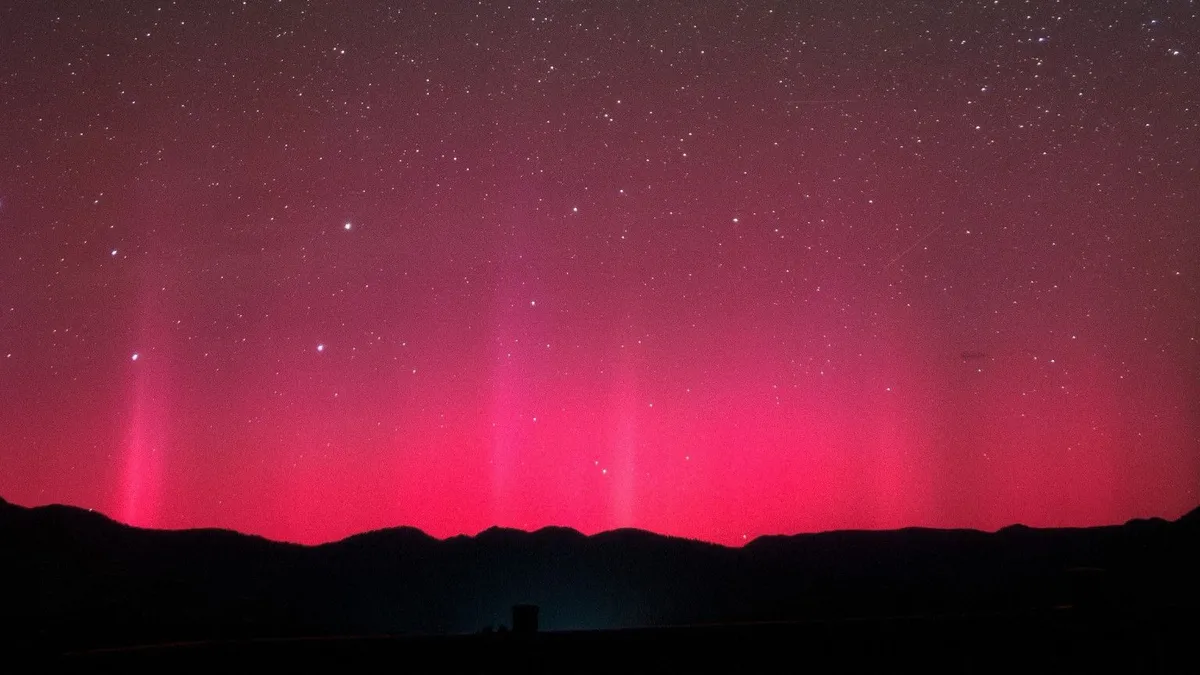
In February 1204, Japanese poet Fujiwara no Teika wrote in his diary about red lights in the night sky for three nights. Now, over 800 years later, these notes, along with other historical records and tree rings, have helped scientists track a solar event from that era.
The findings, published in Proceedings of the Japan Academy, Series B, show a new way to find old solar events. They also suggest the sun's activity cycle was shorter in the early 13th century than it is today.
Uncovering Ancient Solar Storms
When the sun is very active, it can send plasma and high-energy particles toward Earth. These radiation storms are called solar proton events (SPEs). Earth's magnetic field mostly protects us from these harmful particles. However, astronauts in space are still at risk. For example, in 1972, a series of SPEs occurred between the Apollo 16 and 17 missions.
We're a new kind of news feed.
Regular news is designed to drain you. We're a non-profit built to restore you. Every story we publish is scored for impact, progress, and hope.
Start Your News DetoxHiroko Miyahara, a physicist at Okinawa Institute of Science and Technology and a study co-author, explained that radiation from SPEs is the biggest challenge for human space travel. Improving predictions for large events is crucial.
Finding past SPEs helps predict future solar activity. Sometimes, high-energy particles can get through Earth's magnetic shield. They interact with gases in the atmosphere, creating rare atoms like carbon-14. Trees absorb this radioactive carbon, recording the SPE in their yearly growth rings.
This method works well for very strong solar storms. But for milder SPEs, it's more time-consuming. Knowing when and where to look for these "sub-extreme" events can speed up the process.
Teika's diary, Meigetsuki, mentioned "red lights in the northern sky over Kyoto" in February 1204. These were likely auroras. Miyahara noted that auroras usually disappear within 24 hours. A three-day event suggests large, recurring solar flares, which can trigger SPEs.

Reconstructing Solar Cycles
Other historical documents from Japan, China, Korea, Italy, France, and Germany suggested high solar activity from the late 12th to early 13th centuries. The research team used the carbon-14 method to reconstruct past solar cycles from this period.
They studied radioactive carbon in the rings of buried asunaro trees in northern Japan. Surprisingly, they found no evidence of an SPE linked to the auroras Teika saw. Instead, they found a carbon-14 spike from a solar storm between winter 1200 and spring 1201. This matched a red aurora recorded in China.
Kazuaki Yamamoto, a study co-author and scholar, explained that these phenomena were documented because people believed they affected their lives. Examining them scientifically offers new insights.
The team reconstructed the sun's activity using sunspot records and tree ring carbon-14 patterns. They found that solar cycles lasted only seven to eight years during that time, indicating very high solar activity. Today, solar cycles last about 11 years.
The 13th-century SPE happened at the peak of one of these solar cycles. Based on its carbon-14 spike, this event was likely 14 times stronger than the February 1956 event. The 1956 event is the most powerful solar storm measurable from Earth's surface in modern times.
Charlotte Pearson, a tree ring researcher not involved in the study, noted that this research helps build a picture of past solar activity beyond modern records. It provides detailed information on both solar events and cycles. Miyahara added that combining historical literature with tree ring studies is essential to accurately reconstruct past solar activity and understand extreme space weather better.
Deep Dive & References
- Medieval Japanese Poetry and Buried Trees Help Elucidate Volatile Space Weather - Okinawa Institute of Science and Technology, 2026
- Medieval Japanese Diary Helped Scientists Trace a Historic Solar Storm - Discover, 2026
- Medieval aurora poetry provided clues to historic solar storms - Scientific American, 2026
- Medieval Japanese poetry, tree rings help track 800-year-old solar storm - Japan Times, 2026
- Proceedings of the Japan Academy, Series B - 2026