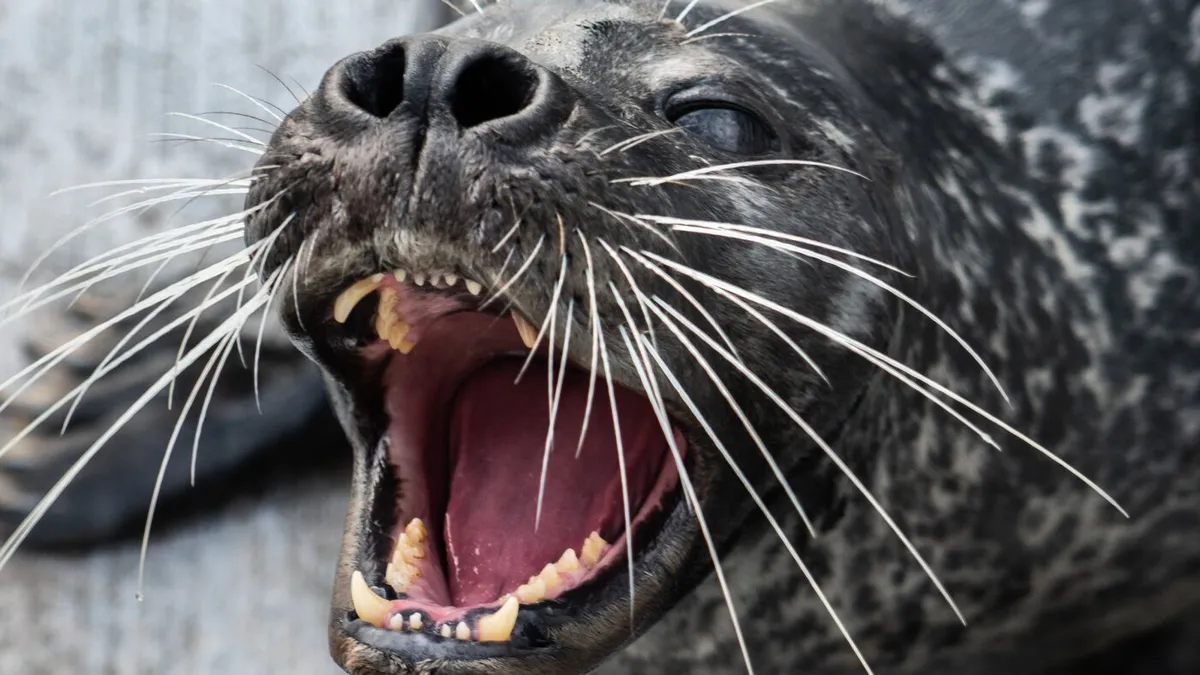
Harbor seals have about a hundred whiskers, and it turns out they're not just for looking cute while balancing a ball on their nose. These aren't just any hairs; they're hyper-tuned sensory antennae that allow seals to basically feel the world around them underwater.
Yvonne Krüger, a biologist at the University of Rostock in Germany, explains that these whiskers are picking up on the subtle water movements created by fish. Think of it like a jet leaving a contrail in the sky — only this trail is invisible, underwater, and a seal can follow it straight to dinner.
Filou's Fishy Business
Seals can decipher an astonishing amount from these underwater disturbances. They can tell which direction a fish moved, and lab studies even suggest they can differentiate between the movements of different types of fish. Which is both impressive and slightly terrifying if you're a fish.
We're a new kind of news feed.
Regular news is designed to drain you. We're a non-profit built to restore you. Every story we publish is scored for impact, progress, and hope.
Start Your News DetoxKrüger's research, published in the Journal of Experimental Biology, centered on a charming adult male harbor seal named Filou. Filou, who lives at a German marine science center, was described as "beautiful" and a "nerd" who loves to learn. Because apparently that's where we are now: seals with academic aspirations.
The big question: Could Filou's whiskers help him outsmart a fish actively trying to escape? Because fish, particularly the speedy rainbow trout, aren't just going to roll over and become dinner. They have a trick: they can bend into a C-shape and dart off in a new direction, leaving behind two swirling "vortex rings" in the water. Only one of these rings points to the fish's actual escape route. The other is a red herring, literally.
Krüger wanted to see if Filou could discern the correct vortex and follow the trout. Turns out, he absolutely could.
The Whiskered Advantage
It took nearly two years of patient training, but Filou learned to distinguish between artificial vortex rings, even when the size difference was minuscule. He was essentially learning to ignore the decoy and follow the real trail, a skill that would be invaluable in the wild.
When Filou's whiskers were covered with a nylon stocking (because science), he couldn't perform the task. This pretty definitively proves the whiskers are the secret sauce.
While Filou is just one very smart seal, Krüger believes this ability is widespread among harbor seals. It means they can hunt effectively in murky waters or at night, without ever needing to lay eyes on their prey. Let that sink in: seals are basically using sonar-grade facial hair to hunt in the dark.
Robyn Grant, a sensory biologist not involved in the study, called this an important step in understanding how seals interpret their watery world. It also raises questions about how environmental changes, like extreme weather, might disrupt these crucial sensory signals.
And, because good science always finds a way, these findings might just inspire new sensors for underwater robots. Imagine: autonomous vehicles navigating the deep like a seal, all thanks to Filou's whisker-powered detective work. Suddenly, underwater archaeology just got a whole lot more interesting.