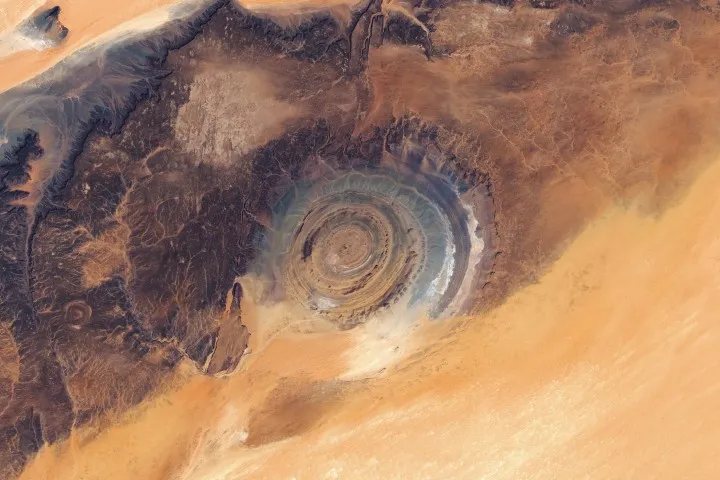
Imagine a geological feature so massive, so perfectly circular, that it looks like a bullseye drawn by a cosmic hand. And yet, if you were standing right in the middle of it, you'd have no idea it was there. That's the Richat Structure for you, a 25-mile-wide enigma in Mauritania, Africa, that's only truly visible from above.
Deep in the remote Adrar Plateau of northern Mauritania, where ancient human history — think Paleolithic tools and Neolithic cave paintings — meets a landscape sculpted by wind and water, lies this absolute showstopper. From the ground, it's just more desert. But from the vantage point of space? It's the Eye of the Sahara, staring right back at you.
French geographers first clocked it in the 1930s, rather charmingly calling it the Richat "buttonhole." But it wasn't until NASA astronauts Ed White and James McDivitt snapped photos during their Gemini IV mission that the rest of the world caught on. Suddenly, everyone wanted to know what this giant, concentric circle was.
We're a new kind of news feed.
Regular news is designed to drain you. We're a non-profit built to restore you. Every story we publish is scored for impact, progress, and hope.
Start Your News DetoxFor a while, scientists figured it had to be an impact crater. Because, let's be honest, that's what it looks like: a perfect target left by some ancient, colossal space rock. But the universe, as it often does, had a more terrestrial explanation.
Turns out, the Richat Structure is actually a deeply eroded geological dome. Picture this: molten rock pushed up from deep underground, lifting the surface like a giant bubble. Over eons, different rock types in that uplifted dome eroded at different rates. The tougher bits stayed, forming those distinct, circular ridges, or cuestas, that give the structure its eye-like appearance. The orange and gray hues? Those are just the different rock layers showing off their true colors.
So, it's not an alien landing site or a meteor's calling card. It's just geology, doing its magnificent, slow-burn thing, creating something so precise and striking that it demands a space-eye view. Which, if you think about it, is both impressive and slightly terrifying.