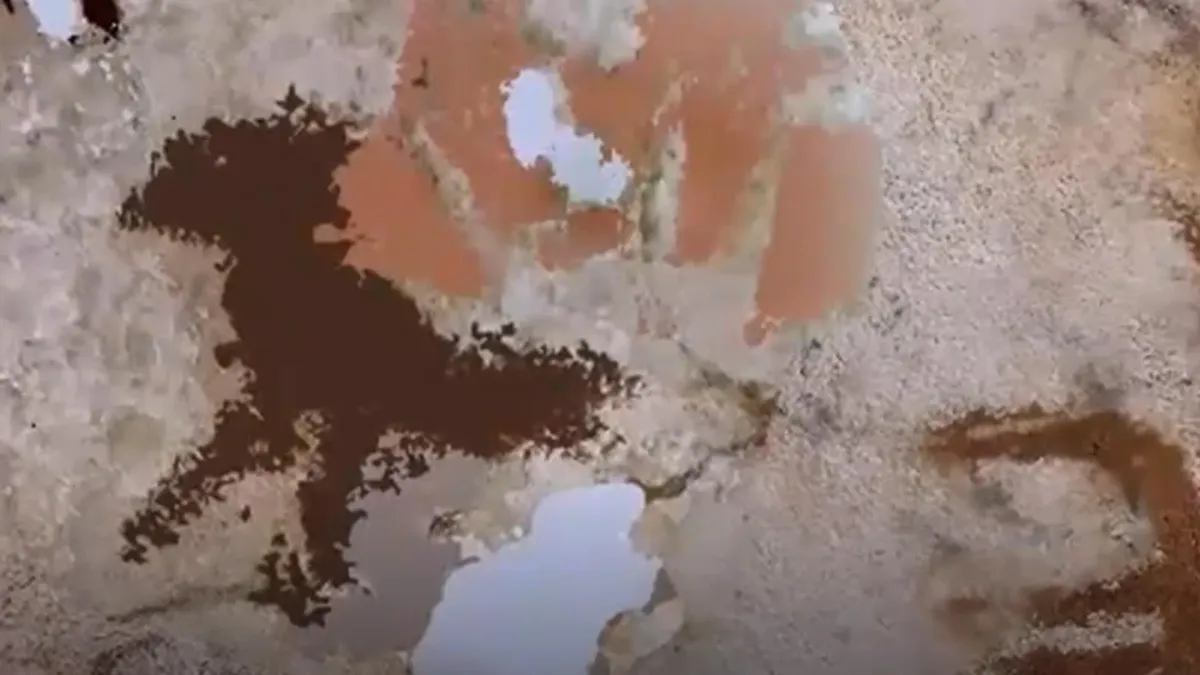
Get this: a handprint found in an Indonesian cave is now officially the oldest art ever discovered. It dates back at least 67,800 years. That's a mind-boggling 15,000 years earlier than we thought humans started making art.
An international team, with researchers from Griffith University and Southern Cross University, found these ancient paintings on the island of Sulawesi. The find also gives us a huge clue about when humans first made it to Australia. The artists were likely ancestors of Indigenous Australians.
Uncovering the Past
The artwork was hidden in limestone caves on Sulawesi's Muna island. Among much newer paintings, scientists spotted a partial hand stencil. To figure out its age, they used a clever trick called uranium-series dating. They looked at tiny mineral layers that built up over and under the art in Liang Metanduno cave. This method helped them pinpoint the exact time the paintings were made.
We're a new kind of news feed.
Regular news is designed to drain you. We're a non-profit built to restore you. Every story we publish is scored for impact, progress, and hope.
Start Your News DetoxThis hand stencil is at least 67,800 years old. That makes it the oldest reliably dated cave art on Earth. It's even older than another Sulawesi painting the same team found just last year. Seriously cool, right? The research also showed that people kept creating art in this cave for a very long time—at least 35,000 years, up until about 20,000 years ago.
Professor Maxime Aubert, an archaeologist from Griffith University, said Sulawesi had one of the world's richest and longest-lasting artistic cultures. He noted its origins go back to the earliest human presence on the island, at least 67,800 years ago.
The Claw Handprint
This isn't just any hand stencil. It's a unique take on a common art style. The image looks like it was changed after it was first made. The finger outlines were narrowed, making the hand look almost like a claw. Professor Adam Brumm of Griffith University said they're not sure why the change was made.
He suggested this art might show a strong connection between humans and animals. Early Sulawesi art often features figures that look like part-human, part-animal beings. This new discovery adds another layer to that mystery.
Tracing Ancient Journeys
Dr. Adhi Agus Oktaviana, a rock art specialist, said this find is key to understanding the history of Australian Aboriginal culture. He believes the people who made these paintings in Sulawesi were part of the larger group that later spread through the region and eventually reached Australia.
For years, experts have argued about when humans first arrived in Sahul. That's the ancient landmass that once connected Australia, Tasmania, and New Guinea. Some thought it was around 50,000 years ago, others pushed it back to at least 65,000 years ago. Dr. Oktaviana said this new discovery strongly supports the idea that the ancestors of the First Australians were in Sahul by 65,000 years ago. That's a big deal for understanding human migration.
Scientists have suggested two main paths into Sahul. One is a northern route through Sulawesi and the 'Spice Islands' toward New Guinea. The other is a southern route directly to Australia via Timor or nearby islands. Professor Renaud Joannes-Boyau of Southern Cross University said this new evidence points to the northern route. He noted that this ancient rock art in Sulawesi is the oldest direct proof of modern humans along this northern path into Sahul. Pretty nuts, right?
Professor Aubert and his team are still working to find more evidence of early human activity along this route. It's all part of a bigger effort to study where we came from and protect these incredible pieces of our shared past.