When the first animals crawled onto land hundreds of millions of years ago, they were meat-eaters. Plants had already blanketed the landscape, but no vertebrate had figured out how to digest them yet. A 307-million-year-old fossil just changed that story.
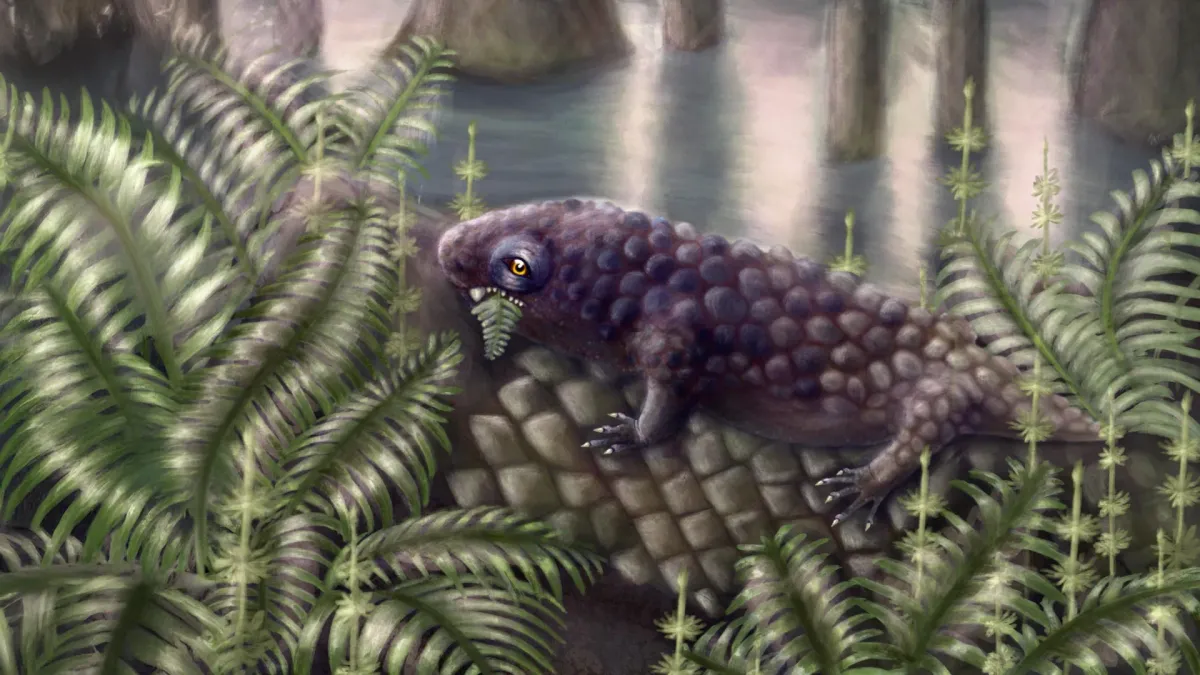
Scientists have discovered Tyrannoroter heberti, one of the earliest known land vertebrates to eat plants. The creature was stocky and football-sized, with a skull packed with specialized teeth designed for crushing and grinding vegetation. It's a reminder that evolution doesn't follow a single script—dietary experimentation happened earlier and more widely than we thought.
A Mouth Built for Plants
Tyrannoroter heberti means "Hebert's tyrant digger," and the animal lived before reptiles and mammals branched into separate evolutionary paths. It wasn't quite either—it was a stem amniote, a close relative of the group that would eventually give rise to both. The fossil skull was found on Cape Breton Island in Nova Scotia, a challenging dig site with high tides and rocky cliffs that make paleontology feel less like lab work and more like an expedition.
We're a new kind of news feed.
Regular news is designed to drain you. We're a non-profit built to restore you. Every story we publish is scored for impact, progress, and hope.
Start Your News DetoxCT scans revealed the key innovation: a mouth "jam-packed with a whole additional set of teeth for crushing and grinding food, like plants." This wasn't a creature that stumbled into herbivory by accident. It had evolved specialized equipment for the job.
Tyrannoroter likely didn't eat plants exclusively. Insects and small prey probably made up part of its diet too. But here's the interesting bit: those plant-fed insects could have carried gut microbes that actually helped Tyrannoroter digest vegetation more efficiently. Evolution often works through these kinds of shortcuts—borrowing solutions from other organisms before developing your own.
Timing Matters
The timing of this discovery adds another layer. Tyrannoroter lived near the end of the Carboniferous Period, roughly 307 million years ago, during a time of major climate upheaval. The planet was transitioning from an icehouse to a greenhouse—the last such shift before the one happening today. It's a period when ecosystems were being remade, and animals had to adapt or disappear.
The lineage Tyrannoroter belonged to didn't survive that transition. But the fact that it experimented with plant-eating at all suggests something important: when the world changes, animals don't just cling to old strategies. Some try new ones. Some succeed, some don't. Understanding how Tyrannoroter responded to its era of rapid change might tell us something about how modern animals could respond to ours.
Study: Carboniferous recumbirostran elucidates the origins of terrestrial herbivory - Nature Ecology, 2026