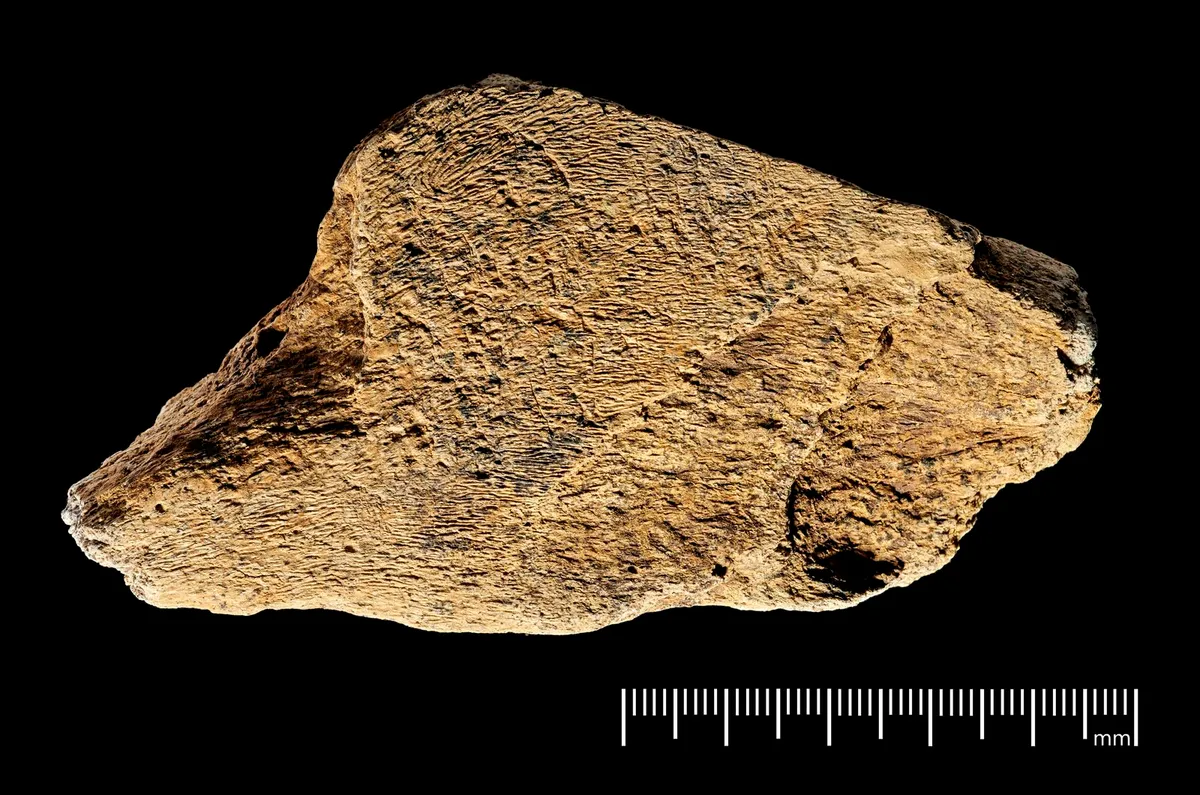
A four-inch fragment of bone, overlooked in a London museum for decades, has just become evidence of something remarkable: our ancestors were far more deliberate craftspeople than we realized.
Archaeologists found the piece in southern England in the mid-1990s at Boxgrove, a site about 60 miles south of London. It sat in the Natural History Museum's collection until recently, when researchers decided to examine it more closely with an electron microscope. What they discovered changed everything.
The bone is covered in deliberate marks—pits, scores, and slices—with tiny flint fragments embedded in some of them. This wasn't a random artifact. It was a tool, carefully shaped and used repeatedly over time. The researchers, publishing their findings in Science Advances in January, argue it's a 480,000-year-old hammer, likely made by Neanderthals or Homo heidelbergensis. If they're right, it's the oldest known tool of its kind ever found in Europe.
We're a new kind of news feed.
Regular news is designed to drain you. We're a non-profit built to restore you. Every story we publish is scored for impact, progress, and hope.
Start Your News DetoxWhat makes this hammer different
This wasn't a crude bludgeon. Researchers believe it's what's called a "soft hammer"—made from bone or antler rather than stone—used for a precise task called knapping. That's the process of striking stone edges to detach flakes and sharpen them. The marks on this particular hammer suggest it was a "retoucher," used for finer work: refining the cutting edges of stone tools used at butchery sites.
"Using soft hammers instead of hard stone ones gave early humans much better control," explains Silvia Bello, a researcher at the Natural History Museum and co-author of the study. "They could produce more finely shaped, efficient tools." That level of precision suggests something deeper: abstract thinking. Someone had to imagine the task, select the right material, shape it deliberately, and use it with care.
What makes the discovery even more striking is where the bone came from. Straight-tusked elephants were rare in southern England 480,000 years ago—they roamed farther south and east across Europe. Finding elephant bone at this site means someone traveled to get it, or traded for it, recognizing its value. No other elephant remains turned up at Boxgrove, which suggests this single piece was precious enough to bring in from elsewhere and shape into a tool.
"Our ancestors were resourceful gatherers and savvy about how to use what they found," Bello says. They didn't just use whatever was at hand. They sought out specific materials and understood their properties.
A handful of older elephant bone tools have been found elsewhere in Europe—dating back roughly 450,000 years—but they're concentrated farther south where elephants were common. Africa holds much older examples, including 1.5 million-year-old specimens recently discovered in Tanzania. But this hammer from Boxgrove, refined and purposeful, sits at a crucial moment in human history: the point where our ancestors were no longer just making tools, but thinking about how to make them better.