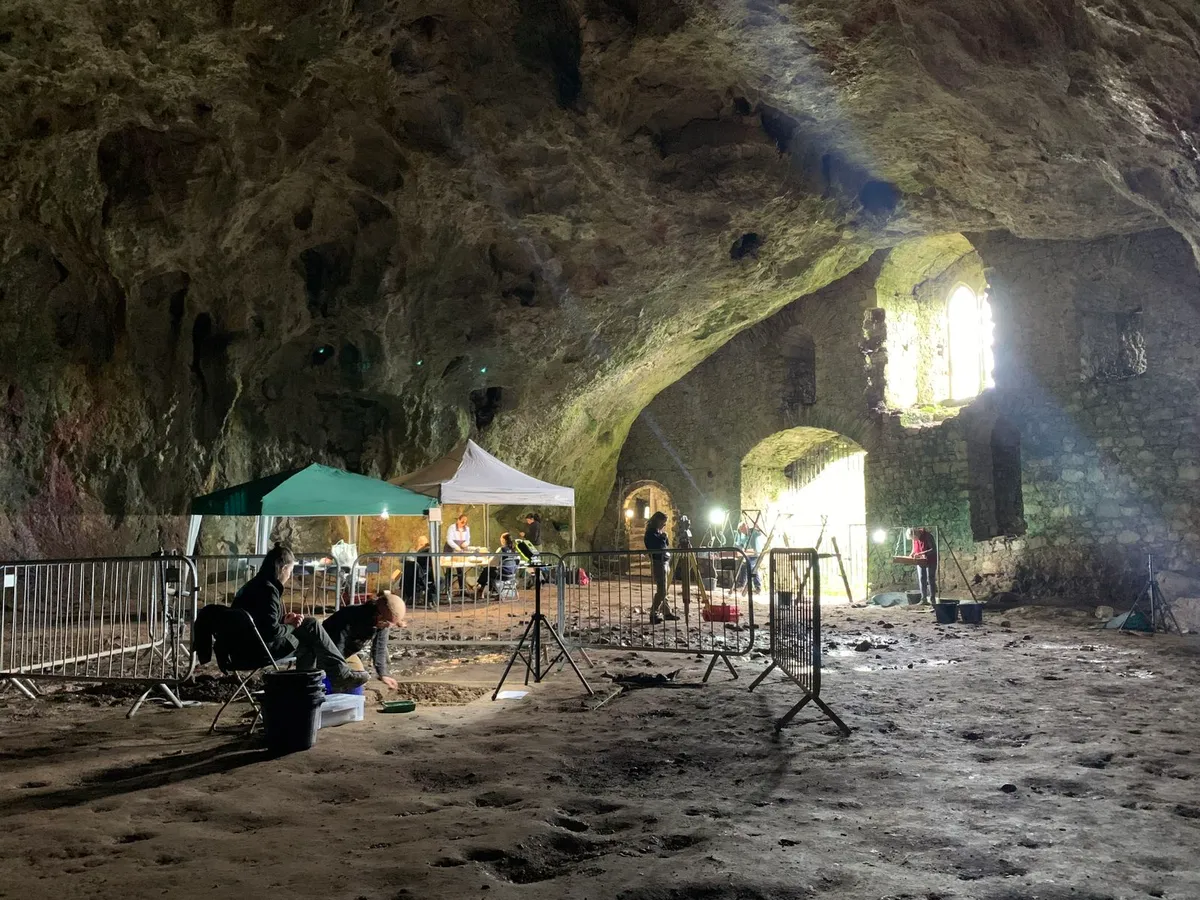
Beneath an 11th-century castle in Wales, archaeologists have found a treasure trove of prehistoric artifacts and animal bones. These discoveries could reveal new information about early inhabitants of Britain.
The finds were made under Pembroke Castle, famous as the birthplace of Henry VII. Researchers knew about a large cave called Wogan Cavern beneath the castle. They thought most archaeological evidence had been removed long ago due to the castle's long history.
However, small digs between 2021 and 2024 showed the cavern is mostly untouched. It still holds many discoveries.
We're a new kind of news feed.
Regular news is designed to drain you. We're a non-profit built to restore you. Every story we publish is scored for impact, progress, and hope.
Start Your News DetoxUncovering Ancient Life
During these first excavations, researchers found signs of animal use from tens of thousands of years ago. They uncovered fossilized remains of mammoths, woolly rhinoceroses, reindeer, and wild horses. Hippopotamus bones were also found, likely from about 120,000 years ago during the last interglacial period.
The work also revealed stone tools and other evidence of human presence. This includes hunter-gatherers from about 11,500 years ago and early Homo sapiens from about 35,000 to 45,000 years ago. There might even be signs of earlier visits by Neanderthals.

Now, a five-year excavation project will begin at the end of May. Archaeologists from the University of Aberdeen in Scotland will lead it, with support from the Calleva Foundation and Pembroke Castle Trust.
Archaeologists hope the site will offer many insights. These include information about past climate change, extinct species, and human lifestyles over thousands of years. This is due to the variety of finds and their good condition.
Kate Britton, an archaeologist at the University of Aberdeen, noted that they can learn a lot about past environments. She added that ancient DNA is preserved in both bones and cave sediments.
Solving Prehistoric Mysteries
Many questions researchers want to answer involve early Homo sapiens and Neanderthals in Britain. They want to know if the two species lived together, interacted, or even interbred. They also seek to understand why Neanderthals disappeared around 45,000 years ago in Britain. They wonder what role Homo sapiens might have played.

Chris Stringer, a paleoanthropologist, believes the site has great potential. He told the Guardian that it is the best chance to find new material. This material could help understand how Neanderthals lived in Britain and how Homo sapiens replaced them.
At other British sites, like Kents Cavern, answering these questions has been hard. This is because Victorian and Edwardian archaeologists often removed all sediment and materials.
Rob Dinnis, an archaeologist leading the project, explained that understanding the transition from Neanderthals to Homo sapiens in this part of Europe is poor. He told the Guardian that this is partly because the best sites were stripped over a century ago.

Wogan Cavern, however, should help correct this. The cave was used as a storeroom in the Middle Ages. Its entrance was walled off in the early 13th century. This left its floor and the layers of sediment below mostly untouched. Today, a spiral staircase from the castle provides access.
Future plans include housing the finds from Wogan Cavern at Pembroke Castle. This will add more historical layers to the site. Jon Williams, general manager of Pembroke Castle, told BBC News that if people could visit Pembroke and also go back to the Stone Age, it would be very interesting and attract more tourists.