Apparently, pollution isn't just bad for the planet; it's also a surprisingly decent energy source. At least, that's what scientists in South Korea just discovered with their new "gas battery" that eats greenhouse gases and spits out usable electricity.
Meet the Gas Capture and Electricity Generator (GCEG), a rather unassuming device cooked up by a team at Sungkyunkwan University (SKKU) in Seoul. While traditional carbon capture systems guzzle energy to trap pollutants, this GCEG flips the script. It converts the energy released when gases are absorbed directly into electrical power. Which, if you think about it, is both impressive and slightly terrifying that we didn't figure this out sooner.
Ji-Soo Jang, a renewable energy expert and assistant professor at SKKU, spearheaded this delightful bit of scientific alchemy. Collaborators from Ajou University and Chungbuk National University also joined the party, because apparently, making pollution pay its own way is a team sport.
We're a new kind of news feed.
Regular news is designed to drain you. We're a non-profit built to restore you. Every story we publish is scored for impact, progress, and hope.
Start Your News DetoxGlobally, we're currently clocking in at around 58.6 gigatons of CO2 equivalent emissions in 2024 (and that's without counting land-use changes and forestry, which is a whole other can of worms). China, the US, and India are the usual suspects at the top of the list. So, tackling both the emission problem and the energy problem simultaneously? That's the kind of elegant solution that makes accountants (and the planet) very happy.
The Korean team's secret sauce involves carbon-based electrodes and some clever hydrogel materials. When gases like carbon dioxide (CO2) or nitrogen oxides (NOx) decide to get cozy with the system, they stick to the electrode surface. This triggers a series of tiny reactions inside the device, shuffling charges and ions around until, voila, you've got a steady flow of direct current (DC) electricity.
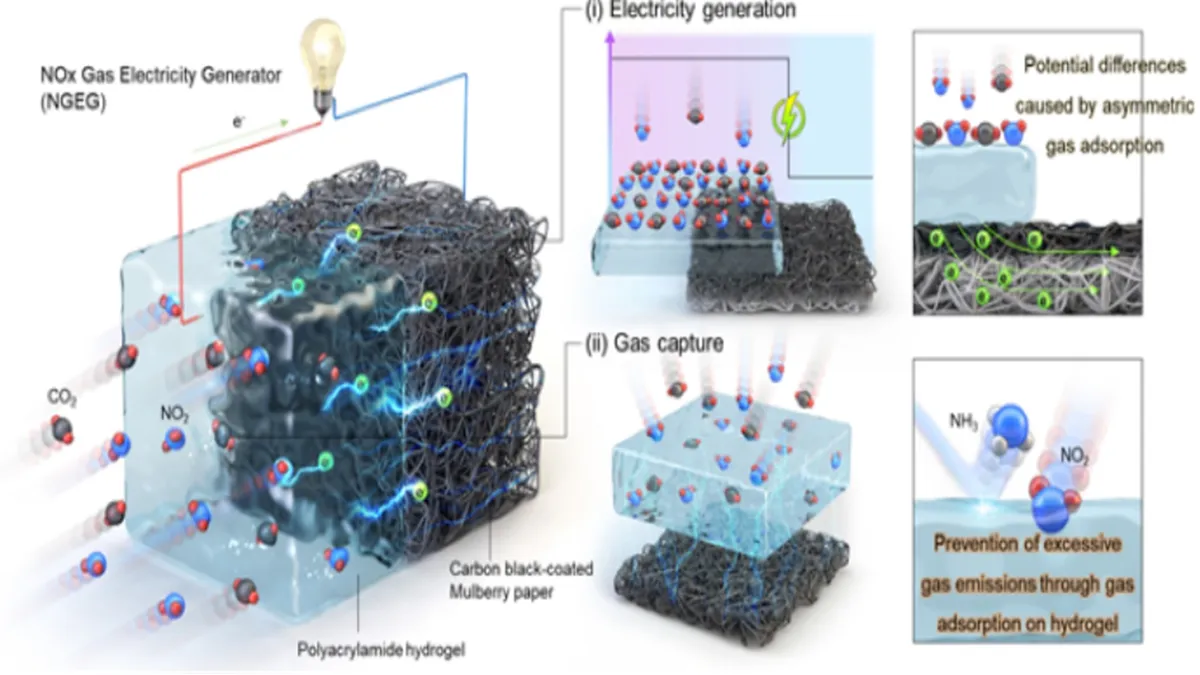
The best part? It does all this without needing any outside energy sources. Jang put it rather succinctly: greenhouse gases aren't just pollutants; they can also be a new energy source. Let that sink in.
Beyond the Lab
Researchers are convinced this battery isn't just a lab curiosity. Because it's self-powered, it could open the door to a whole new generation of self-sufficient tech. Imagine air quality sensors that never need a battery change, or Internet of Things (IoT) devices humming along in remote areas without a power grid in sight.
Industrial facilities, the usual suspects for massive emissions, could use this to both clean up their act and generate a bit of free power from their exhaust. It's like turning industrial burps into clean energy. Which, honestly, sounds like something out of a sci-fi novel.
The team's conclusion is pretty straightforward: atmospheric pollutants act as "fuel" for electricity. It's a scalable, low-energy approach to reducing a whole host of greenhouse gases, integrating capture and generation into one neat, self-powered package. Carbon neutrality, here we come, possibly with a side of free electricity.