A lipstick vine in Taiwan is forcing botanists to reconsider a model they've trusted for 50 years. The plant evolved its unusual flowers—short, wide, greenish-yellow—in a place where they shouldn't have been advantageous. It's the kind of discovery that only happens when someone actually goes outside and looks.
Most lipstick vines are easy to recognize. They're long, trailing plants with crimson tubular flowers that practically advertise themselves to long-beaked sunbirds across Southeast Asia. The sunbirds visit, drink nectar, and inadvertently move pollen between plants. It's a neat evolutionary bargain, refined over millennia.
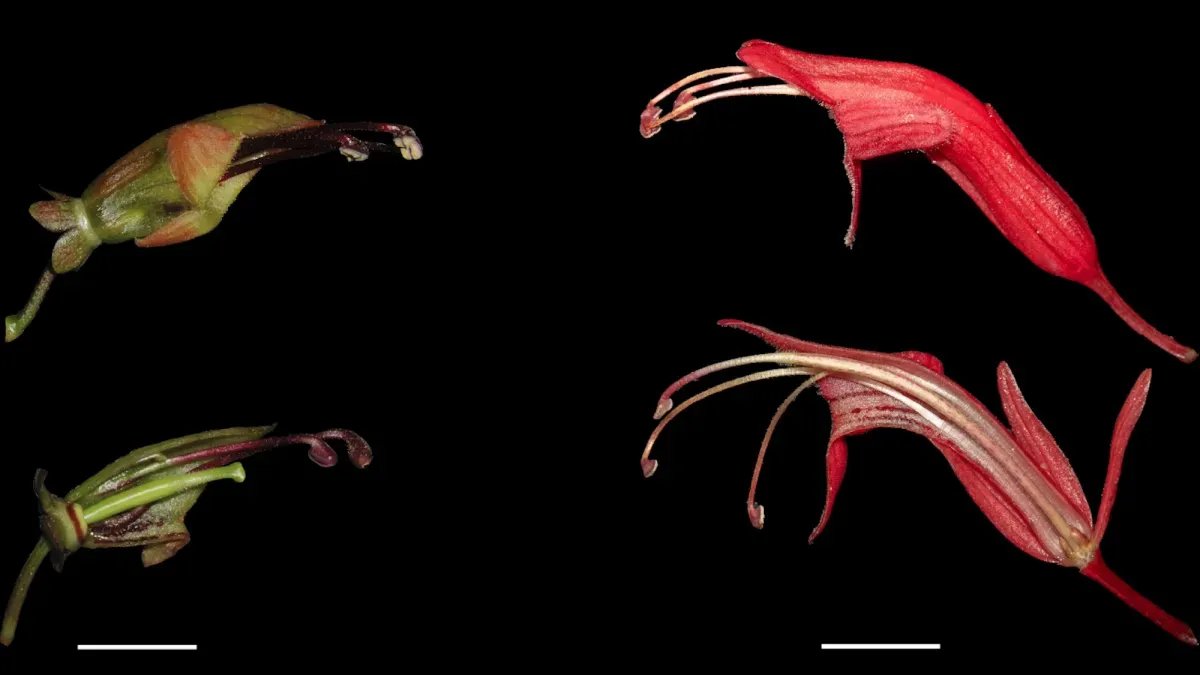
Then there's Aeschynanthus acuminatus in Taiwan. "Compared to the rest of its genus, this species has weird, unique flowers," says Jing-Yi Lu, a botanist at the Field Museum in Chicago. Instead of the classic red tubes, A. acuminatus has short, wide flowers with a greenish-yellow tint—flowers that look almost designed for Taiwan's shorter-beaked birds. The problem: sunbirds don't live in Taiwan.
We're a new kind of news feed.
Regular news is designed to drain you. We're a non-profit built to restore you. Every story we publish is scored for impact, progress, and hope.
Start Your News DetoxThe model that didn't fit
For over 50 years, botanists have relied on the Grant-Stebbins model to explain how new plant species arise. The logic is straightforward: plants migrate to a new region, encounter different pollinators, and evolve new flowers to match. Repeat this enough times and you get biodiversity.
By that model, A. acuminatus should have originated in Taiwan, evolving its stubby flowers specifically to suit the island's short-beaked birds. But when Lu and his colleagues sequenced DNA from lipstick vines across mainland Asia and Taiwan, the family trees told a different story.
The Taiwanese plants descended from mainland relatives—which means the unusual flowers evolved before the plant ever reached Taiwan. They evolved in a place where long-beaked sunbirds were plentiful and seemingly ideal pollinators. "The branching patterns revealed that the A. acuminatus plants on Taiwan descended from other A. acuminatus plants from the mainland," explains Rick Ree, Lu's coauthor and curator of the Field Museum's Negaunee Integrative Research Center.
So why would a plant abandon a perfectly good pollinator partnership? Ree's hypothesis: something changed on the mainland. "At some point in the past, sunbirds stopped being optimal or sufficient pollinators for some of the plants," he says. Maybe sunbird populations declined. Maybe competition for nectar intensified. Maybe the plant's flowers simply drifted genetically in a direction that made them less attractive to sunbirds but more useful to generalist birds with shorter beaks. Natural selection, working on a problem we can only guess at, favored the transition.
What makes this discovery meaningful isn't just that one model needs tweaking. It's the reminder that evolution doesn't follow a script. Plants don't always adapt to their environment in the way we'd predict. Sometimes they evolve first, then find the environment they fit into. Sometimes the answer is messier than our frameworks suggest.
"This study shows the importance of natural history, of actually going out into nature and observing ecological interactions," Ree says. Lu spent time in the field, watching how these flowers actually interact with birds, before the DNA work began. That human observation—the kind that can't be automated or accelerated—turned out to be irreplaceable.
The Grant-Stebbins model isn't wrong, exactly. It's just incomplete. And A. acuminatus is proof that evolution still has surprises for botanists willing to look.