Researchers have found a way to engineer new materials that's gentler, faster, and far more practical than the laser-heavy methods that came before. Instead of blasting semiconductors with high-intensity light, an international team co-led by the Okinawa Institute of Science and Technology and Stanford University discovered that particles called excitons—created from the material's own electrons—can reshape how materials behave at the quantum level with far less energy and damage.
The work, published in Nature Physics, centers on a principle called Floquet engineering: the idea that when a system experiences a repeating force, its behavior becomes more complex and controllable than the pattern itself. In quantum materials, this opens a door to designing custom properties on demand.
How the old way worked—and why it wasn't enough
Until now, researchers have used light to drive Floquet effects. Shine a laser at just the right frequency on a crystal, and you can shift the energy bands that electrons are allowed to occupy. Tune it carefully, and you create hybrid bands that fundamentally alter how electrons move and interact. Theoretically elegant. Practically brutal.
We're a new kind of news feed.
Regular news is designed to drain you. We're a non-profit built to restore you. Every story we publish is scored for impact, progress, and hope.
Start Your News DetoxThe problem: light couples weakly to matter. To achieve the effect, you need femtosecond-scale pulses—incredibly short, incredibly intense bursts that tend to vaporize the material. The effects last microseconds at best. And it takes tens of hours of experimentation to observe the results clearly.
Then excitons changed the equation.
Why excitons work better
When an electron in a semiconductor absorbs energy, it jumps to a higher energy level, leaving behind a positively charged "hole." The electron and hole attract each other—they're bound together as an exciton. Because excitons are made from the material's own electrons, not external photons, they interact far more strongly with the surrounding structure.
"Excitons couple much more strongly to the material than photons due to the strong Coulomb interaction," says Professor Keshav Dani from OIST's Femtosecond Spectroscopy Unit. "And they can achieve strong Floquet effects while avoiding the challenges posed by light."
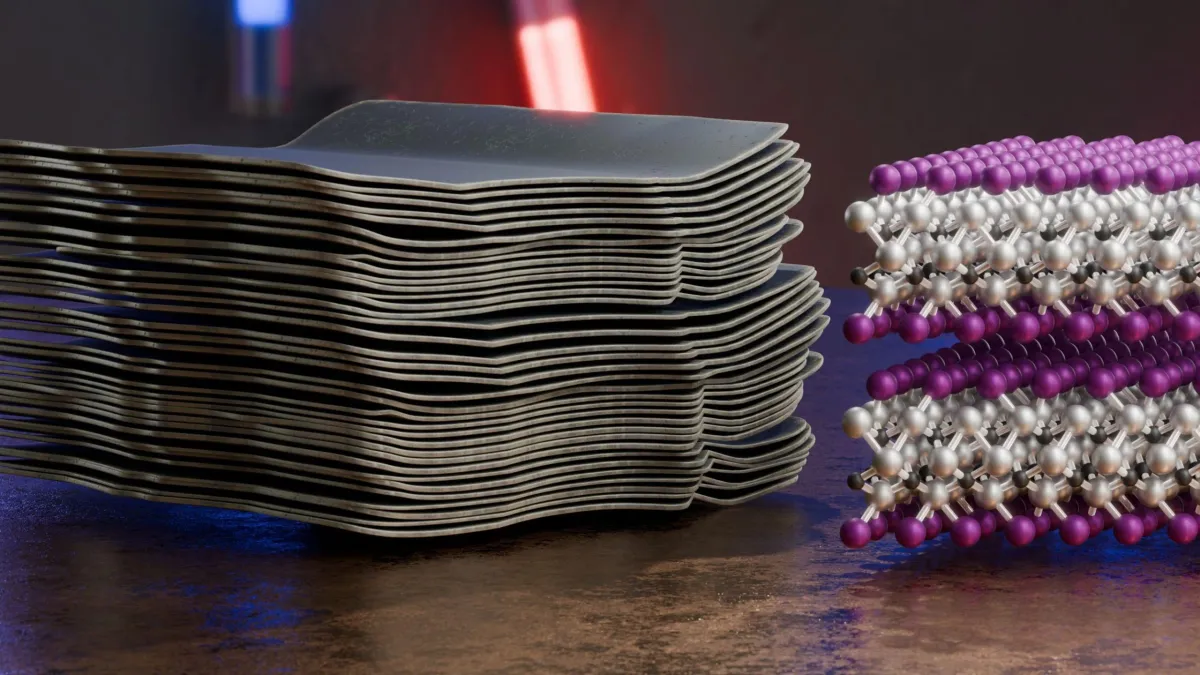
The practical difference is striking. The research team studied an atomically thin semiconductor, first confirming traditional light-driven Floquet effects, then reducing the light intensity by more than tenfold and measuring the electronic response 200 femtoseconds later. This isolated the exciton effects.
The results were unambiguous. Where light-based methods required tens of hours of data collection to observe Floquet effects, excitons achieved the same—and stronger—results in around two hours. Lower energy. Faster observation. Less damage to the material.
"The experiments spoke for themselves," says Dr. Vivek Pareek, a graduate researcher now at Caltech. "It took us tens of hours with light, but only around two to achieve excitonic Floquet – and with a much stronger effect."
What comes next
This isn't just a refinement of an existing technique. The team has shown that Floquet effects aren't limited to light at all—they can be driven by other types of particles beyond photons. That opens a broader toolkit for controlling quantum materials, moving Floquet engineering from a theoretical promise toward practical application. The next phase is obvious: using this method to actually design and build the exotic quantum devices researchers have long theorized about.