Electrons aren't supposed to work this way. In a material made of cerium, ruthenium, and tin, they stop behaving like particles altogether — no fixed position, no single speed, no classical description that should work. Yet instead of collapsing into chaos, the material reveals an entirely new form of quantum structure that physicists didn't think was possible.
For decades, the particle picture has held up remarkably well. When electricity flows through metal, we imagine electrons as tiny objects being pushed and redirected by electromagnetic forces. It's a simplification, but it works even in complex materials where electrons interact strongly with each other. The problem is that this picture assumes electrons have well-defined energies and velocities — a foundation that most modern quantum theories still rely on.
But there are extreme situations where this breaks down completely. At temperatures near absolute zero, certain materials enter a quantum-critical state where they fluctuate between two different configurations, as if unable to commit. The material studied by researchers at TU Wien (Technische Universität Wien) does exactly this. In that fluctuating regime, the particle picture should lose all meaning.
We're a new kind of news feed.
Regular news is designed to drain you. We're a non-profit built to restore you. Every story we publish is scored for impact, progress, and hope.
Start Your News Detox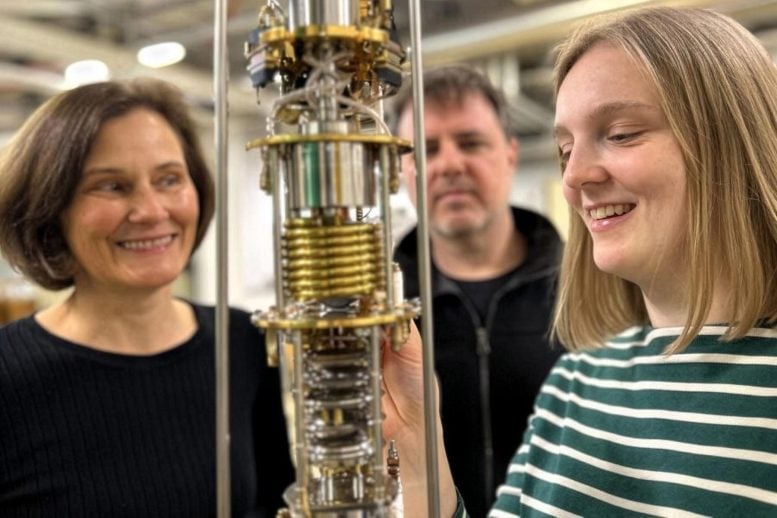
Topology without particles
Here's where it gets interesting. Topology is a mathematical concept that describes geometric properties so fundamental they survive continuous deformation. A donut and an apple are topologically equivalent — you can reshape one into the other. But a donut and a sphere are topologically different because the donut's hole cannot be created by stretching or bending. Physicists use similar ideas to describe states of matter, and these topological properties are remarkably robust — small defects can't destroy them, just as you can't turn a donut into a sphere with minor changes.
Theories predict that the cerium-ruthenium-tin material should exhibit topological properties. But there's a catch: those theories were built on the assumption that electrons behave like particles. In a material where electrons lose their particle-like character, topology shouldn't exist at all. This created a direct contradiction.
Curiosity won out over skepticism. Diana Kirschbaum, the first author of the study, began searching for experimental evidence anyway. At temperatures less than one degree above absolute zero, she found something striking: an anomalous Hall effect. Normally, a magnetic field deflects moving charge carriers. But here, deflection appeared without any external field — and the charge carriers behaved as if they were particles, despite all evidence suggesting they shouldn't.
"This was the key insight that allowed us to demonstrate beyond doubt that the prevailing view must be revised," says Silke Bühler-Paschen, who led the research team.
The effect was strongest precisely where the material's quantum fluctuations were largest. When those fluctuations were suppressed using pressure or magnetic fields, the topological properties disappeared. The researchers call this newly identified phase an emergent topological semimetal — and the name captures something crucial: the topology emerges from the absence of a particle picture, not from it.
Working with Rice University, the team developed a theoretical model that connects quantum criticality with topology in a more abstract, mathematical way. The implication is profound: a particle picture isn't required to generate topological properties at all. The concept can be generalized far beyond what physicists thought possible.
This opens a practical pathway forward. Quantum-critical behavior appears across many classes of materials and can be reliably identified. If topological properties genuinely emerge from quantum criticality, then searching for new topological materials becomes much more systematic — and many more "emergent" topological materials may be waiting to be discovered.