Three billion years ago, Mars may have been half blue.
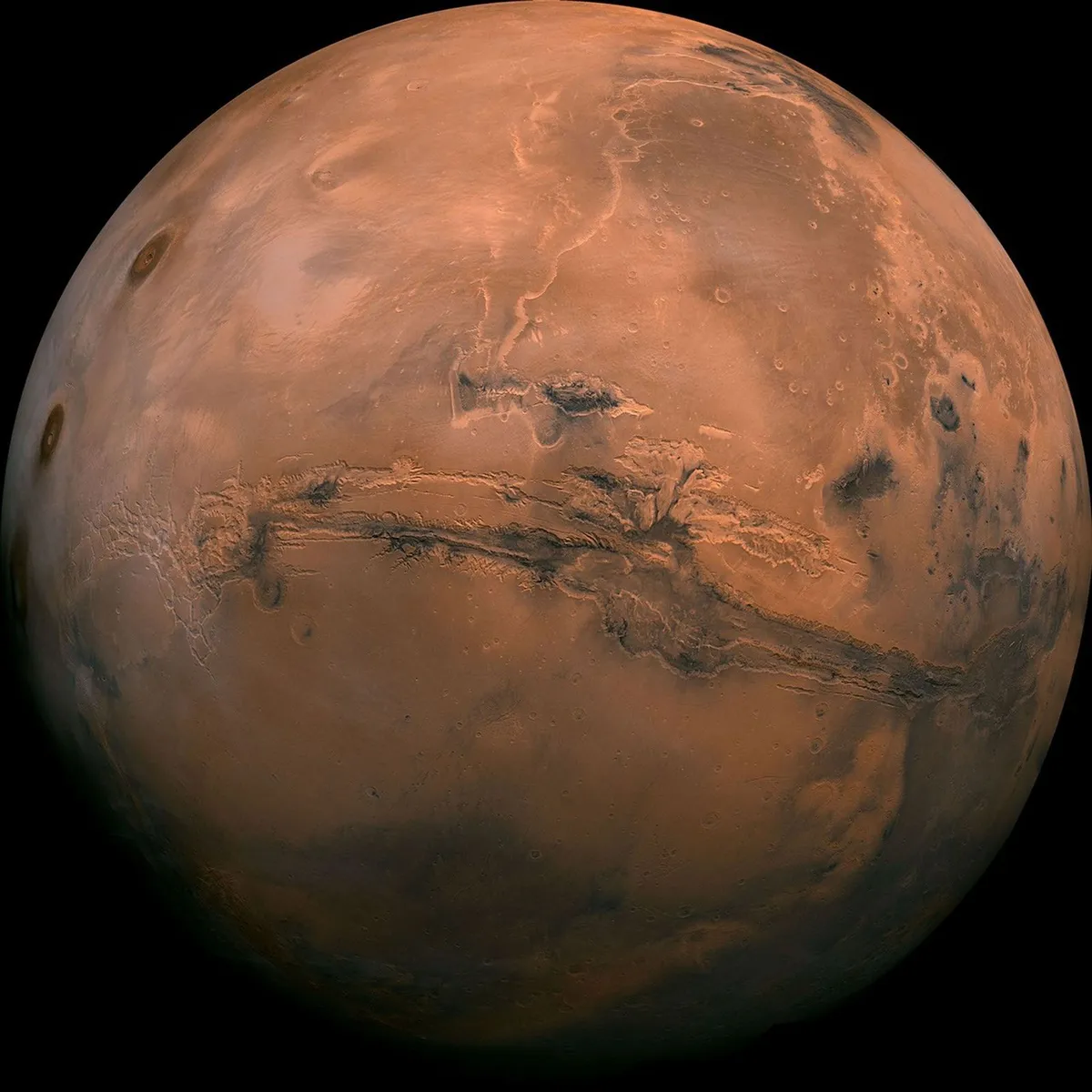
Scientists studying data from multiple space probes—the European Space Agency's ExoMars Trace Gas Orbiter and Mars Express, plus NASA's Mars Reconnaissance Orbiter—have found evidence that a sea the size of Earth's Arctic Ocean covered part of the Red Planet around 3.37 billion years ago. The discovery comes from a careful study of one of Mars's most dramatic features: the Valles Marineris, a 2,500-mile-long canyon system that stretches along the Martian equator.
The researchers focused on a particular 600-mile trough called Coprates Chasma, where they spotted something familiar. The geologic formations there resemble Earth's fan deltas—cone-shaped structures that form where rivers meet standing water and deposit sand and debris. "Delta structures develop where rivers debouch into oceans, as we know from numerous examples on Earth," explains Fritz Schlunegger, a geologist at the University of Bern and co-author of the study published in npj Space Exploration.
NASA / JPL-Caltech
What made this evidence so compelling was the elevation. The deposits were all mapped at roughly the same depth—about 12,000 feet below the surrounding terrain. That consistency allowed the team to trace an ancient shoreline, suggesting a vast body of water once existed across Mars's northern hemisphere.
We're a new kind of news feed.
Regular news is designed to drain you. We're a non-profit built to restore you. Every story we publish is scored for impact, progress, and hope.
Start Your News DetoxThis isn't the first time scientists have proposed oceans on Mars, but previous work relied heavily on indirect evidence. "Our reconstruction of the sea level, on the other hand, is based on clear evidence for such a coastline, as we were able to use high-resolution images," Schlunegger says. The difference matters: high-resolution satellite imagery provided direct visual confirmation rather than inference.
For the search for extraterrestrial life, this finding carries weight. A planet with an ocean—with liquid water persisting across vast regions—had the basic ingredients for life to emerge. Yet the discovery also carries a quieter message. "This finding shows that water is precious on a planet and could possibly disappear at some point," notes Ignatius Argadestya, another planetary geologist at the University of Bern. Mars once had the conditions we associate with habitability. Then it lost them. Understanding how and why that happened could reshape how we think about planetary change.
What comes next
The search for evidence of ancient Martian life continues. Last year, NASA's Perseverance rover detected spots on rocks that resemble the chemistry and appearance of microbial markings found on Earth—a tantalizing hint of what might have lived in those ancient seas. Confirming whether those marks were actually made by life will require bringing samples back to Earth, though NASA's Mars Sample Return program was recently canceled, pushing that confirmation further into the future.