4,400 light-years away, a dying star is putting on a show that has captivated astronomers for 160 years. The Cat's Eye Nebula—NGC 6543 in the constellation Draco—is what's left when a star like our Sun reaches the end of its life and sheds its outer layers into space. What makes it remarkable isn't just that it's beautiful. It's that it's a fossil record written in gas, a visual timeline of how a star dies.
When early astronomers first looked at this nebula through telescopes in the 1800s, they thought they were seeing planets. Round, glowing, distant. It wasn't until 1864 that spectroscopy revealed the truth: these weren't solid objects at all, but expanding clouds of gas ejected by dying stars. The discovery rewrote our understanding of stellar evolution.
For decades, the Cat's Eye remained something of a cosmic mystery. Ground-based telescopes could see it was intricate, but the full complexity stayed hidden. Then, in 1995, the Hubble Space Telescope changed everything. When Hubble's images came back, astronomers saw structures they'd never imagined—concentric shells, jets of gas moving at thousands of kilometers per second, dense knots sculpted by shock waves. What looked simple from Earth was actually a masterpiece of cosmic violence and precision.
We're a new kind of news feed.
Regular news is designed to drain you. We're a non-profit built to restore you. Every story we publish is scored for impact, progress, and hope.
Start Your News DetoxNow, two telescopes are looking at NGC 6543 together, and the combination reveals something neither could show alone.
The Power of Two Perspectives
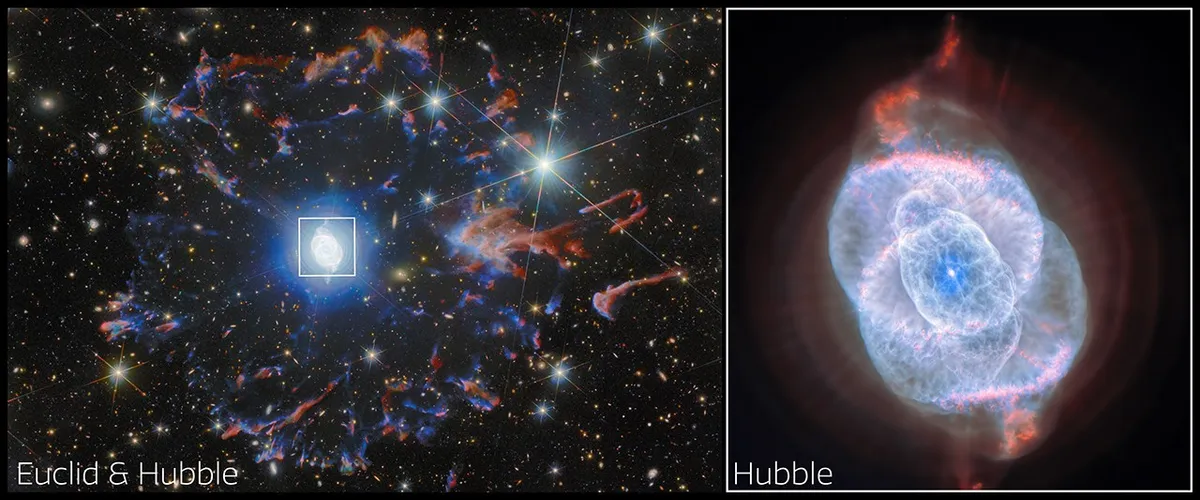
Hubble, the veteran observer, zooms in on the nebula's core with extraordinary detail, capturing the intricate dance of gas shells and high-speed jets. But Euclid, the European Space Agency's newer telescope, was designed for a different job—mapping the distant universe to understand dark energy and the cosmos's largest structures. When Euclid turned its wide field of view toward the Cat's Eye as part of routine observations, it captured something unexpected: the nebula's outer halo, the gas ejected during an earlier stage of the star's death, all set against a backdrop of distant galaxies.
Together, they tell a complete story. Hubble shows you the detail. Euclid shows you the context. The outer ring of gas was ejected first, long before the central nebula formed. The inner structures—those intricate shells and jets—came later, during more recent episodes of mass loss. Each layer, each filament, each knot represents a moment in the star's final years. It's like reading the rings of a tree, except this tree is made of light and the rings span thousands of years.
What's striking about this collaboration is how it mirrors a broader shift in astronomy. For decades, we've built increasingly specialized telescopes—Hubble for detail, Euclid for surveys, others for different wavelengths or distances. But the real breakthroughs often come when we combine them, when we let focused precision and wide-field context speak to each other. One telescope sees the brushstrokes. The other sees the frame and the wall it hangs on.
The Cat's Eye Nebula will keep expanding for millennia. The star at its center has already died; what we're seeing is the echo, the ghost of its final moments. But through Hubble and Euclid, we're reading that ghost more clearly than ever—understanding not just what happens when stars die, but how the universe recycles itself, turning one star's ending into the raw material for new worlds.