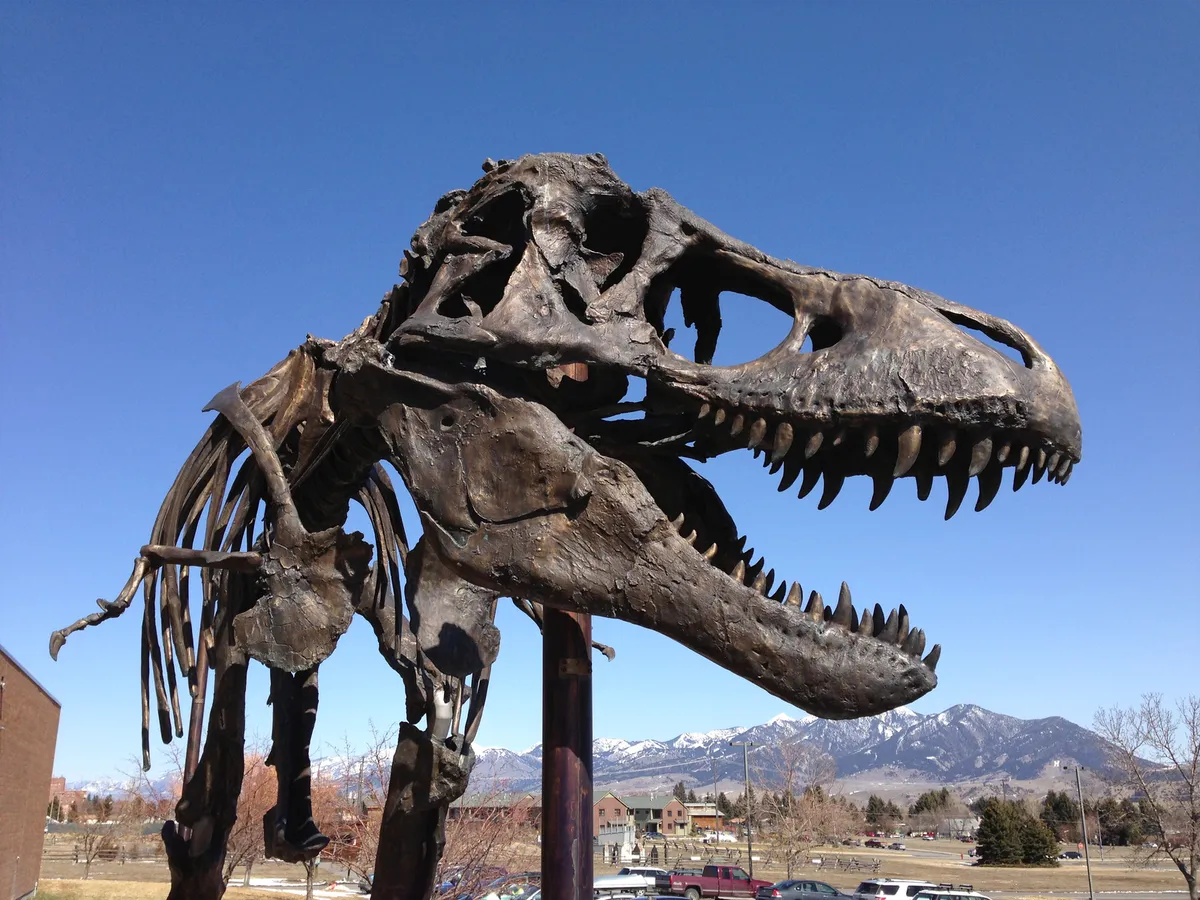
Tyrannosaurus rex spent most of its life as a mid-sized predator, not the towering apex hunter we imagine. A new analysis of 17 fossil leg bones suggests these dinosaurs didn't reach full maturity until around age 40—roughly double what scientists thought just two decades ago.
The shift matters because it rewrites what we thought we knew about one of Earth's most famous creatures. For the first 30-odd years of a T. rex's life, it would have been smaller, less dominant, probably scrapping for food alongside other predators rather than ruling the Late Cretaceous landscape unchallenged.
How scientists counted 40 years in stone
Researchers at Oklahoma State University and elsewhere examined growth rings in fossilized thigh and shin bones—essentially dinosaur tree rings that form year by year. The trick was looking closely enough. Previous studies, conducted in the early 2000s with fewer specimens, had missed narrow growth rings bunched together at the edges of the bones. Using polarized-light microscopy and a larger sample size, the team spotted rings they hadn't seen before.
We're a new kind of news feed.
Regular news is designed to drain you. We're a non-profit built to restore you. Every story we publish is scored for impact, progress, and hope.
Start Your News DetoxHolly Woodward, the study's lead paleohistologist, explains why leg bones matter most: "Leg bones tend to be one of the fastest growing bones in an animal, because they have to compensate for the weight as the animal is getting bigger. So, it's going to tell us the most about how the animal was growing from year to year."
The growth rings stopped appearing around age 40, suggesting that's when T. rex reached full size—up to 20,000 pounds and 40 feet long. But most individuals probably died before reaching that threshold, the researchers note. Scotty, the largest known T. rex specimen on display at the Royal Saskatchewan Museum in Canada, is estimated to have lived to around 30 and weighed nearly 20,000 pounds.
Two of the 17 specimens grew noticeably slower than the others, hinting they might belong to a different species entirely (possibly the smaller Nanotyrannus lancensis), or that they were sick, injured, or stunted by environmental stress.
The finding shifts how we understand dinosaur life cycles more broadly. "I expect that the estimates of growth curves of other dinosaurs will now have to be revisited," says Thomas Carr, a paleontologist at Carthage College not involved in the research. "Overall, we'll see a shift in our understanding of dinosaur development across the board."
For T. rex specifically, the new timeline suggests a creature that had to earn its throne—spending decades as a capable but not dominant predator before finally reaching the size that made it unstoppable.