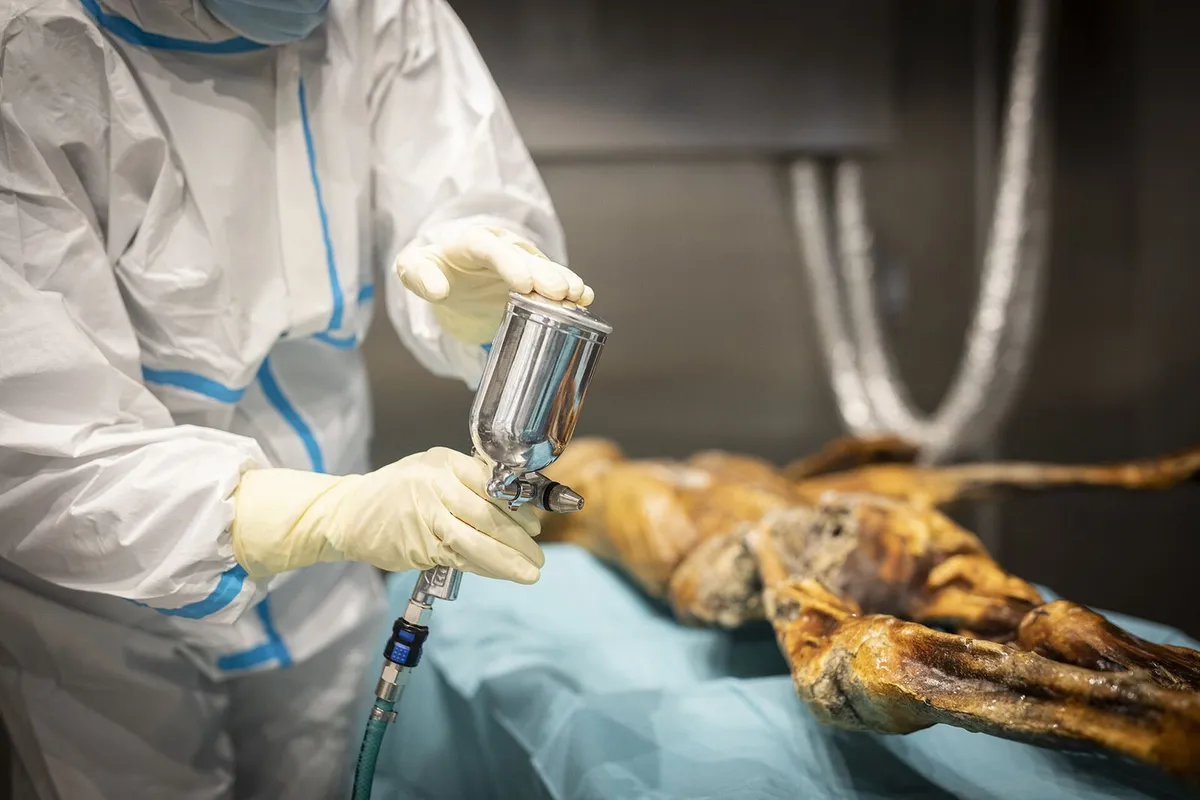
A 5,300-year-old mummy and the remains of a man who died 45,000 years ago both carried HPV16, a strain of human papillomavirus known to cause cancer today. The discovery rewrites what we thought we knew about when this virus first started infecting our species.
Human papillomaviruses are common — most sexually active people encounter them at some point. Most strains are harmless and clear on their own. But a handful, including HPV16, can lead to cervical cancer and other malignancies. Finding the virus in Ötzi the Iceman (preserved in ice in the Italian Alps) and in the ancient DNA of Ust'-Ishim man (whose remains were discovered in Siberia) suggests we've been living with this particular pathogen for longer than we've had agriculture, written language, or cities.
"Homo sapiens was basically infected by these viruses for all of its existence," says Ville Pimenoff, a computational geneticist at the University of Oulu in Finland. The finding challenges an earlier hypothesis that Neanderthals picked up cancer-causing HPV strains and passed them to humans through interbreeding. When researchers checked Neanderthal DNA, they found no sign of HPV16, suggesting the virus may have a different origin story entirely.
We're a new kind of news feed.
Regular news is designed to drain you. We're a non-profit built to restore you. Every story we publish is scored for impact, progress, and hope.
Start Your News DetoxWhat this really tells us is that oncogenic HPV isn't a modern plague — it's an ancient companion that evolved alongside us. "These are not recent pathogens but long-term companions of their hosts, evolving alongside primates and humans over extended evolutionary timescales," says Marcelo Briones, a molecular biologist at the Federal University of São Paulo in Brazil. That perspective matters because it shifts how we think about the virus. It's not something that suddenly appeared and started harming us. It's been there the whole time.
Will this discovery lead to better vaccines or treatments. Probably not directly. But virologist Koenraad Van Doorslaer at the University of Arizona points out that not all science needs to justify itself by immediate practical payoff. Sometimes the value is simply in understanding where we came from — in this case, learning that a virus we're still fighting today has been fighting alongside us since our species was young.