Darlène Dubuisson's path to becoming a UC Berkeley professor didn't start in a lecture hall. It started in a fundamentalist Baptist church school in Boston, where she taught herself from booklets in a cubicle, isolated from classmates, while being told that Black people were inferior and that her ambition to become a writer was foolish.
Her mother, an immigrant from Haiti, had chosen this independent school because it was the only private education she could afford for her four children in their single-parent, working-class household. The curriculum carried a specific kind of damage: students learned that African ancestors had used drums to worship the devil—a justification for banning "Black music." Women were taught they could aspire to be pastor's wives, missionaries, teachers, or nurses. Nothing else. When 11-year-old Dubuisson dressed as a writer for career day, her teachers discouraged the idea.
She lived in two worlds simultaneously. One was white, ultra-conservative, and deeply restrictive. The other was Black, Haitian, culturally rich, and spiritually diverse. That tension sharpened at 16 when she discovered Breath, Eyes, Memory by Edwidge Danticat at a local bookstore. It was the first time she'd read a book by a Black author other than Booker T. Washington—and the first time she saw herself reflected in literature. When a teacher tried to confiscate the book, Dubuisson understood something crucial: the power of seeking knowledge that no one had sanctioned.
We're a new kind of news feed.
Regular news is designed to drain you. We're a non-profit built to restore you. Every story we publish is scored for impact, progress, and hope.
Start Your News DetoxReading as Rebellion
She graduated at 16 and briefly attended an HBCU, then a Bible college in Florida, before returning to Boston. There, she made a deliberate choice to live differently. She moved into an apartment with self-proclaimed "hippies" and shared a room with people of different genders, sexualities, and beliefs—people she had been taught were "heathens and sinners." This shared living space became her real education in unlearning the false divisions she'd internalized.
At 19, she enrolled full-time at Boston University to study English, working two jobs to pay for school. She read voraciously—Toni Morrison, Alice Walker, Chinua Achebe—and discovered that the self-study skills she'd developed in that church school cubicle became her greatest asset. "I was really in awe of my own liberation through this self-study," she reflected later.
After graduation, Dubuisson moved to Senegal to teach English at an elementary school. What she witnessed there—a colonial education model that seemed designed to separate people from their own knowledge systems—echoed what she'd seen in Haiti and Jamaica. She recognized a pattern: people were being educated away from themselves, their heritage, their cultures. This realization crystallized her mission: to decolonize education.
It led her to Columbia University for doctoral studies under anthropologist George C. Bond. Her dissertation focused on Haitian intellectuals who returned home during two critical moments: after the fall of the 29-year Duvalier dictatorship in 1987 and after the 2010 earthquake. These scholars wanted to participate in bringing about new futures in Haiti. The earlier group focused on political activism and leadership; the later group concentrated on public higher education reform.
Dubuisson conducted long-term fieldwork in Port-au-Prince, teaching at the State University of Haiti during a period when it was occupied by state police in response to student protests. In 1987, Haiti had enshrined academic freedom in its constitution as a safeguard after the dictatorship had persecuted and killed intellectual dissidents. During her fieldwork, Dubuisson witnessed that constitutional autonomy being eroded in real time, even as professors advocated for expelled student protesters.
Her first book, Reclaiming Haiti's Futures, published by Rutgers University Press, explores how Haitian scholars worked to create futures beyond the legacies of colonialism. A particularly meaningful moment came when Edwidge Danticat—the author whose book had transformed her teenage years—attended a book talk at Barnard College and purchased a copy. The arc from reader to writer to scholar had completed itself.
The Question That Matters Now
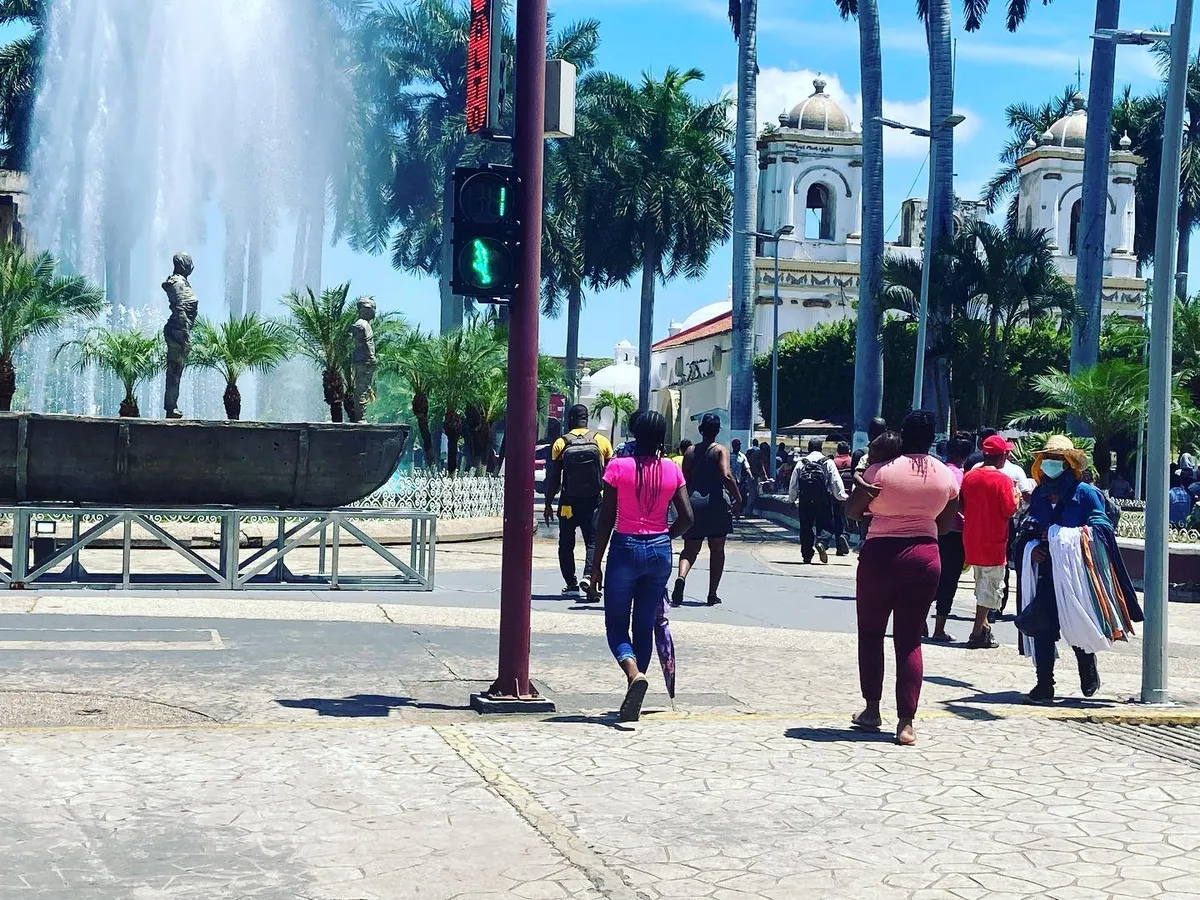
Dubuisson's current research extends this inquiry to Mexico, where she works with Black refugees, Africans, and Haitians. As an ethnographer, she seeks a useful role within the communities she studies. In 2022, she worked as a community organizer with an organization serving Black refugees, witnessing how people operated in love despite contexts of violence and death. Women and men engaged in care work, celebrated new relationships, and created life. She became curious about these everyday acts of future-making in the midst of dire circumstances.
This is where her work becomes particularly relevant now. Her research explores the relationship between crises and futures, centering on the everyday and imaginative practices of people in the African diaspora. She asks fundamental questions: What do we do when collective hopes for change don't materialize? How do we continue to create futures in the wake of ever-unfolding crises?
These questions, rooted in her own journey from a fundamentalist classroom to a position as a UC Berkeley professor, reflect a scholar committed to understanding how marginalized peoples imagine and build better worlds. It's not abstract theorizing. It's asking: when the system fails you, what do you do? How do you keep imagining something different? And what does that imagining look like when it happens in the everyday—in conversations, care work, relationships, and small acts of resistance?
Dubuisson's work suggests that the answer lies not in waiting for perfect conditions, but in the practices of people who have always known how to create futures despite the obstacles.