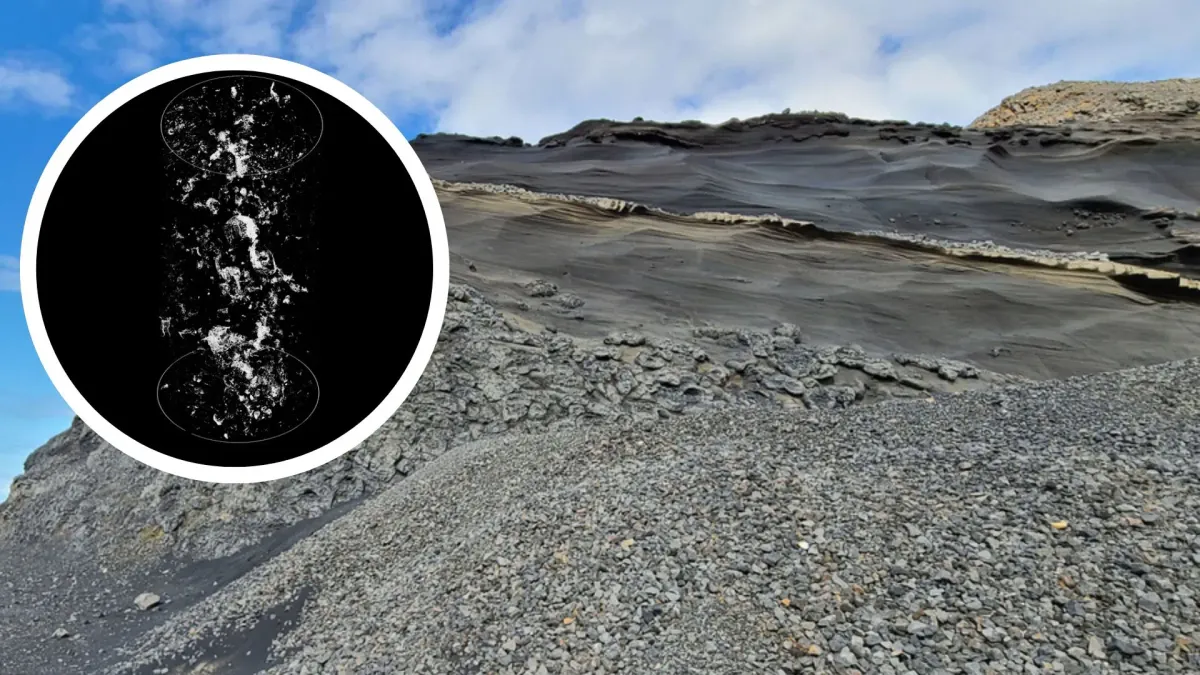
Scientists have long known that certain rocks can lock away carbon dioxide underground. What they didn't fully understand was exactly how—and whether the process would actually work at scale. A new study from MIT used hospital-grade X-ray scanners to watch it happen in real time, revealing something reassuring: the rocks keep working even when they seem to be clogging up.
The challenge is urgent. To avoid the worst climate impacts, we need to capture and permanently store billions of metric tons of CO2 by 2100. One of the most promising methods involves injecting CO2-rich fluid deep underground, where it reacts with certain rocks—particularly basalt, the volcanic stone found in Iceland, Hawaii, and other geologically active regions. When CO2 meets the calcium, magnesium, and iron in basalt, a chemical reaction converts the gas into solid minerals like calcite. Once that happens, the carbon is locked in stone for millions of years.
But the process has a potential problem. As minerals form inside the rock, they can clog up the tiny fractures that let fluid flow through. If those pathways seal shut, the injection stops working. The MIT researchers wanted to understand whether this clogging actually kills the whole operation.
We're a new kind of news feed.
Regular news is designed to drain you. We're a non-profit built to restore you. Every story we publish is scored for impact, progress, and hope.
Start Your News DetoxWhat the scanner revealed
The team collected basalt samples from Iceland in 2023 and placed them in a custom apparatus that pumped mineral-forming fluids through the rock. Then they slid the samples into an X-ray CT scanner—the same technology hospitals use for medical imaging—and watched what happened over weeks. The scanner captured detailed 3D images of the rock's internal structure as minerals formed inside.
What they found was counterintuitive. Yes, the rock's permeability—how easily fluid moves through it—dropped sharply as minerals clogged the tiniest microfractures. But here's the critical part: the rock didn't actually fill up with minerals. Even after extended experiments, only about 5 percent of the pore space had turned to stone. The minerals were forming selectively in the microscopic cracks that connect larger pores, not throughout the entire rock.
"You don't need much to clog up the tiny microfractures," explained Jonathan Simpson, one of the researchers. "But when you do clog them up, that really drops the permeability." The key insight: despite the dramatic drop in permeability, fluid continued to move through the rock and kept forming minerals. The system didn't jam—it just slowed down.
This matters enormously for real-world projects. Engineers injecting CO2 underground will see their flow rates drop and might panic, thinking they've ruined the well. This research suggests that in many cases, the drop doesn't signal failure—it's just the mineralization process doing its job. As long as some flow continues, carbon storage keeps happening.
The findings align with what's already working in practice. In Iceland, the company CarbFix has been injecting CO2-rich water into basalt formations for years. Their pilot projects show that more than 95 percent of the injected CO2 converts to minerals within two years—proof that the process scales beyond the laboratory.
The research adds a crucial piece to the engineering puzzle. Understanding exactly how rocks change during mineralization means engineers can design injection systems that work with the process rather than against it. "This study gives you information about what the rock does during this complex mineralization process, which could give you ideas of how to engineer it in your favor," said study co-author Matėj Peč.
As carbon capture moves from pilot projects to industrial deployment, this kind of detailed knowledge becomes the difference between systems that work and systems that fail. The X-rays revealed not just how the rock transforms, but how we can use that transformation to our advantage.