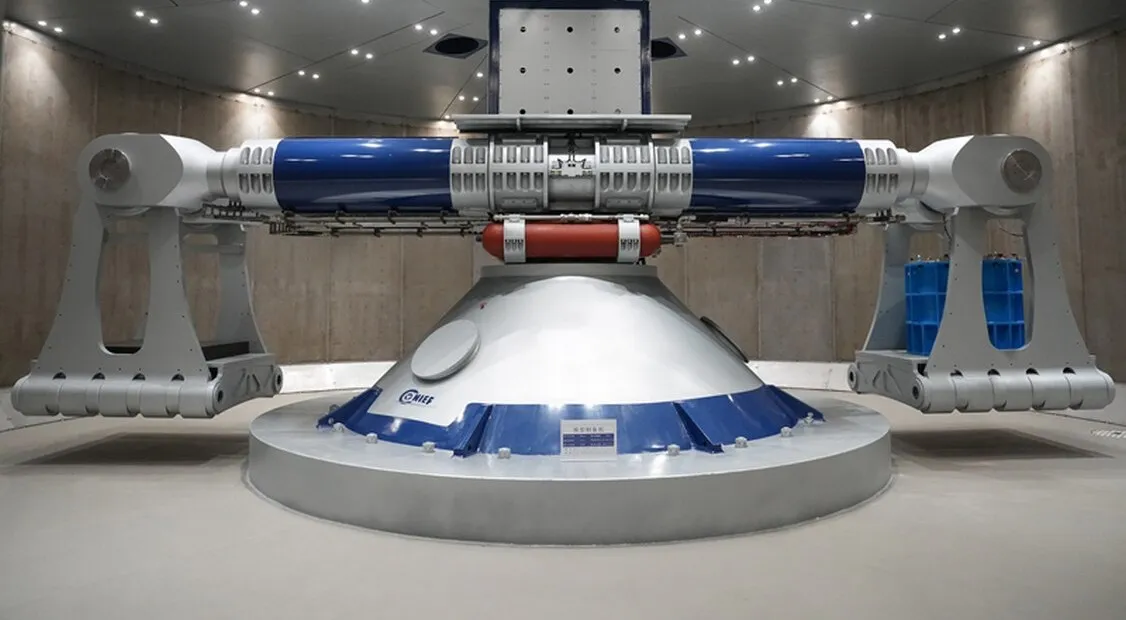
Zhejiang University has begun installing the CHIEF1900, a machine that spins objects so fast it creates gravitational forces 100 times stronger than Earth's pull. To put that in perspective: a home washing machine tops out around 2g. This centrifuge will hit 100g, letting researchers compress time in ways that sound like science fiction but are entirely practical.
The machine can handle objects weighing up to 20 metric tons. That means engineers can test a 3-meter scale model of a 300-meter dam without building the actual structure first—and watch decades of stress and weathering happen in hours. Soil scientists can watch how pollutants leach through earth over centuries, but see the results in days. Materials researchers can explore how substances behave under extreme forces that don't exist naturally on our planet.
What makes this different from other centrifuges isn't just raw power. It's the scale of collaboration it enables. Zhejiang designed the CHIEF1900 as an open facility, welcoming researchers from universities, institutes, and industries worldwide. That's a deliberate choice—the kind of infrastructure that tends to accelerate discovery because it puts the tool in many hands at once.
We're a new kind of news feed.
Regular news is designed to drain you. We're a non-profit built to restore you. Every story we publish is scored for impact, progress, and hope.
Start Your News DetoxThe implications ripple across fields. Civil engineers get faster, cheaper ways to test infrastructure resilience. Materials scientists can explore phenomena that would take lifetimes to observe naturally. Even astrophysicists studying extreme gravitational environments now have a way to run experiments that were previously impossible outside of simulations.
The facility is still being installed, but it represents something worth noting: when a country decides to build the world's most powerful version of something, they usually don't keep it locked away. They open it up. That's how tools become breakthroughs.