Researchers at Germany's Helmholtz-Zentrum Dresden-Rossendorf have found something unexpected in tiny magnetic vortices: a new oscillation state that could eventually act as a universal translator between electronic, spintronic, and quantum systems.
The catch? It works with barely any power. Where previous attempts required intense laser pulses, this approach needs only microwatts — less energy than your phone uses when it's sitting idle.
How magnetic whispers became a bridge
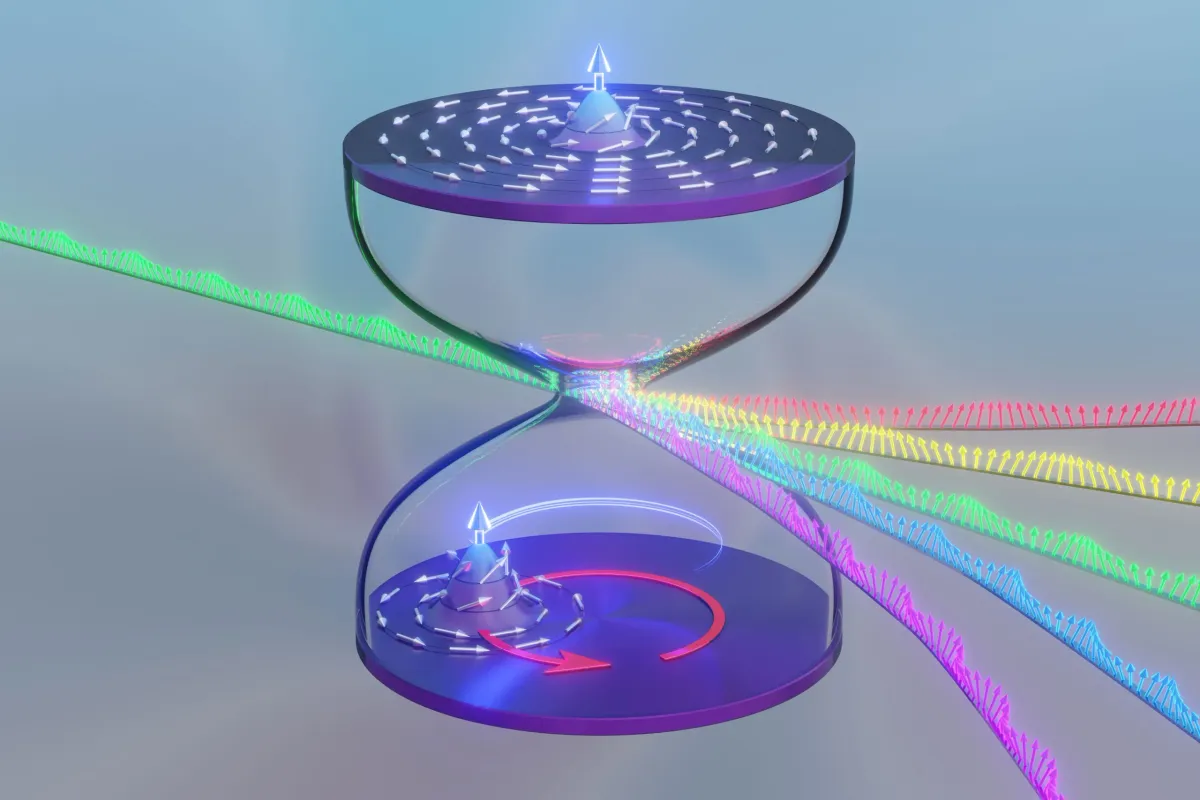
Inside ultrathin disks made from materials like nickel-iron, magnetic moments naturally arrange themselves in circles. When you disturb the system, waves ripple through it like a stadium crowd wave, with each tiny magnetic moment nudging its neighbor. Physicists call these wave-like motions magnons, and they're useful because they can carry information through a magnet without needing electric charge to move around.
We're a new kind of news feed.
Regular news is designed to drain you. We're a non-profit built to restore you. Every story we publish is scored for impact, progress, and hope.
Start Your News DetoxThe team, led by Dr. Helmut Schultheiß, discovered that these magnons can trigger something called Floquet states — a type of oscillation that shouldn't exist under normal conditions. The concept itself comes from 19th-century mathematics: the French mathematician Gaston Floquet proved that systems exposed to regular, repeating forces can enter entirely new states of motion.
What's new here is how efficiently it happens. When magnons are excited strongly enough in a magnetic vortex, they transfer energy to the vortex core, making it perform a tiny circular motion. This subtle movement rhythmically modulates the magnetic state — and it requires almost no power to set in motion.
"We call it the universal adapter," Schultheiß explains. "Just as a USB adapter lets devices with different connectors work together, Floquet magnons could bridge frequencies that would otherwise remain incompatible."
The practical implications are genuinely interesting. Right now, electronic circuits, spintronic devices (which use electron spin instead of charge), and quantum systems operate in separate worlds. They work at different frequencies and don't naturally communicate. This discovery suggests a way to link them — a single protocol that could translate between all three realms.
The team has already begun exploring whether this principle extends to other magnetic structures. If it does, it could reshape how we think about building next-generation computers, where different types of information processing could finally talk to each other efficiently.
For now, the finding opens two doors at once: it raises new questions about how magnetism works at fundamental levels, while also pointing toward a tool that could eventually make our most advanced technologies work together.