
Astronomers have spotted something genuinely puzzling in our galaxy: a distant object that fires off bursts of radio waves and X-rays like clockwork, every 44 minutes, for about two minutes each time. It's called ASKAP J1832-0911, and it doesn't fit neatly into any category we already have.
The discovery matters because this is the first time anyone has caught one of these long-period transients (as astronomers call them) emitting X-rays. Until now, we've only detected radio signals from objects like this. X-rays suggest something much more energetic is happening — which means the old theories about what these things actually are might need revising.
Finding a needle in two haystacks at once
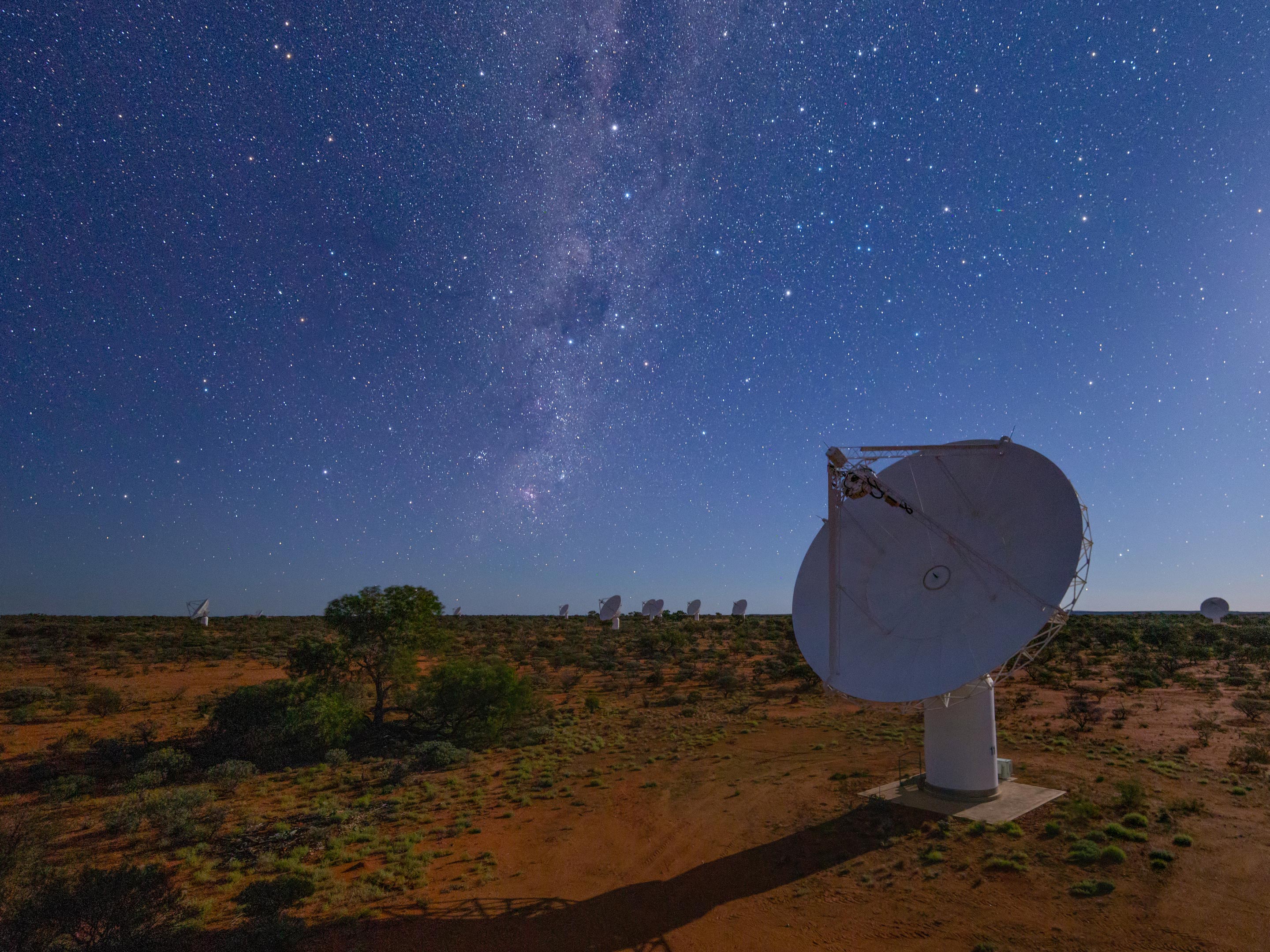
The find itself was a stroke of luck. Researchers at Australia's ICRAR used the Australian Square Kilometer Array Pathfinder (ASKAP) radio telescope to pick up the radio bursts. But to confirm the X-rays, they needed the Chandra X-ray Observatory to be looking at the same patch of sky at the same time — a rare alignment. "It felt like finding a needle in a haystack," said lead researcher Dr Ziteng Wang from Curtin University. "ASKAP has a wide field of view, but Chandra observes only a small fraction of the sky. We got lucky."
We're a new kind of news feed.
Regular news is designed to drain you. We're a non-profit built to restore you. Every story we publish is scored for impact, progress, and hope.
Start Your News Detox
Once they matched the radio pulses to the X-ray flashes, the real puzzle began. ASKAP J1832-0911 sits about 15,000 light-years away in our Milky Way, and it doesn't behave like anything astronomers have catalogued before. It could be a magnetar — the dense, magnetic remnant of a dead star. It could be a binary system with a highly magnetized white dwarf. Or it could be something we haven't named yet.
"This object is unlike anything we have seen before," Wang said. "Even our best theories don't fully explain what we're observing. This could indicate a new type of physics or new models of stellar evolution."
Why this matters for what comes next
The real significance is methodological. By detecting these objects in both X-rays and radio waves, astronomers now have a new search strategy. One object hints at many more. "Finding one such object hints at the existence of many more," said Professor Nanda Rea from Spain's Institute of Space Science. "The discovery of its transient X-ray emission opens fresh insights into their mysterious nature."
And because X-rays are far more energetic than radio waves, any explanation has to account for both types of emission simultaneously — a constraint that narrows the possibilities and points toward the real answer. The discovery also showcases what international collaboration can do: researchers from Australia, Spain, and beyond pooling expertise to solve something none of them could alone.
The object remains a mystery, but now we know where to look for answers.