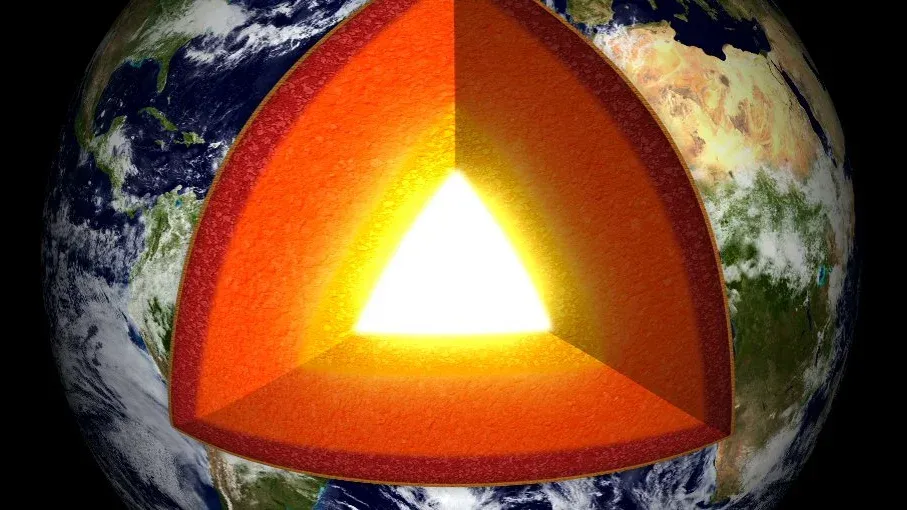
Three thousand kilometers beneath your feet, something vast and ancient is keeping you safe. Two enormous blobs of rock, one lurking beneath Africa and another under the Pacific Ocean, have been subtly controlling Earth's magnetic field for hundreds of millions of years—a discovery that rewrites how we understand the planet's interior.
Earth's magnetic field is the invisible shield that deflects harmful solar radiation away from our atmosphere. Without it, the planet would look very different. That protective force comes from a churning ocean of molten iron in the outer core, a process called the geodynamo. It takes enormous energy to sustain, heat that flows upward from the core through the mantle, Earth's thick rocky middle layer.
For decades, scientists noticed something odd in seismic wave maps of the mantle: two regions where waves traveled more slowly than anywhere else. Near the equator, one beneath Africa and one beneath the Pacific, these zones—nicknamed "big lower-mantle basal structures" or Blobs—seemed different from their surroundings. They were hotter, denser, or compositionally distinct. But no one quite understood what they were doing there, or why they mattered.
We're a new kind of news feed.
Regular news is designed to drain you. We're a non-profit built to restore you. Every story we publish is scored for impact, progress, and hope.
Start Your News DetoxThe Heat That Changed Everything
New research published this year finally connects the dots. By studying the magnetic signatures frozen into ancient rocks—minerals that align with Earth's magnetic field as they cool—researchers found a pattern. Rocks up to 250 million years old showed magnetic directions that varied depending on where they'd formed, particularly near the equator. That's where the Blobs sit.
Then came the supercomputer simulations. When researchers modeled the geodynamo with realistic heat-flow patterns at the core's surface, including the cooler zones created by the Blobs, something clicked. The simulations reproduced the actual magnetic field behavior observed in those ancient rocks. The Blobs, it turns out, act as insulators. They trap heat beneath them, preventing the liquid metal from cooling and sinking in their vicinity. This stagnation screens the magnetic field generated deeper down, creating those characteristic longitude-dependent patterns scientists had been puzzling over.
For hundreds of millions of years, these two rock formations have been quietly stabilizing one of Earth's most essential features. They're not dramatic. They don't move. They just sit there, regulating the heat flow like a thermostat on a planetary scale, keeping the geodynamo steady enough that life has had a reliable magnetic umbrella.
The research doesn't answer every question about the Blobs—their exact composition, precise age, and full influence on the magnetic field remain areas for future study. But it reveals something profound: Earth's protection isn't a simple, elegant system. It's a complex interplay of heat, rock, and time, where massive geological features play roles we're only now beginning to understand.