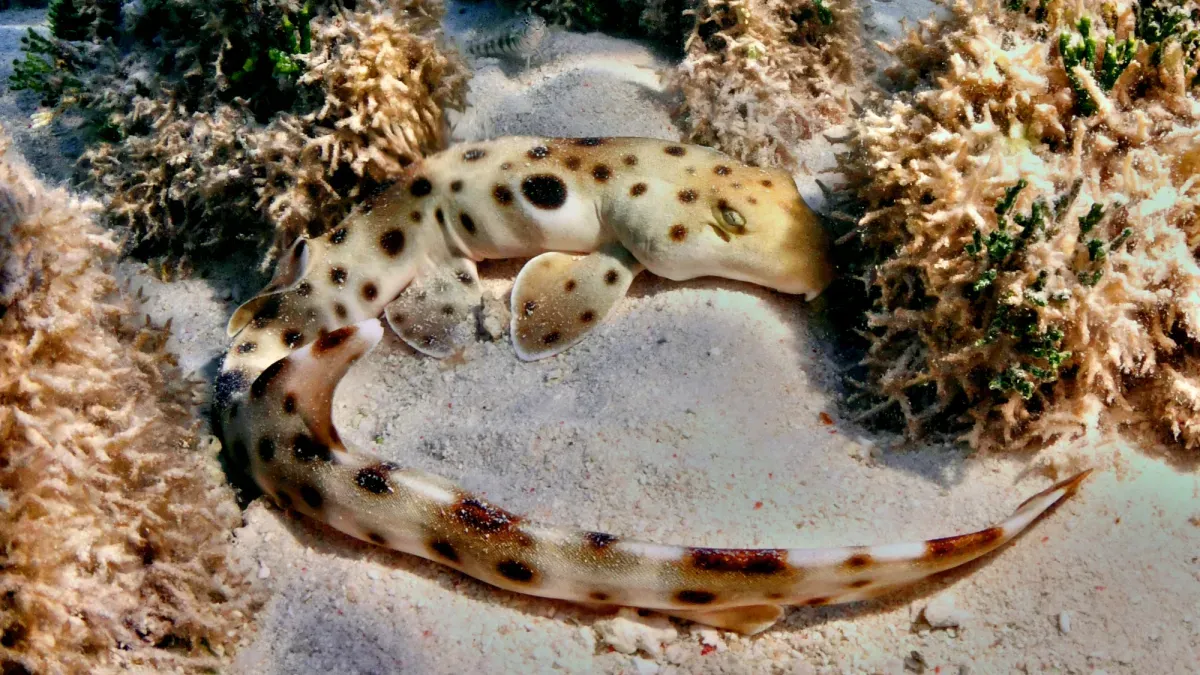
Epaulette sharks have a peculiar talent: they can walk. Using their fins like legs, these small predators shuffle across the seafloor and even onto land in search of food. But a new study suggests they've evolved something even more remarkable—the ability to reproduce with almost no metabolic cost.
When most animals breed, their bodies work overtime. Building eggs or carrying young demands energy. Researchers expected the same for epaulette sharks (Hemiscyllium ocellatum), especially since egg production is metabolically expensive. "Reproduction is the ultimate investment," says Jodie Rummer, a marine biologist at James Cook University. "You are literally building new life from scratch. We expected that when sharks make this complex egg, their energy use would shoot up. But there was no uptick in energy use, it was completely flat."
This is the first time scientists have directly measured the energetic cost of shark reproduction. The team monitored captive epaulette sharks, tracking their oxygen consumption to calculate metabolic rate while they laid eggs. They also measured shifts in blood hormones—the usual markers of reproductive stress. Everything stayed stable. "This research challenges our fundamental assumptions about chondrichthyan fishes," says Carolyn Wheeler, the study's lead author, also from James Cook University.
We're a new kind of news feed.
Regular news is designed to drain you. We're a non-profit built to restore you. Every story we publish is scored for impact, progress, and hope.
Start Your News DetoxWhy this matters for reef ecosystems
The finding has quiet but significant implications. Most species face a trade-off during environmental stress: they either reproduce or they survive. If conditions worsen—warming oceans, food scarcity—reproduction typically shuts down first. But epaulette sharks appear to keep producing eggs even under pressure. "This work challenges the narrative that when things go wrong, that reproduction will be the first thing to go," Rummer explains.
Healthy shark populations support healthy reefs. If epaulette sharks can maintain reproduction despite environmental stress, they're more likely to persist as ocean conditions shift. It's a small but meaningful clue about how some species might adapt to a changing world. "Sharks have been around since before the dinosaurs and have already shown incredible resilience to the earth's changing climate," notes Madoc Sheehan, a lecturer at James Cook University.
The team's next step is testing wild epaulette sharks to see whether the same efficiency holds outside the controlled lab environment.