A German YouTuber just built a mechanical Lego clock that can count up to a billion years — and it actually works.
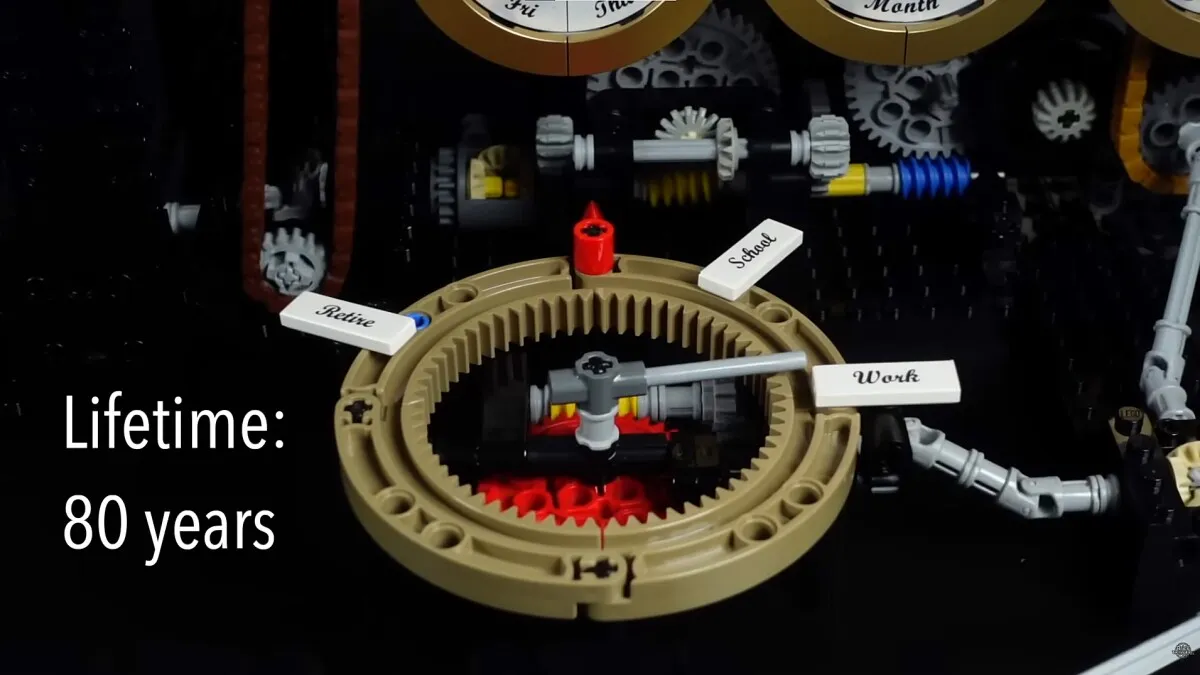
Brick Technology's creation tracks time the way a grandfather clock does: a weight-driven pendulum ticks once per second, with an electric motor automatically rewinding the falling weight. But instead of stopping at hours and minutes, the display keeps going. It shows seconds, minutes, hours, days, fortnights, months, lifespans, and galactic years — the time it takes our solar system to orbit the Milky Way's center.
To grasp the scale here: dinosaurs walked the Earth for less than 200 million years. The Grand Canyon took 5–6 million years to form. A billion years is so vast that both events disappear into the background noise.
We're a new kind of news feed.
Regular news is designed to drain you. We're a non-profit built to restore you. Every story we publish is scored for impact, progress, and hope.
Start Your News DetoxThe clock runs on a solar panel that charges its batteries, theoretically giving it endless energy. The mechanics are clever — a differential gear system lets the motor rewind the weight without interrupting the pendulum's rhythm, keeping the timekeeping accurate even as the device is being powered.
Astronomers estimate our universe is about 61 galactic years old. Our solar system formed roughly 20 galactic years ago. So this Lego clock could theoretically measure our entire cosmic neighborhood's lifespan.
What this reveals about Lego
The project isn't just an engineering flex. It's a reminder that Lego has become something different than what most people think. In the hands of someone with patience and mechanical intuition, those plastic bricks stop being a children's toy and become a medium for exploring ideas — in this case, the sheer magnitude of deep time.
Another Lego creator, from the Akiyuki Brick Channel, recently built a separate clock using a mangle rack mechanism to display seconds, minutes, and hours in a compact, watch-like form. Both projects point to the same thing: Lego's constraint — the fact that pieces only connect in specific ways — somehow becomes an advantage for mechanical design. You're forced to think clearly about how motion transfers from one part to the next.
The billion-year clock won't change how we measure time in daily life. But it does something quieter: it makes the vast incomprehensible scale of cosmic time tangible enough to hold in your hands.