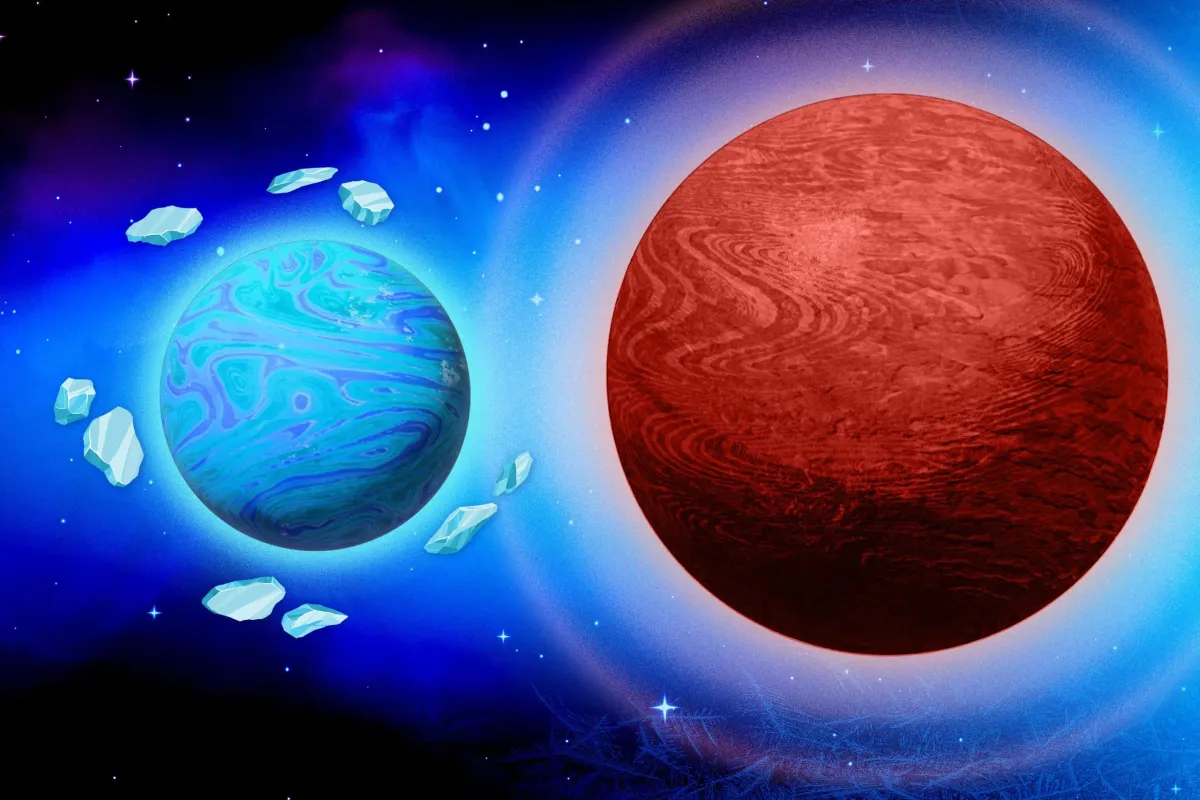
Imagine finding two roommates who, by all laws of physics and common sense, should have immediately kicked each other out. That's essentially what astronomers just did, 190 light-years from Earth. They’re looking at a bizarre planetary duo that has scientists utterly rethinking how planets even form in the first place.
This “odd couple” consists of a “hot Jupiter” (a gas giant orbiting ridiculously close to its star) and, even weirder, a smaller “mini-Neptune” tucked inside the hot Jupiter's orbit. Since their discovery in 2020, the cosmic question has been: How in the swirling accretion disk did these two end up together without one flinging the other into deep space?
The Mini-Neptune's Deep, Dark Secrets
Now, thanks to the James Webb Space Telescope (JWST), researchers from MIT have peered into the mini-Neptune’s atmosphere, and the results are like a planetary paternity test. Published in Astrophysical Journal Letters, this marks the first time anyone has measured the atmosphere of a mini-Neptune orbiting inside a hot Jupiter's path. Because apparently that’s where we are now.
We're a new kind of news feed.
Regular news is designed to drain you. We're a non-profit built to restore you. Every story we publish is scored for impact, progress, and hope.
Start Your News DetoxThe JWST found the mini-Neptune has a thick atmosphere, packed with heavy molecules: water vapor, carbon dioxide, sulfur dioxide, and even some methane. Here’s the kicker: a planet forming so close to its star shouldn’t have an atmosphere like that. The intense radiation and heat should have stripped away these heavier elements, leaving only the lightest gases.
Instead, the data points to a far more dramatic origin story: both the mini-Neptune and its giant companion likely started their lives much farther out, in the colder, quieter suburbs of their young planetary system. In those icy, outer reaches, they could have both collected those thick, ice-rich atmospheres. Then, like a couple of cosmic snowbirds, they slowly migrated inward, keeping their precious atmospheres intact.
This also provides the strongest evidence yet that mini-Neptunes can form beyond a star’s "frost line"—that magical distance where water finally chills out enough to freeze into ice. As Saugata Barat, the study's lead author from MIT, dryly put it, this measurement confirms the mini-Neptune formed beyond the frost line, “proving this type of formation is possible.” Because, you know, some things just have to be proven.
A Lonely Giant and Its Unlikely Companion
Mini-Neptunes are smaller than Neptune, mostly gas around a rocky core, and quite common in the Milky Way – just not in our solar system, because we’re apparently not cool enough. Most mini-Neptunes are pretty standard. But in 2020, Chelsea X. Huang, then at MIT, found one in a system that defied all expectations.
Hot Jupiters are usually the strong, silent types, preferring to orbit alone. Their immense gravity tends to scatter away any inner companions like annoying gnats. Yet, in this system, an inner companion didn't just survive; it thrived. The discovery, made by NASA’s Transiting Exoplanet Survey Satellite (TESS), showed two planets orbiting the star TOI-1130 every four and eight days, respectively. Huang noted that hot Jupiters are typically “lonely,” making this duo a head-scratcher.
To study this unique system, particularly the inner mini-Neptune (dubbed TOI-1130b), scientists knew they needed the JWST. The catch? The planets are in a "mean motion resonance," meaning their gravity subtly tugs at each other, making their orbits a bit wobbly and hard to predict.
Researchers, led by Judith Korth, combined earlier observations to create a precise model, predicting exactly when the planets would pass in front of the star from JWST’s perspective. Barat called it a “challenging prediction” that had to be “spot-on.” It was, and the cosmic detective work paid off.
The Atmospheric Evidence
JWST, observing in different wavelengths, revealed the atmospheric signature of water, carbon dioxide, sulfur dioxide, and even some methane. These heavy molecules are the smoking gun. Planets forming close to their stars usually have lighter atmospheres, mostly hydrogen and helium. The presence of these heavier elements strongly suggests TOI-1130b must have formed much farther from its star before migrating inward.
Scientists believe the planet initially collected water and other volatile compounds in the cold regions beyond the frost line. There, water freezes onto dust particles, forming icy pebbles that a growing planet can pull into its atmosphere. As the planet later moves closer to its star, the ice evaporates, leaving behind the rich atmosphere we see today. The evidence, Barat says, strongly suggests both planets formed in the outer parts of the system and slowly migrated inward together.
It’s one of the rarest systems ever found, and the observations of TOI-1130b provide the first hint that such mini-Neptunes, formed beyond the water/ice line, truly exist. Which, if you think about it, is both impressive and slightly terrifying, because who knows what else is out there breaking all the rules.