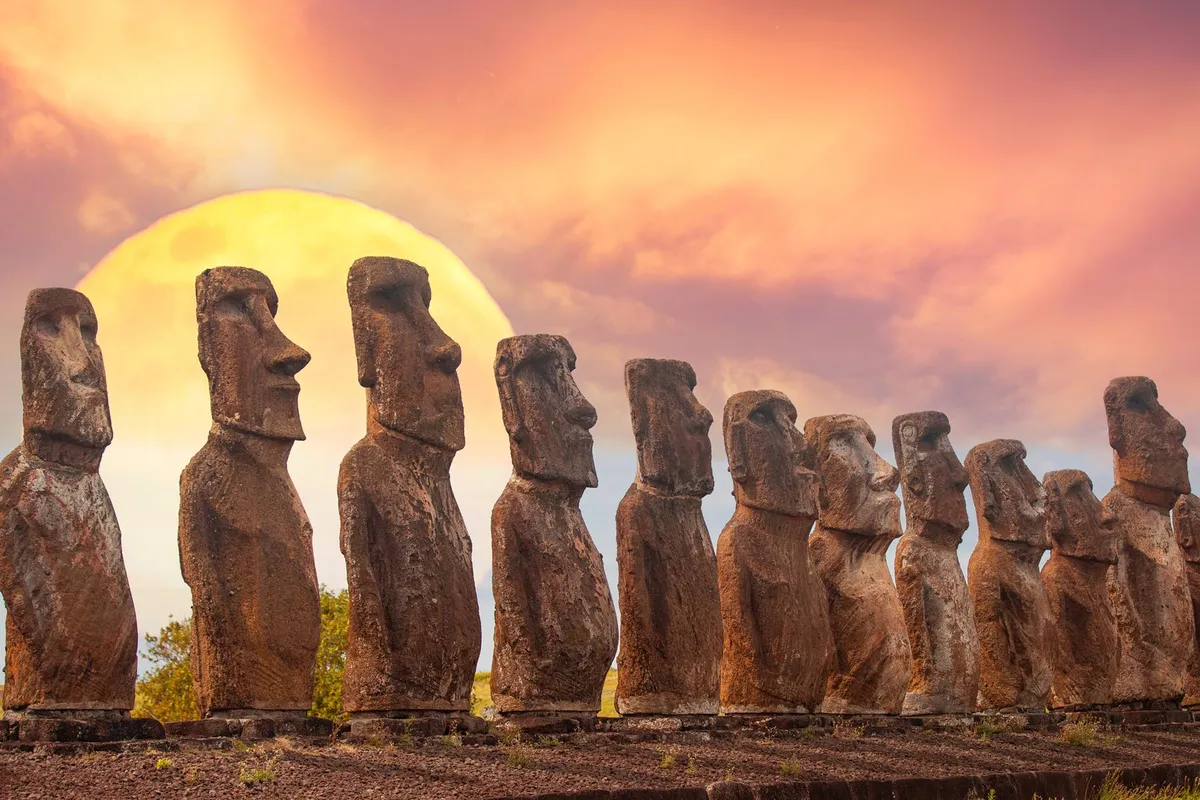
For decades, Easter Island has been the cautionary tale we tell ourselves. A civilization that cut down all its trees, collapsed under its own ambition, and left behind only mysterious statues as a warning. New evidence suggests the story was never that simple.
Scientists at the Lamont-Doherty Earth Observatory have reconstructed 800 years of rainfall patterns on Rapa Nui (Easter Island's Polynesian name) by analyzing microscopic chemical signatures in sediment cores. What they found: around 1550, the island entered a prolonged drought that lasted centuries, with rainfall dropping by 600 to 800 millimeters annually. That's roughly the amount of rain New York City gets in a year, vanishing from an island that was already water-poor.
How scientists read the island's weather diary
The researchers didn't have rainfall records or weather stations. Instead, they extracted cores from two freshwater sites—Rano Aroi, a high-elevation wetland, and Rano Kao, a volcanic crater lake—and examined the molecular fingerprints left by ancient plants. Specifically, they looked at hydrogen isotope ratios in leaf waxes, the waxy coating on plant surfaces. These ratios shift depending on the hydrogen composition of rainwater absorbed by plants, creating a precise record of dryness and moisture stretching back centuries.
We're a new kind of news feed.
Regular news is designed to drain you. We're a non-profit built to restore you. Every story we publish is scored for impact, progress, and hope.
Start Your News DetoxPrevious studies had relied on pollen, plant remains, and sediment layers—useful signals, but ones that blur together multiple causes like temperature, rainfall, and human activity. Leaf wax isotopes offered something clearer: a direct measurement of how much rain actually fell.
The drought that rewrote society
The timing is striking. The drought's onset coincides almost exactly with major cultural shifts on the island. Construction of ceremonial ahu platforms—the elaborate stone structures—slowed dramatically. Rano Kao, the crater lake, became a new ritual center. Most significantly, a new social system called Tangata Manu emerged, where leadership was determined through athletic competition rather than inherited status tied to the moai statues.
Archaeologists still debate the precise sequence of these changes, but the pattern is clear: the island's social and spatial organization transformed between the 16th and 18th centuries in ways that differed sharply from earlier periods. The people of Rapa Nui didn't simply abandon their culture. They adapted it to a radically changed environment.
Rewriting the ecocide narrative
This matters because it challenges a story that has calcified into near-gospel. The "ecocide" account holds that Rapanui people deforested their island through their own choices, triggering societal conflict and population collapse before Europeans arrived. While it's true the island was gradually deforested—a genuine ecological transition—the new evidence complicates the blame.
Yes, the island was deforested. But there's no strong archaeological evidence of demographic collapse before European contact. Instead, what we see is a society managing an increasingly difficult resource situation. A drought doesn't excuse environmental damage, but it does reframe it. The people of Rapa Nui weren't reckless. They were dealing with cascading crises.
What this teaches us now
The researchers are careful not to offer this as a modern parable. Instead, they emphasize something more important: listen to the people living with these challenges now. The voices of Rapanui and other Pacific islanders already navigating climate impacts matter far more than lessons we project backward onto the past.
The research team has an even longer sediment record—covering roughly 50,000 years—that they're now analyzing to understand how atmospheric circulation in the southeast Pacific responds to climate shifts over vast timescales. Rapa Nui sits 3,000 kilometers off Chile's coast, isolated enough that its sediment archive could reveal regional climate patterns no other location can.
The island's story isn't a parable about civilizational collapse. It's a record of people responding to environmental stress with cultural innovation. That's worth knowing.