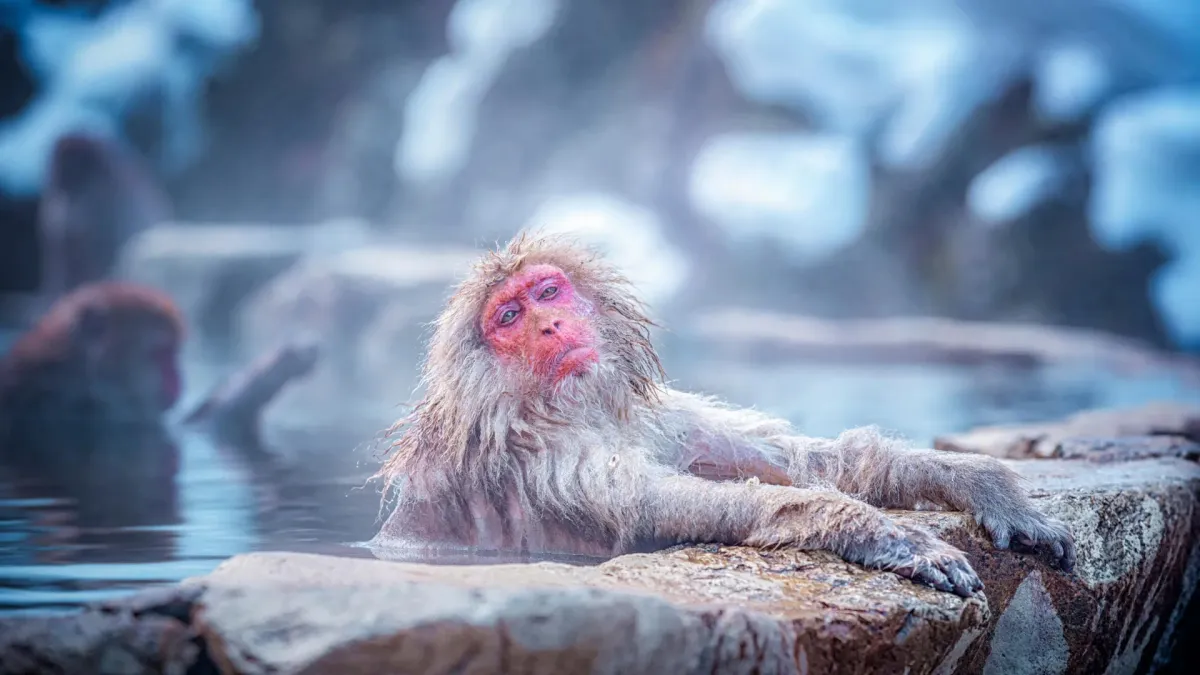
Japanese macaques have been soaking in steaming hot springs through winter for decades, and researchers finally understand why: the baths aren't just keeping them warm. They're actively remodeling the microscopic world living on and inside the monkeys' bodies.
A team at Kyoto University spent two winters tracking female macaques at Jigokudani Snow Monkey Park in Nagano, comparing the frequent bathers with the non-bathers. They weren't just watching behavior—they were sequencing gut bacteria, counting parasites, and examining lice patterns. What they found was subtle but significant: the hot water was changing how the monkeys' bodies interacted with the organisms living on and inside them.
The Holobiont Effect
Monkeys that regularly soaked in the springs had noticeably different patterns of body lice and shifts in certain gut bacteria compared to those that rarely bathed. The researchers suspect the heat interferes with lice reproduction or egg-laying. The gut changes were more modest—overall bacterial diversity stayed roughly the same, but specific bacterial types were less common in the bathers.
We're a new kind of news feed.
Regular news is designed to drain you. We're a non-profit built to restore you. Every story we publish is scored for impact, progress, and hope.
Start Your News DetoxHere's what's striking: sharing the pools didn't increase parasite infections. The monkeys weren't trading diseases with each other. This challenges an assumption many of us hold—that communal water automatically spreads illness. Under natural conditions, at least, it doesn't seem to work that way.
What makes this research novel is connecting a single behavior to changes across multiple biological systems at once. The monkeys aren't just regulating their body temperature. They're grooming their microbiome. Their behavior is functioning as a kind of selective health maintenance, keeping some microbial relationships intact while subtly pruning others.
Researcher Abdullah Langgeng puts it plainly: "Behavior is often treated as a response to the environment, but our results show that this behavior doesn't just affect thermoregulation or stress: it also alters how macaques interact with parasites and microbes that live on and inside them."
The parallel to human bathing is worth sitting with. We shower and bathe partly for cleanliness, partly for comfort. We've always known it affects our skin and general health. But we rarely think of it as microbiome management—as actively shaping the ecosystem of organisms we carry. The macaques are doing exactly that, and they've been doing it long enough that it's become routine behavior, woven into their winter survival strategy.
This is one of the first studies to show that a natural primate behavior can reshape both parasites and gut bacteria simultaneously. It suggests that health-related behaviors—in humans and other animals—don't evolve for single reasons. They're solutions to multiple problems at once, refined over generations into habits so ordinary we barely notice them.