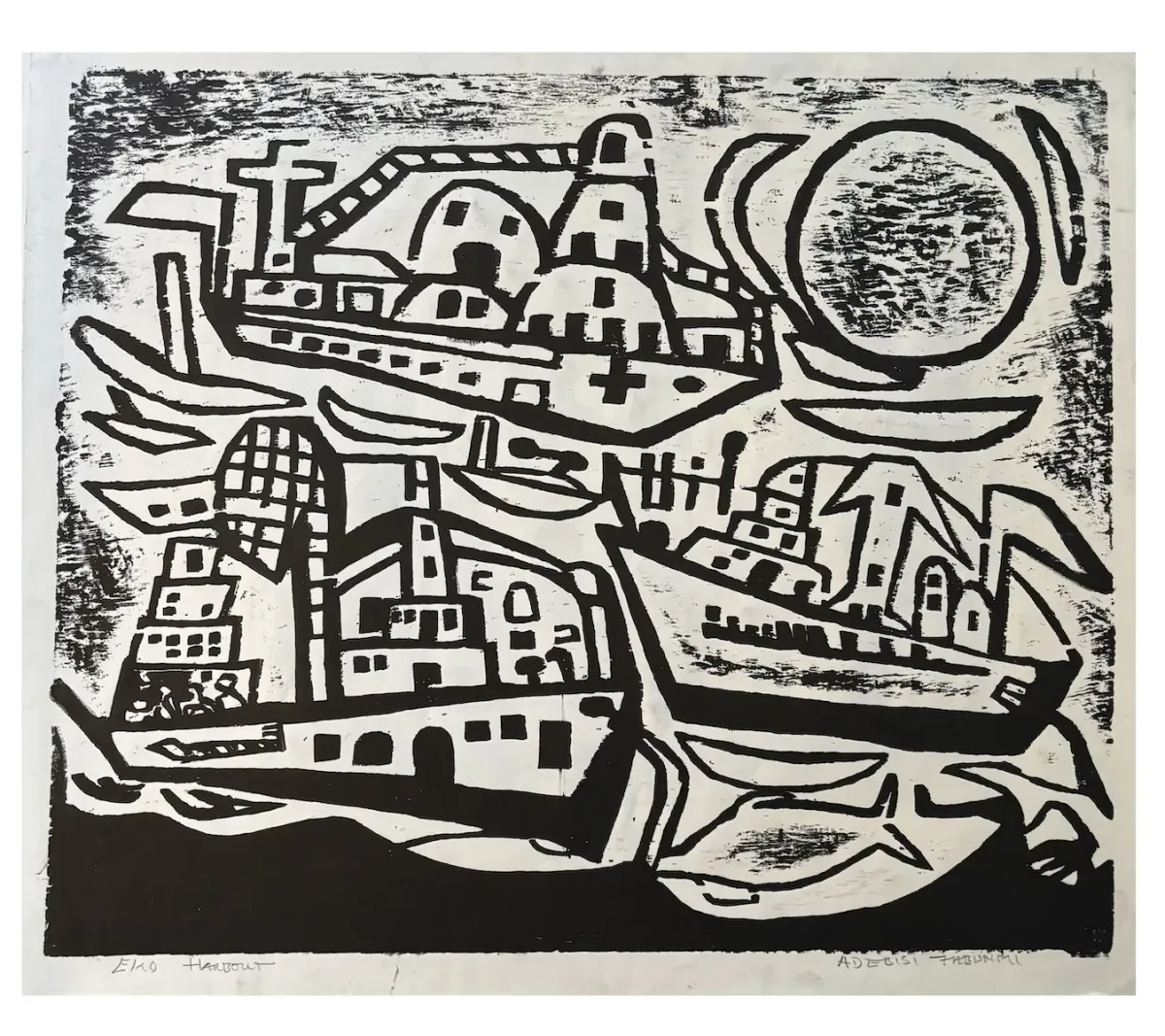
In the 1960s, a quiet revolution began in Osogbo, a city in southwestern Nigeria. It wasn't a political uprising or a tech boom, but an art movement that would take the world by storm, all from the humble beginnings of experimental workshops in a local theater.
This was the Osogbo School of Art, a place where young artists could dive into their creativity, unburdened by the usual pressures of formal training or artistic dogma. And while some European figures helped kickstart the movement, the artists themselves were the ones who truly shaped its vibrant, unique vision, celebrating their Yoruba heritage with every brushstroke and bead.
From Local Workshops to Global Stages
Imagine: no fancy art degrees, no stuffy academies. Just raw talent and a supportive environment. Yet, Osogbo School artists quickly became international sensations. Their work graced the walls of London's Institute of Contemporary Arts, New York's Studio Museum in Harlem, and is even featured in Tate Modern's "Nigerian Modernism" exhibition. Which, if you think about it, is both impressive and slightly terrifying for anyone who spent four years in art school.
We're a new kind of news feed.
Regular news is designed to drain you. We're a non-profit built to restore you. Every story we publish is scored for impact, progress, and hope.
Start Your News DetoxYet, despite this global acclaim, the story of how it all began isn't as widely known outside Nigeria. It started at the Mbari Mbayo Club, a hub for Nigerian playwright Duro Ladipo's theater productions. Over time, actors and other young people drawn to the club began attending art workshops covering everything from painting to textile design. Joseph Gergel, director of Lagos's Kó gallery, noted that many of these workshop attendees became "global superstars" by the 1970s.
Ladipo founded Mbari Mbayo with German academic Ulli Beier. Beier, along with his first wife, Austrian artist Susanne Wenger, and his second wife, British artist Georgina Betts Beier, were instrumental in setting up these workshops. The first kicked off in 1962, led by Ulli Beier and Guyanese painter Denis Williams. American painter Jacob Lawrence led another in 1963. By 1964, Georgina Beier was at the helm, and many artists credit her guidance for helping them discover their distinct voices.
The Art of Individuality
Jimoh Buraimoh, a prominent Osogbo School artist, summed up Georgina Beier's impact: "You can see that none of us resembles each other, and that’s the beauty of Osogbo." Buraimoh himself started as a lighting technician and actor before attending his first workshop in 1964. He started with paint, then, inspired by a king's crown, began incorporating beads into his work. Today, he's globally recognized for his stunning, large-scale bead murals.
Other artists from the school also developed signature styles. Twins Seven-Seven, a painter, sculptor, and musician, created mixed-media pieces exploring Yoruba mythology. Muraina Oyelami, originally a drummer, developed a unique roller technique for landscapes and portraits. Asiru Olatunde, a blacksmith by trade, crafted intricate metal plates depicting biblical and Yoruba scenes.
Nike Davies-Okundaye, a textile designer and gallerist, is another major figure whose influence is palpable throughout Osogbo. Her art center offers free training, and her guesthouse and galleries showcase her vibrant work. However, Davies-Okundaye doesn't consider herself part of the Osogbo School in the traditional sense. She acknowledges the influence of Wenger and Beier but emphasizes her self-taught journey. She recalls the misogyny of the 1960s, which forced her to work by candlelight to avoid male artists stealing her materials and work. Because apparently that's where we were then.
The Osogbo Art School was recently a hot topic at Art X Lagos, West Africa’s leading art fair, where its artists were lauded for their remarkable achievements in an era when art careers were far from common. For many, Osogbo wasn't just a school; it was an experiment in collective creation, built on strong friendships and a shared passion that ensured the art lived on long after the initial teachers moved on. A testament to creativity, community, and the power of finding your own damn voice.