Measuring anything at quantum scales is a fight against noise. Even the best instruments blur slightly when they try to pin down electromagnetic fields, gravity, or time. Nature's rules at that scale just don't cooperate.
But researchers at the University of Basel have found a way around this limit using quantum entanglement—and they've done something no one has managed before: they've made it work across distance.
The breakthrough is practical, not just theoretical. By linking atoms in different locations, the team showed they can measure how physical quantities change across space with far sharper precision than existing methods allow. This could eventually improve some of the most accurate measuring tools ever built, from atomic clocks to gravity sensors.
We're a new kind of news feed.
Regular news is designed to drain you. We're a non-profit built to restore you. Every story we publish is scored for impact, progress, and hope.
Start Your News DetoxHow they pulled it off
The experiment starts with atoms chilled to near absolute zero, where quantum effects take over. Each atom spins like a tiny magnet, and that spin responds to electromagnetic fields—making it a sensitive detector.
Normally, when you measure many atoms separately, their random quantum jitter adds up and blurs your result. Physicists have long known that entanglement—a quantum link that ties particles together so they behave in correlated ways—can fix this. But here's the catch that stumped everyone until now: earlier experiments only worked when all the entangled atoms stayed in the same place. You could measure one spot very precisely, but you couldn't see how a field changed from point A to point B.
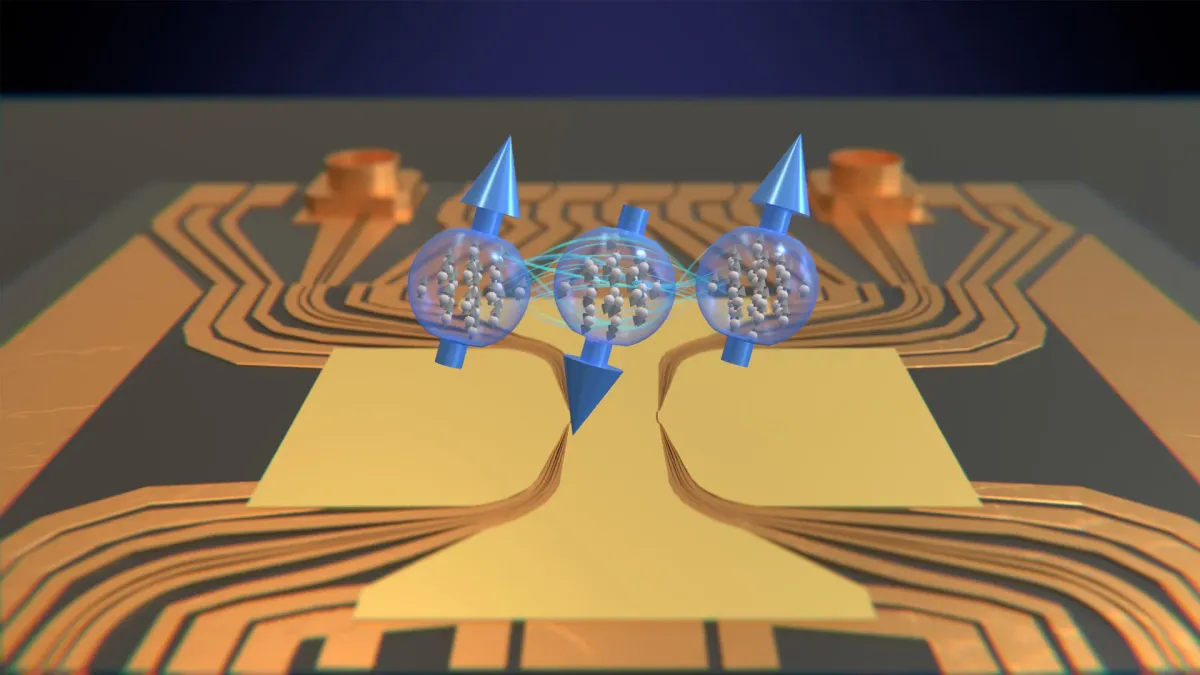
The team solved this by changing the order of operations. They started with a single cloud of ultracold atoms and entangled their spins while they were still touching. Only after that quantum connection was locked in did they split the cloud into separate pieces and move them to different locations. The entanglement survived the separation—the distant clouds kept behaving as parts of one quantum system, even though they were physically apart.
"We have now extended this concept by distributing the atoms into up to three spatially separated clouds," said Philipp Treutlein, a professor at the University of Basel. "As a result, the effects of entanglement act at a distance, just as in the EPR paradox."
Each separated cloud sensed a different slice of the electromagnetic field. By combining what all three clouds measured, the researchers could map how the field varied across space. Because the clouds were entangled, the usual quantum uncertainty dropped sharply, and errors that affected all atoms the same way largely cancelled out.
What comes next
This opens a door to a new kind of quantum sensor—one that's spread across multiple locations but works as a single, coordinated instrument. Optical lattice clocks, which use atoms arranged in space to keep time, could become even more accurate by reducing errors from variations in atom positions. Atom-based gravimeters, which measure how gravity changes from place to place, would benefit even more directly.
The catch is that this is technically demanding. Keeping entanglement alive while splitting and controlling multiple atomic clouds requires extreme stability and precision. Pushing the method to larger distances or more measurement points won't be straightforward.
The researchers are now refining their protocols and testing them in real precision instruments. The study appears in Science.