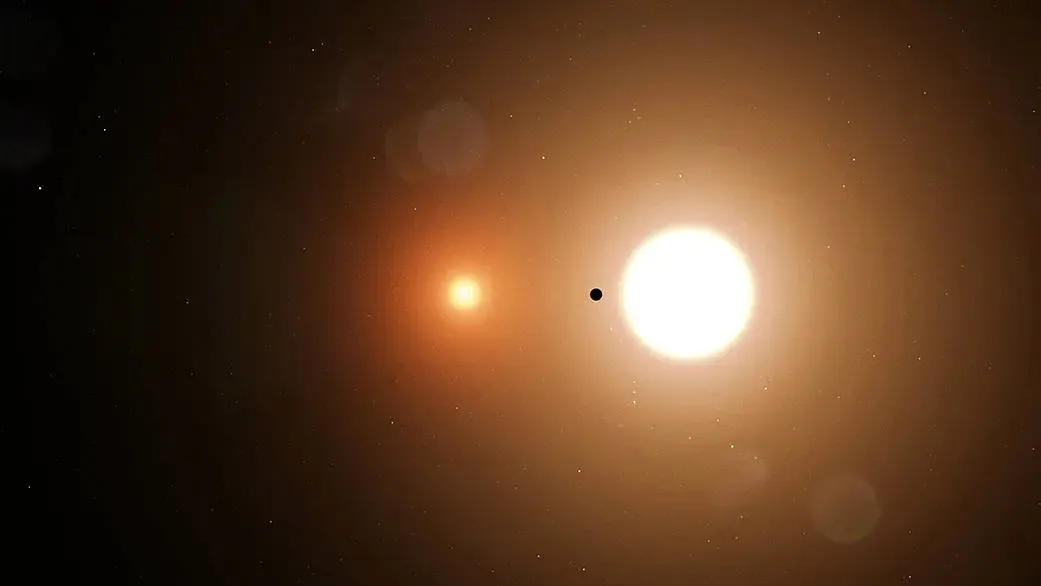
Most stars in the galaxy come in pairs, orbiting each other through space. You'd think that would mean plenty of planets with two suns — like Tatooine from Star Wars. Instead, they're vanishingly rare. Astrophysicists at UC Berkeley and the American University of Beirut have figured out why: Einstein's theory of gravity is actively destroying them.
Of the 4,500 known exoplanet-hosting stars, only 14 confirmed planets orbit binary star systems. That's roughly 0.3%. For comparison, about 10% of single stars host planets. The discrepancy is so stark that tight binaries — stars orbiting each other in less than seven days — have virtually no planets at all. It's not that planets don't form around binary stars. It's that they don't stick around.
How Relativity Clears the Field
When two stars orbit each other, they pull on any nearby planet, warping its orbit into an increasingly elongated ellipse. This orbital stretching is called precession — the same wobble you see in a spinning top as it slows down. Normally, this would be a slow, gradual process. But general relativity speeds things up dramatically.
We're a new kind of news feed.
Regular news is designed to drain you. We're a non-profit built to restore you. Every story we publish is scored for impact, progress, and hope.
Start Your News DetoxAs the two stars gradually spiral closer together over time (due to gravitational waves they emit), their own precession rate accelerates. Meanwhile, the planet's precession rate slows. When these two rates match — when they resonate — something catastrophic happens. The planet's orbit becomes wildly stretched. It swings dangerously close to one star, then far away from both. "Either the planet gets very, very close to the binary, suffering tidal disruption or being engulfed by one of the stars, or its orbit gets significantly perturbed to be eventually ejected from the system," said Mohammad Farhat, the UC Berkeley researcher who led the study.

The math is brutal. Farhat and co-author Jihad Touma calculated that general relativistic effects would destroy eight out of every ten planets around tight binaries. Most wouldn't just drift away — they'd be consumed by their host stars or flung violently into space.
This explains the observation that's been puzzling astronomers since the Kepler and TESS missions started cataloging exoplanets. Kepler found roughly 3,000 eclipsing binary stars. If planets formed around binaries at the same rate they form around single stars, we should have found about 300 planets in these systems. We found 14.
A Cosmic Balancing Act
What's striking is that general relativity isn't always a planet-killer. Touma notes that the same relativistic effects that destabilize planets around binary stars actually stabilize Mercury's orbit in our own solar system, preventing it from being scattered into chaos. "General relativity is stabilizing systems in some ways and disturbing them in other ways," he said.
The researchers are now exploring whether this same mechanism affects planets around other exotic systems — binary pulsars and supermassive black holes. The work suggests that Einstein's century-old equations continue to shape the architecture of planetary systems in ways we're only now beginning to understand.