Earth's magnetic shield is reshaping itself, and it's happening unevenly across the planet. Eleven years of satellite data now show that a weak zone in the magnetic field over the South Atlantic—already known to exist—has expanded to nearly half the size of continental Europe since 2014.
This matters because that magnetic field is what keeps us alive. It deflects cosmic radiation and charged particles from the Sun that would otherwise strip away our atmosphere. Without it, Earth would look more like Mars: barren, exposed, hostile to complex life.
The South Atlantic Anomaly, as scientists call it, isn't new. It was first documented in the 1800s as an area where Earth's magnetic field runs unusually weak. But what's changed is the speed and pattern of its growth. "The South Atlantic Anomaly is not just a single block," says Chris Finlay, a geomagnetism professor at Denmark's Technical University and lead author of the latest research. "It's changing differently towards Africa than it is near South America. There's something special happening in this region that is causing the field to weaken in a more intense way."
We're a new kind of news feed.
Regular news is designed to drain you. We're a non-profit built to restore you. Every story we publish is scored for impact, progress, and hope.
Start Your News Detox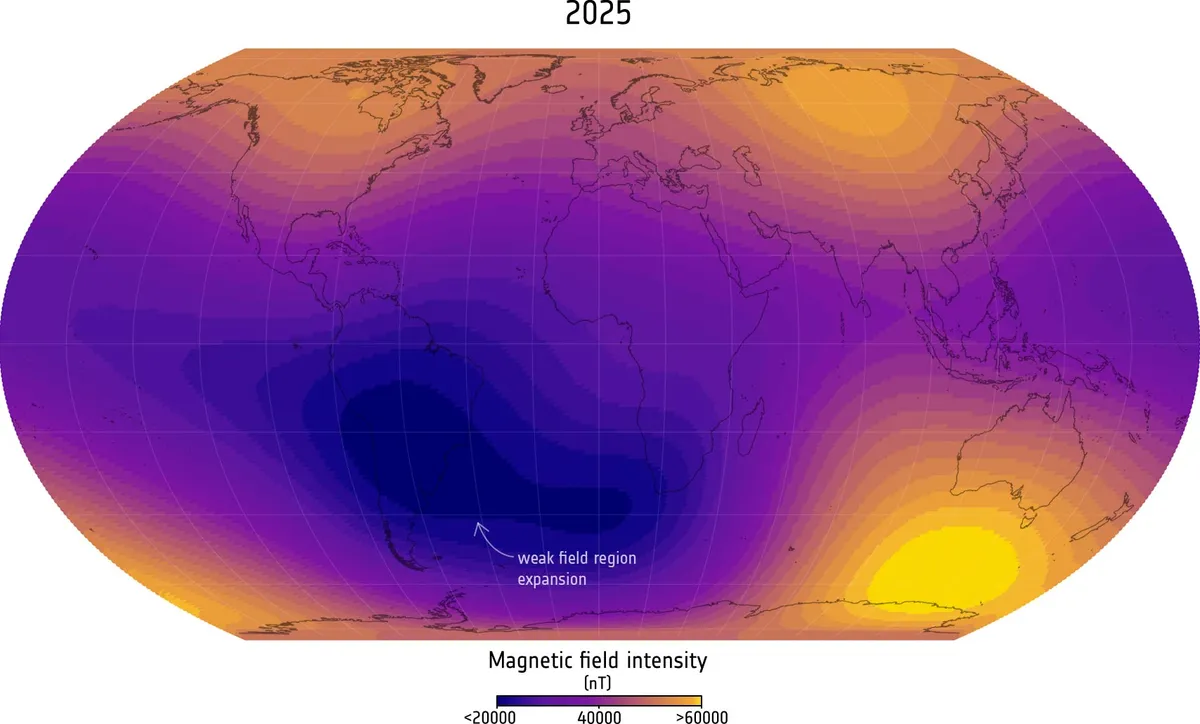
The culprit lies 3,000 kilometers below your feet. Earth's magnetic field is generated by a vast ocean of molten, churning iron in the outer core. At the boundary between that liquid core and the rocky mantle above it, strange patterns are emerging—patches where the magnetic field lines reverse direction, flowing back into the core instead of pushing outward. These "reverse flux patches" are intensifying the anomaly's growth, particularly in the Atlantic southwest of Africa since 2020.
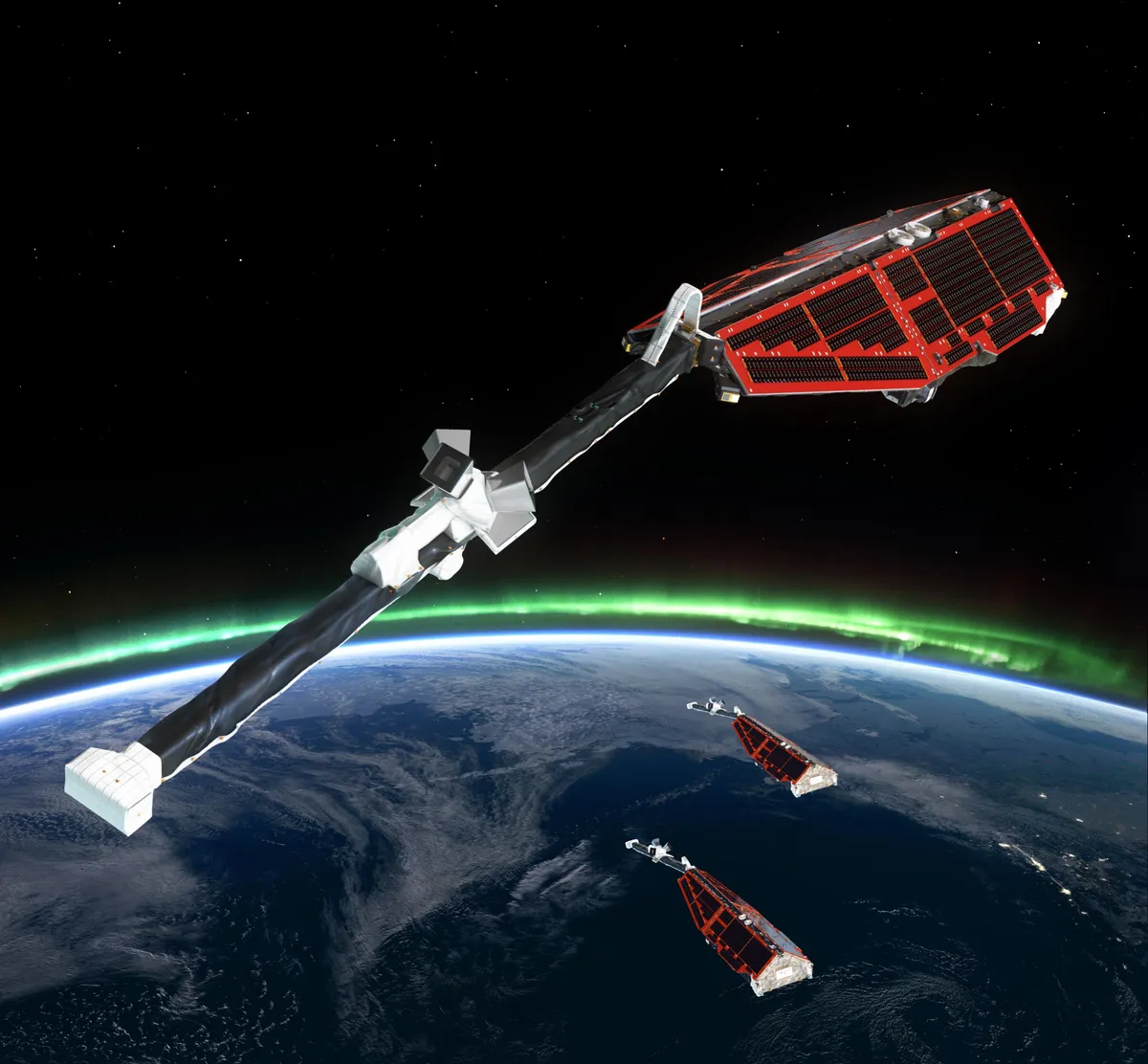
The European Space Agency's Swarm satellite constellation—three identical spacecraft launched in 2013—has provided the most precise measurements of these shifts. For over a decade now, these satellites have been mapping Earth's magnetic field from space with unprecedented detail, revealing a planet far more dynamic than a simple bar magnet.
The bigger picture is striking: Earth's magnetic poles aren't static. The northern magnetic pole is drifting toward Siberia. Over the past 11 years, the field over Siberia has strengthened while weakening over Canada—a shift driven by the turbulent processes in Earth's core. In the Southern Hemisphere, there's one magnetic pole. In the Northern Hemisphere, there are two.
"It's only by having satellites like Swarm that we can fully map this structure and see it changing," Finlay notes. For practical purposes, this matters most for spacecraft passing through the South Atlantic Anomaly, where they're exposed to elevated radiation levels. For the rest of us, the field remains robust—for now.
Swarm's data have already extended our understanding further than any previous mission. The satellites are healthy and sending back excellent measurements, which means scientists expect to keep monitoring these shifts well beyond 2030. The next solar minimum will offer a rare window into how the core's behavior influences Earth's upper atmosphere—another piece of a much larger puzzle about how our planet's interior shapes the conditions for life on its surface.