For the first time, researchers watched a single active region on the sun evolve continuously for nearly three months — a feat that required combining data from two space missions orbiting different sides of our star.
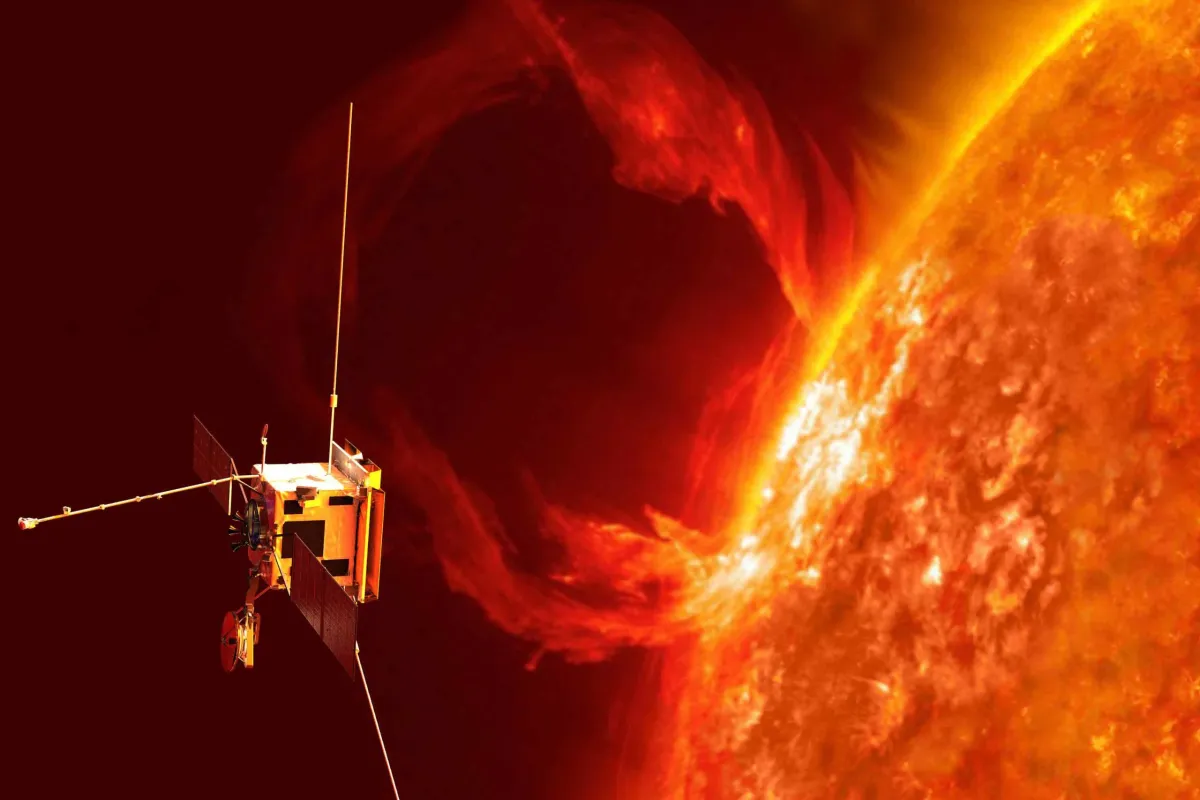
The sun rotates every 28 days, which means any feature visible from Earth disappears behind the solar disk for about two weeks before reappearing. This built-in blindness has always limited what scientists could learn about how solar storms develop. But in 2020, the European Space Agency launched Solar Orbiter, a spacecraft that circles the sun every six months and can see the far side. By merging Solar Orbiter's observations with NASA's Solar Dynamics Observatory — stationed between Earth and the sun — researchers finally had continuous sight lines.
From April to July 2024, they tracked NOAA 13664, one of the most active solar regions in two decades. "This is the longest continuous series of images ever created for a single active region," says Ioannis Kontogiannis, a solar physicist at ETH Zurich. "It's a milestone in solar physics."
We're a new kind of news feed.
Regular news is designed to drain you. We're a non-profit built to restore you. Every story we publish is scored for impact, progress, and hope.
Start Your News DetoxWhat they saw was a magnetic structure growing more and more complex over three full solar rotations, tangling itself into a configuration that would eventually release the strongest solar flare in 20 years.
Why this matters on Earth
When NOAA 13664 rotated into view in May 2024, it triggered the most severe geomagnetic storms on Earth since 2003. The aurora borealis blazed so brightly it was visible from Switzerland. But the real impacts were quieter and more costly.
Solar storms hurl charged particles and radiation into space, disrupting the infrastructure we've built to depend on. In May 2024, farmers across multiple continents lost working days when satellite signals, drone communications, and soil sensors all went down simultaneously — a particularly painful blow to modern precision agriculture. Railway signaling systems can flip from red to green without warning. In February 2022, a solar storm knocked 38 of 49 newly launched Starlink satellites out of commission within two days.
These aren't edge cases. As our technology becomes more interconnected and sensitive, solar weather becomes more consequential. "The sun is the only star that influences our activities," Kontogiannis notes. "We live with this star, so it's really important we observe it and try to understand how it works."
The 94-day tracking window gave researchers an unprecedented look at how magnetic complexity builds. When they see a region with an extremely tangled magnetic field, they now know energy is accumulating — energy that will eventually be released as a storm. But prediction remains elusive. Scientists still can't forecast whether a region will explode in one massive flare or several smaller ones, or when the eruption will happen.
The European Space Agency is building a new spacecraft called Vigil, scheduled to launch in 2031, dedicated entirely to improving space weather forecasts. With better predictions, power grids, satellites, and communication networks could be hardened in advance — turning passive observation into active defense.
Study: "Near-continuous tracking of solar active region NOAA 13664 over three solar rotations" — Astronomy & Astrophysics, 2025