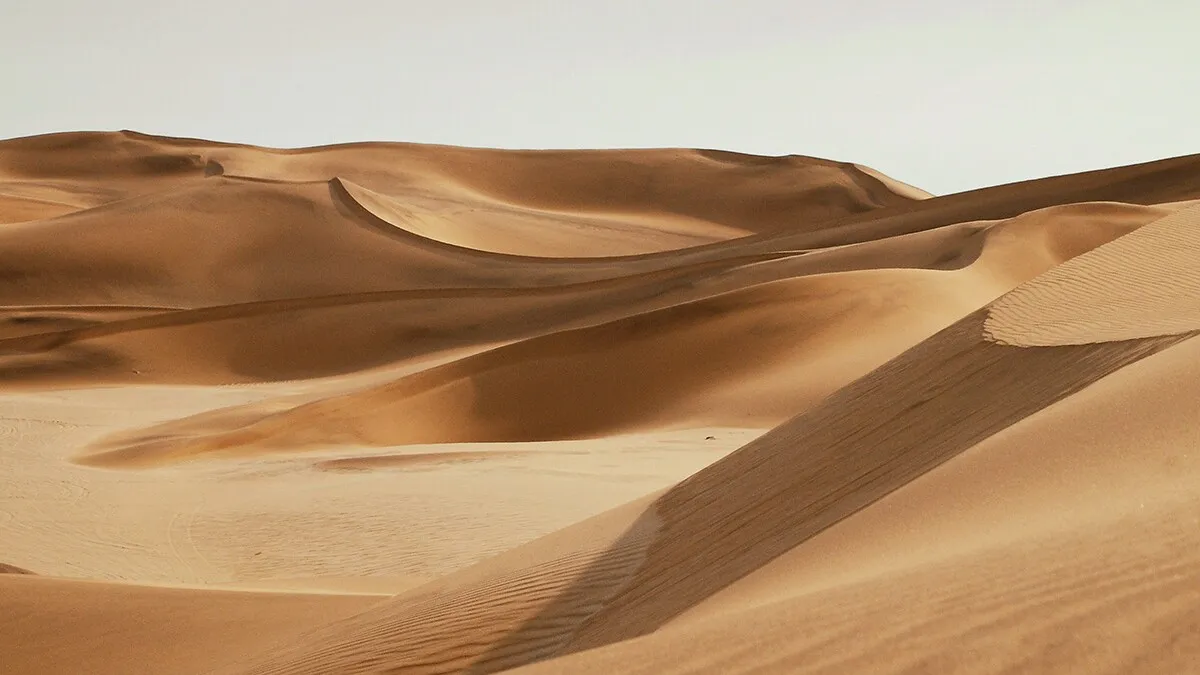
Researchers in Norway and Japan have figured out how to turn desert sand—the kind that's too fine for traditional concrete—into a viable construction material by mixing it with wood scraps.
The problem they're solving is real: we're running out of usable sand. Concrete production devours about 50 billion tons of sand annually, mostly dredged from riverbeds and seafloors in ways that destroy ecosystems and destabilize riverbanks. Deserts cover nearly 20 million square miles of the planet, but their sand has always been considered too fine-grained to work as a binder. Until now.
How Wood Becomes Glue
The team's approach is elegantly simple. They combined equal parts desert sand with powdered wood, then applied heat and pressure. Under those conditions, lignin—the organic polymer that gives wood its structure—becomes a natural adhesive that binds the sand particles together. The sand's natural alkalinity strengthens the bond further. The result, called Botanical Sand Concrete or Sandcrete, is strong enough to meet Japanese Industrial Standards for pavement bricks.
We're a new kind of news feed.
Regular news is designed to drain you. We're a non-profit built to restore you. Every story we publish is scored for impact, progress, and hope.
Start Your News DetoxWhat makes this particularly promising is that the production process doesn't require specialized infrastructure. In theory, Sandcrete could be manufactured almost anywhere—in or near desert regions where both materials are abundant. The researchers are already testing agricultural waste as a replacement for wood scraps, which would create a closed loop: use byproducts from farming and forestry to build with sand that's currently considered worthless.
There are still hurdles. The material's performance in cold climates remains untested, which matters for deployment in places like Norway. The team is running those trials now. But the core insight—that you can unlock desert sand's potential by pairing it with abundant organic waste—opens a different way of thinking about construction materials in arid regions.
This isn't a complete replacement for traditional concrete. It's a targeted solution for specific applications where Sandcrete's properties work. But in a world where sand extraction is becoming a genuine resource crisis, having another option that uses materials we're currently discarding changes the equation.