The Vera C. Rubin Observatory has started releasing its first discoveries—supernovae, variable stars, asteroids—marking the beginning of something genuinely unprecedented. For the next ten years, this camera will photograph the night sky repeatedly, tracking everything that moves, brightens, or explodes across billions of light-years. Astronomers around the world are preparing to answer questions they've been asking for decades: Where did we come from? What is dark matter? Is there a ninth planet hiding beyond Neptune?
To your eyes, the night sky looks static. But point a sophisticated telescope at the same patch of sky night after night, and hundreds of new phenomena reveal themselves—dying stars, near-Earth asteroids, cosmic events that would otherwise remain invisible forever.
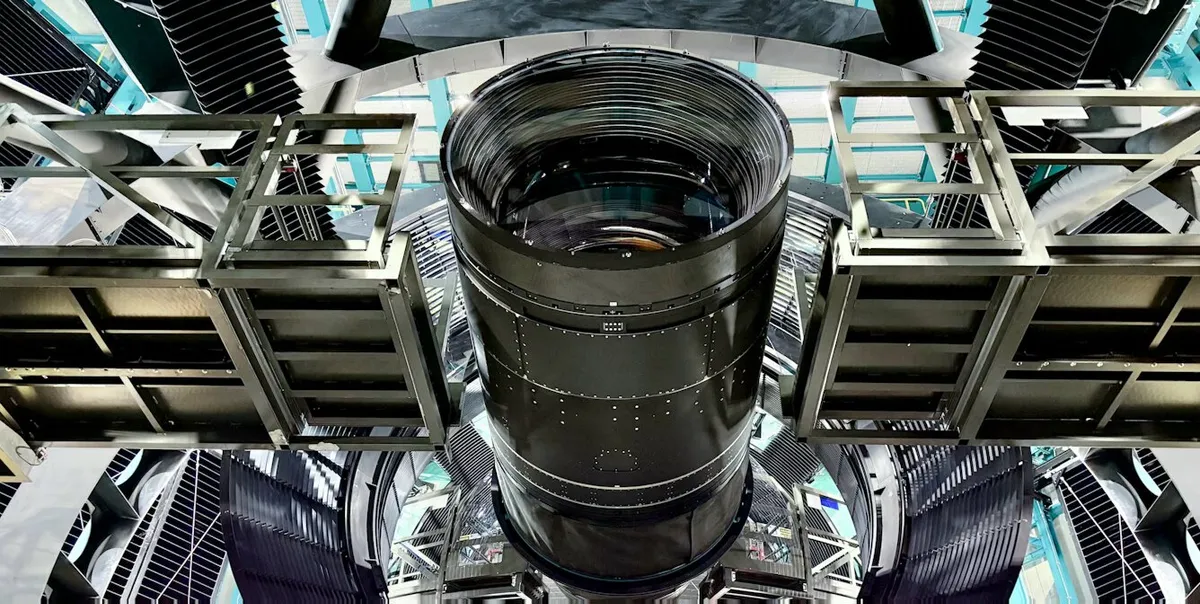
The camera doing this work sits atop Cerro Pachón in Chile, bolted to a telescope over eight meters wide. It weighs almost three tonnes and took a decade to build. It is, quite simply, the largest camera in the world. This isn't a camera that takes pretty pictures. It captures light that has traveled for 12 billion years to reach Earth. By photographing the same regions of sky multiple times each night and comparing the images, scientists can track tens of millions of asteroids and comets moving through our solar system—objects we've never catalogued before.
We're a new kind of news feed.
Regular news is designed to drain you. We're a non-profit built to restore you. Every story we publish is scored for impact, progress, and hope.
Start Your News DetoxThis matters more than it might sound. Every new asteroid mapped helps astronomers understand how our solar system formed and evolved. But the real prize lies further out. Beyond Neptune sits the Kuiper Belt, a region of icy bodies that looks like our solar system did in its infancy. Studying it is like having a time machine. Theorists have long suspected that strange orbital patterns in this region point to an undiscovered "planet nine"—a massive world lurking at the edge of our cosmic neighborhood. Rubin might finally provide evidence for it.
The universe's building blocks
Beyond the solar system, Rubin will hunt for something rarer and more violent: supernovae. When massive stars explode, they scatter the elements essential to life—oxygen, iron, carbon—across space. These explosions are how the universe builds the raw materials for new stars, planets, and eventually, us. Capturing more supernovae and understanding how they occur is essential to understanding cosmic evolution. Some of these explosions also act as cosmic measuring sticks, allowing astronomers to calculate the distances to galaxies at the edge of the observable universe.
But here's where the story gets strange. Scientists believe the universe immediately after the Big Bang was perfectly uniform in all directions. Yet today, galaxies cluster into filaments spanning billions of light-years, with vast voids between them. How did that happen?
The answer involves something we can't see. Dark matter—an invisible substance that comprises 80 percent of all matter in the universe—shaped everything. It formed the gravitational scaffolding around which gas and dust clumped together to birth galaxies. Without dark matter, there would be no galaxies, no stars, no planets, no life. Yet we've never directly observed it. Rubin won't see dark matter itself, but by mapping how galaxies are distributed and how they've evolved, astronomers can infer dark matter's behavior and properties—essentially reading the universe's fingerprints.
This is the deeper mission: to understand not just what the universe contains, but how it came to be this way. The Legacy Survey of Space and Time is explicitly designed to answer a question that sounds almost philosophical: what is the universe? And beneath that, a more practical one: why does understanding this matter to us?
The answer is that knowing where we come from—understanding the forces that shaped galaxies, stars, and planets—gives us a framework for predicting the universe's future. It's the difference between seeing individual puzzle pieces and seeing the completed picture. Humanity has chased this understanding throughout history, and Rubin represents another major step toward finally getting it.
The scale of collaboration behind this work is worth noting. Scientists from Chile, the US, France, Germany, Australia, Japan, Brazil, and the UK are pooling resources and expertise. The machine learning and artificial intelligence techniques required to process Rubin's data will likely find applications in finance, medicine, and engineering. In other words, the tools we develop to understand the cosmos often become the tools that improve ordinary life.
Over the next decade, Rubin will photograph the same regions of sky hundreds of times, building a movie of the universe's behavior. What it reveals about dark matter, planetary formation, and the universe's structure could reshape how we understand existence itself.