Researchers at Vienna University of Technology have created a QR code so small it requires an electron microscope to read. At just 1.98 square micrometers, it's now the world's tiniest—and it holds a Guinness World Record. But the real significance isn't the novelty. It's what this tiny code represents: a way to preserve digital information for centuries, possibly longer than any storage method we have today.
The challenge wasn't just making something small. It was making something small that actually works. Paul Mayrhofer and his team at the university, working with data storage company Cerbyte, needed to create a structure invisible to optical microscopes while keeping it stable and readable. Each pixel in their QR code measures 49 nanometers—roughly ten times smaller than a visible light wavelength. To put that in perspective, you couldn't see it even if you tried.
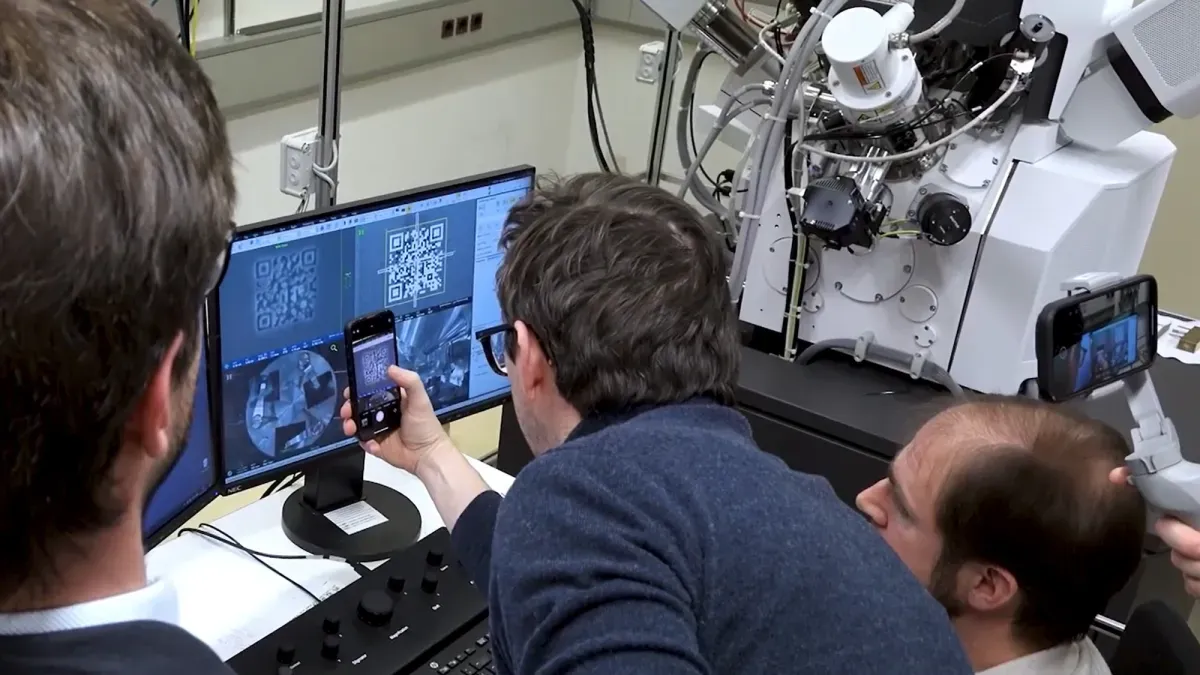
They achieved this using an unexpected material: ceramic films, the kind normally used to coat high-powered cutting tools. Using focused ion beams instead of standard printers, the researchers essentially carved the QR code into the ceramic layer with extraordinary precision. Mayrhofer described the difficulty like "hands as callused as an elephant's foot attempting to feel Braille." Once complete, they used electron microscopy to verify the code worked, then tested it by scanning with a smartphone camera. It read perfectly.
We're a new kind of news feed.
Regular news is designed to drain you. We're a non-profit built to restore you. Every story we publish is scored for impact, progress, and hope.
Start Your News DetoxWhy This Matters Now
We live in an information age built on surprisingly fragile foundations. Blu-rays degrade. Hard drives fail. Solid-state drives deteriorate. Meanwhile, we're generating more data than ever—and we have no reliable way to preserve it long-term. A single sheet of printer paper coated with these microscopic QR codes could theoretically hold over two terabytes of data. More crucially, ceramic is chemically inert. It doesn't rot. It doesn't corrode. It lasts.
This isn't theoretical. Ancient stone inscriptions remain readable after thousands of years. Ceramic can do the same. "We live in the information age, yet we store our knowledge in media that are astonishingly short-lived," said researcher Alexander Kirnbauer. The ceramic approach circles back to how humans have always preserved what matters: by etching it into something that endures.
The work represents a full-circle moment. Our ancestors carved knowledge into stone. Modern scientists are doing nearly the same thing—only at a scale of billionths of a meter, readable by machines, capable of holding the sum of human knowledge in a space smaller than a grain of sand.