Quantum computers are fragile. The systems that power them are inherently chaotic—entropy creeps in, information dissolves, and calculations collapse. For years, physicists have known about a peculiar loophole called dynamical freezing, where precisely timed vibrations can temporarily shield quantum states from thermodynamic decay. But no one could say for how long.
Cornell physicists have now answered that question with numbers. Using new mathematical tools, they've shown that dynamical freezing can preserve quantum information for timescales approaching the age of the universe itself. The work, published in Physical Review X, doesn't promise permanence—but it offers something nearly as good: a way to calculate exactly how long the protection lasts, and why.
"It's like asking, how do you evade the laws of physics from eventually taking over?" said Debanjan Chowdhury, the physicist leading the research. "Imagine a cup of coffee that stays hot without a heater, or ice that never melts on a hot plate. Is that even possible?"
We're a new kind of news feed.
Regular news is designed to drain you. We're a non-profit built to restore you. Every story we publish is scored for impact, progress, and hope.
Start Your News DetoxThe answer turns out to be yes—for an extraordinarily long time.
How the freezing actually works
Think of a playground swing. If you push it at just the right moments, over and over, you can keep its motion controlled and predictable. Stop pushing, and it eventually slows. Quantum systems work similarly under dynamical freezing: a periodic drive—like those timed pushes—creates what Chowdhury describes as "noise-canceling headphones for quantum chaos."
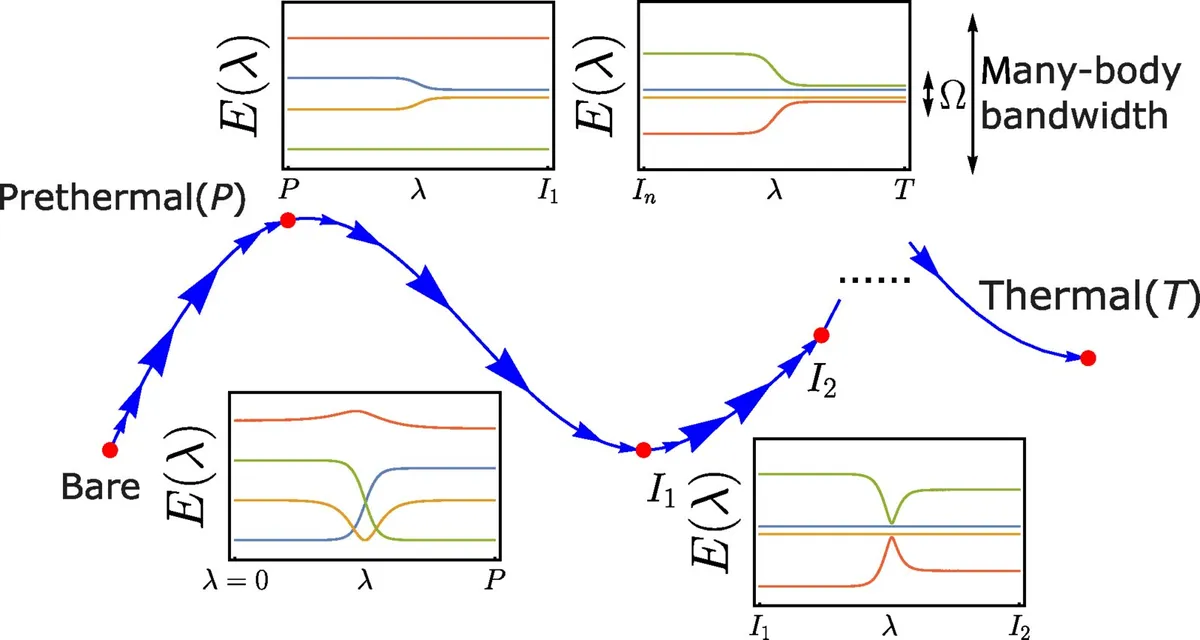
Without that drive, the system doesn't stay frozen on its own. The periodic vibrations, tuned to precise frequencies, create a delicate balance. They cancel out the quantum processes that normally lead to chaos and information loss. It's not that thermodynamics stops working. Rather, the system enters a finely balanced state between order and chaos, where disorder creeps in so slowly that it becomes practically irrelevant.
Co-first author Haoyu Guo offered an image: "Imagine a ball sitting quietly in a valley that unexpectedly shows up in the next valley over—not by rolling uphill, but by passing through the mountain itself, something only quantum physics allows." These rare quantum jumps are what eventually break the frozen state. Most of the time, nothing happens. But occasionally, the system makes a sudden leap to a different configuration.
The breakthrough is that Chowdhury's team can now predict, from first principles, exactly how long before those jumps become frequent enough to destroy the frozen state. The timescale is exponentially long in the presence of the drive—meaning it grows enormously with even small changes to the system parameters.
Why this matters for scaling
Quantum computers today work with dozens or hundreds of qubits. The dream is millions. But here's the problem: as systems grow, maintaining coherence becomes exponentially harder. A single unstable qubit can trigger cascading errors across millions of interacting components. It's like trying to keep one person quiet in an increasingly rowdy crowd.
"With a few qubits, control is manageable," Chowdhury said. "With millions, even small chaotic processes can avalanche. We need strategies that remain effective as systems scale."
Dynamical freezing is one such strategy—and possibly the most promising for the jump from small labs to large devices. The research shows it doesn't violate thermodynamics; instead, it leverages quantum mechanics to create a state whose lifetime is now predictable and usable. That shift from theoretical curiosity to practical tool is what makes this work significant.
The frozen state won't last forever. But approaching the age of the universe is close enough.